

Consensus
Consensus · Coding
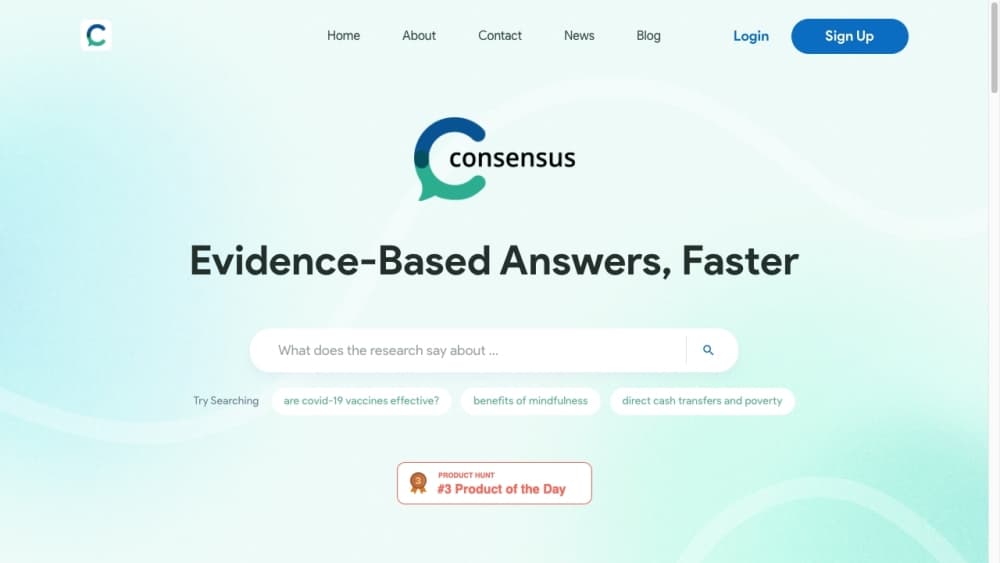
Consensus is an AI academic search engine and research assistant that answers questions using peer-reviewed papers rather than open web pages. You type a question in plain language. It pulls matching studies from a corpus of more than 220 million papers, then writes a cited summary of what those studies found and where the peer-reviewed sources disagree. So it suits students, clinicians, and researchers who need real scientific sources instead of a chatbot's best guess.
Über Consensus
What Is Consensus
Consensus is a research tool built around one constraint: only scholarly literature counts. Where a general chatbot answers from whatever it absorbed during training, Consensus runs a scientific paper search over actual journal articles, conference papers, and preprints, then summarizes them with links back to each source. That difference matters most when you need to defend an answer to a supervisor, a reviewer, or a patient.
Consensus, the company behind it, was founded in 2021 by Christian Salem and Eric Olson and now based in San Francisco. The product works as a web app, with a mobile app on Google Play and iOS, plus integrations that let you run Consensus searches inside ChatGPT, Claude, and Microsoft 365 Copilot. Its corpus comes from Semantic Scholar, OpenAlex, and the company's own crawl of the scholarly web. The team describes coverage as nearly all high-impact journals plus the full PubMed index.
The obvious limit? Scope. Consensus won't tell you the capital of Germany, and it won't help with anything outside peer-reviewed research. It also isn't a writing tool. It hands you evidence and citations, not finished prose. If your question is medical, legal, or personal rather than scientific, you're using the wrong instrument. And the free tier caps the number of Deep reviews and AI messages you get each month, so heavy users run into the paywall quickly.
Getting Started
- Create an account at consensus.app, or sign in through the ChatGPT or Claude integration if you'd rather stay inside a tool you already use.
- Type a research question in plain language. Keywords work ("cash transfers and poverty"), full research questions work, and yes/no phrasing works best because it triggers the Consensus Meter.
- Narrow the results with filters for publication date, study type, sample size, journal quartile, citation count, open-access status, and academic field.
- Open individual papers to read extracted findings, or use Ask Paper to ask follow-up questions about a single study.
- Save papers into Collections, then export citations in RIS, BibTeX, or CSV format for whatever reference manager you use.
Produktinformationen
Ein kurzer Überblick über Preise, unterstützte Plattformen und die Leistung von Consensus.
Am besten für
Die Nutzer, Aufgaben und Szenarien, für die dieses Tool am besten passt.
Nutzer
- Students and grad students
- Clinicians and health professionals
- Researchers and R&D teams
Aufgaben
- Checking whether a claim is actually settled
- Building a literature review
- Interrogating one paper
Szenarien
- Before a journal club or a supervisor meeting
- Early-stage project scoping
- Fact-checking a claim you saw in the news
Wichtigste Funktionen
AI Answers Grounded in Peer-Reviewed Papers
Every response starts with retrieval, not generation. Consensus scans its corpus using semantic search and keyword matching, picks the most relevant papers, and only then writes a summary that cites each source. That means you can trace any sentence back to the study it came from. It's the main reason people pick this over a general AI chatbot.
Consensus Meter and Consensus Snapshot
Ask a yes/no question. The Meter shows the split of scientific opinion, backed by an overview of the papers on each side. The Snapshot view goes further and reports four quality indicators for each position: how recent the papers are, how many are meta-analyses, systematic reviews, or randomized controlled trials, the average journal rank, and citation counts. It's a blunt instrument. A one-paper position still looks like a position. Still beats guessing.
Pro Search and Deep Review Modes
Pro Search is the everyday literature review tool: it answers questions with citations in a conversational format. Deep Review takes longer. It produces a full literature review across a larger set of studies, which you want when you need the state of a field rather than a single answer. Think hours of reading, compressed. Plan tiers are largely defined by how many Deep reviews you get: 3 on Free, 15 on Pro, 200 on Deep, and 50 per user on Teams.
Ask Paper
Ask Paper turns one study into a conversation. Instead of skimming a 20-page PDF for the sample size or the measurement method, you open the paper and ask. Done. It saves the most time on a narrow question, and it behaves least like a search engine.
Study Snapshots, Citation Graph, and Collections
Study Snapshots pull out key findings and the methods behind them so the results list is scannable. The Citation Graph shows how papers relate to one another. That helps when you're hunting the foundational work behind a recent result. Collections hold papers you want to keep, and everything exports to RIS, BibTeX, or CSV.
Filters and Complex Queries
Filters cover publication date, study type, sample size, journal quartile, citation count, academic field, country, and open-access status. You can also ask comparative questions ("carbon taxes vs cap-and-trade") or request a format like a pros-and-cons list. Filtering for human randomized controlled trials is the difference between a useful answer and a pile of animal studies.
API and MCP Access
The Consensus API is a single REST endpoint. It returns ranked papers with titles, authors, journals, publication years, citation counts, and links, and it supports the same filters as the web app. It shares a monthly call pool with MCP usage. That pool is 30 calls on Free, 500 on Pro, 2,000 on Deep. Extra calls cost $0.05 each for paid users. Not free, but cheap. API keys are self-serve from your account dashboard.
Vor- und Nachteile
Vorteile
- Every AI answer carries citations back to the original paper, so claims stay checkable.
- The corpus covers more than 220 million papers, drawing on Semantic Scholar, OpenAlex, and Consensus's own crawl. Full PubMed coverage is included.
- The Consensus Meter gives a quick read on whether a yes/no question is actually settled in the literature.
- Filters for study type, sample size, and journal quartile let you exclude weak evidence. No scrolling required.
- A free tier and a self-serve API make it cheap to test before committing. Low risk.
Nachteile
- Anything outside peer-reviewed literature returns nothing useful. It can't replace a general search engine for everyday questions.
- The free tier is thin for real work: 3 Deep reviews, 10 Pro messages, and 30 API calls a month won't carry a thesis.
- Deep reviews burn through credits fast, and the jump from $20 to $65 per month is steep for occasional users.
- Consensus summarizes and links. It doesn't draft your paper, so you still do the writing.
Häufige Fragen
Consensus is used to answer research questions with peer-reviewed evidence. It searches scientific papers, summarizes what they found, and cites each source. That makes it useful for literature reviews, evidence checks, and coursework where claims need backing. It isn't built for general knowledge questions.
Ähnliche Inhalte
Entdecke passende Tools, Skills und Artikel zu Consensus.
Alternativen zu Consensus
Forefront
Forefront · CodingForefront ist eine Webplattform zum Bauen mit Open-Source-KI. Sie lassen sich führende Open-Source-Sprachmodelle mit eigenen Daten feintunen, ihre Leistung bewerten und sie über eine API ausführen oder exportieren, um sie selbst zu hosten. Entwickler, die den Komfort einer geschlossenen Plattform wollen, aber darauf bestehen, ihre Modelle und Daten zu besitzen, sind hier die Zielgruppe.

Startkit
StartKit.AI · CodingStartkit ist ein Boilerplate zum Bauen von KI-SaaS-Produkten und KI-Wrappern. Man kann es sich als KI-Startup-Boilerplate vorstellen, bei dem die langweiligen Teile schon verdrahtet sind: Authentifizierung, Zahlungen über Stripe und Lemon Squeezy, Nutzungslimits, transaktionale E-Mail und ein KI-API-Starter-Kit, das mit OpenAI, Anthropic, Groq oder Llama spricht. Man klont das Repository, setzt seinen Preis und kümmert sich um den Teil des Produkts, für den Menschen wirklich bezahlen. Es basiert auf Next.js über React und Tailwind, deshalb fühlt sich ein Großteil des Boilerplate-Codes schon vertraut an.
Testim
Tricentis · CodingTestim ist eine KI-gestützte Plattform für Testautomatisierung, mit der man End-to-End-Tests für Web-, Mobile- und Salesforce-Anwendungen baut und ausführt. Sie setzt auf maschinelles Lernen, um Tests stabil zu halten, wenn sich eine Oberfläche ändert, sodass Teams weniger Zeit mit der Reparatur kaputter Selektoren verbringen. Nicht schlecht für ein Tool für automatisierte Tests, das Sie heute schon nutzen können. Sie erstellen Tests, indem Sie Aktionen im Browser aufzeichnen, und fügen danach JavaScript hinzu, wenn Sie mehr Kontrolle brauchen. Für ein beschäftigtes QA-Team eine solide Wahl.