
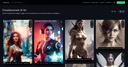
Arthub.ai
Arthub.ai · Image
Arthub.ai is a browser-based community platform for AI generated art, where artists upload images alongside the exact prompts and settings used to make them. You can browse a public feed, search by tag or prompt text, build your own gallery, and generate new images directly on the site after signing in. It's three tools in one: a gallery, a prompt reference, and a light AI image generator. What sets this AI art community apart is that it lets you share AI art with the recipe attached.

À propos de Arthub.ai
What Is Arthub.ai
Arthub.ai is a place to look at AI art and, more usefully, to see how it was made. Every post pairs the finished image with the prompt that produced it, and often with metadata like the sampler, steps, seed, and model version. That combination is the point: you aren't just admiring someone's dragon, you can copy the prompt, tweak two words, and run it yourself.
The site also hosts its own AI image generator, so you can create art in the browser without jumping to a separate AI art generator. Sign-in runs through GitHub or Discord rather than a fresh username and password, which keeps the barrier low. So what do people actually come here for? Mostly the prompts. The feed is organized around tags like cyberpunk, fantasy, and sci-fi, plus a prompt library that collects the AI art prompts on their own. Tags do the heavy lifting.
The biggest catch is the age of the content. The public feed is dominated by Stable Diffusion era work from 2023, and the footer still reads 2024. If you want the newest models and the sharpest community activity, this isn't that scene. The archive is deep, and the prompt data alone is worth the visit, but nobody here is racing to post the model that dropped last week. Treat Arthub as a large, searchable archive of prompts and reference images rather than a fast-moving feed.
Getting Started
- Open the site and sign in with GitHub or Discord to save and share work.
- Browse the Community feed, or search for a tag such as cyberpunk or fantasy to narrow the grid.
- Open any image to read its full prompt, then hit Copy to grab the text.
- Paste the prompt into the on-site AI image generator, or take it to your own tool, and adjust a few words.
- Upload your result to build a public gallery, or keep it in your personal library.
Informations sur le produit
Aperçu des tarifs, des plateformes compatibles et des performances de Arthub.ai.
Idéal pour
Les utilisateurs, tâches et cas d'usage où cet outil convient le mieux.
Utilisateurs
- New AI art enthusiasts
- Prompt-focused creators
- Artists building a public portfolio
Tâches
- Finding a starting prompt
- Learning prompt structure
- Generating a quick image in the browser
Cas d'usage
- Weekend browsing for inspiration
- Building a reusable prompt file
- Showcasing a finished series
Fonctionnalités clés
Prompt-Backed Image Feed
Each upload shows the artwork together with the text that created it. Open a post and you'll see the full prompt, and often the generation settings like sampler, steps, seed, and model. That makes the feed a working reference, not just a gallery. If a look catches your eye, the recipe is right there. That's the whole idea.
On-Site AI Image Generator
Arthub runs its own text-to-image generator, reachable from the Generate link in the top navigation. You type a prompt and it produces an image without leaving the site. It's a convenience feature rather than a full studio, so expect a simpler set of controls than a dedicated desktop app would give you, and don't plan on fine-tuning every setting before you hit generate. For a quick draft, that's usually enough.
Tag and Search Discovery
The feed is split into categories such as Fantasy, Characters, Low Poly, Sci Fi, and Furniture, with a separate search that indexes prompt text. Searching a phrase like "cinematic lighting" surfaces every post that used it, which means you can reverse-engineer a style from a single phrase you half-remember. This is the fastest way to find examples of a specific style or subject. Type it, hit enter, done.
Prompt Library
Beyond individual posts, Arthub keeps a Prompt Library that strips the images away and lists the prompts themselves. It's built for people who want to read and collect wording, not scroll pictures. Copy a few entries and you have a starting template for your own work, which beats opening a blank generator and hoping for the best. No images required.
Personal Galleries and Profiles
Every user gets a profile page that collects their uploads. You can browse a single creator's entire body of work, from one experimental prompt to a long series. For anyone building an audience, the profile acts as a portfolio tied directly to the method behind the art. Simple, and it works.
Model and Settings Metadata
Under many posts you'll find the generation parameters: model name, seed, resolution, sampler, CFG scale, and even LoRA hashes. That level of detail lets you reproduce a result far more closely than the image alone would allow, since you can match the seed and sampler and land on nearly the same output. It's the kind of transparency most galleries skip, and it's the feature that turns a pretty picture into something you can actually learn from.
Avantages et inconvénients
Avantages
- Prompts are shown with the images, so you can copy the exact wording that produced a result.
- Search indexes prompt text, letting you find examples of a specific style or subject quickly.
- Free to browse, and free to use with a GitHub or Discord login.
- Many posts include full generation metadata, including seed and sampler, which makes results reproducible.
- The on-site generator means you can go from inspiration to a finished image without switching apps.
Inconvénients
- The public feed leans heavily on 2023-era Stable Diffusion work, so it isn't a source for the newest models.
- Pricing and paid tiers aren't published on the site, so you can't plan costs in advance. Not a dealbreaker, but it's a blank spot.
- There's no documented public API, which rules it out for automated or bulk workflows.
- Some images and prompts are adult or explicit in nature, so the feed isn't safe to browse unmoderated around kids, and a content filter won't reliably shield anyone who stumbles into the wrong tag.
Questions fréquentes
It's a community site for browsing AI generated art and, more specifically, for seeing the prompts behind each image. People use it to find inspiration, collect prompt wording, and generate simple images in the browser. Think of it as an AI artwork platform you read as much as you look at.
Contenus associés
Découvrez des outils, des compétences et des articles liés à Arthub.ai.
Alternatives à Arthub.ai

X Ray Interpreter
X-ray Interpreter · ImageX Ray Interpreter est un outil de radiologie par IA basé sur le web qui transforme les radiographies, les scanners, les IRM, les échographies et les images TEP en comptes rendus en langage clair. Vous téléchargez un examen, obtenez une interprétation préliminaire de la radiographie en quelques instants, puis posez des questions complémentaires si quelque chose mérite une explication. Il sert de second avis et d'aide à l'apprentissage, pas de diagnostic médical.

Aieasypic
AIEasyPic · ImageAIEasyPic est un générateur d'images par IA qui transforme de simples prompts texte en œuvres finies en quelques secondes. Vous pouvez aussi entraîner des modèles personnalisés sur vos propres photos, échanger des visages dans des images existantes et créer de courts clips vidéo à partir de texte, le tout depuis un navigateur. Il convient aux créateurs occasionnels qui veulent des visuels rapides et aux amateurs qui souhaitent bâtir un modèle personnel sans toucher à la moindre ligne de code.

Chargen
Chargen · ImageChargen est un générateur de personnages par IA et une boîte à outils de création d'univers conçue pour Donjons & Dragons et les autres jeux de rôle sur table. Il transforme une idée d'une ligne en un portrait de personnage peint, crée des PNJ, des monstres, des cartes et des rencontres dans la même session, et garde les détails de chaque créature à portée de main. Le volet art pour jeu de rôle sur table repose sur un système de crédits appelé Gold, tandis que les générateurs de texte restent gratuits pour tous.