

Consensus
Consensus · コーディング
Consensus is an AI academic search engine and research assistant that answers questions using peer-reviewed papers rather than open web pages. You type a question in plain language. It pulls matching studies from a corpus of more than 220 million papers, then writes a cited summary of what those studies found and where the peer-reviewed sources disagree. So it suits students, clinicians, and researchers who need real scientific sources instead of a chatbot's best guess.
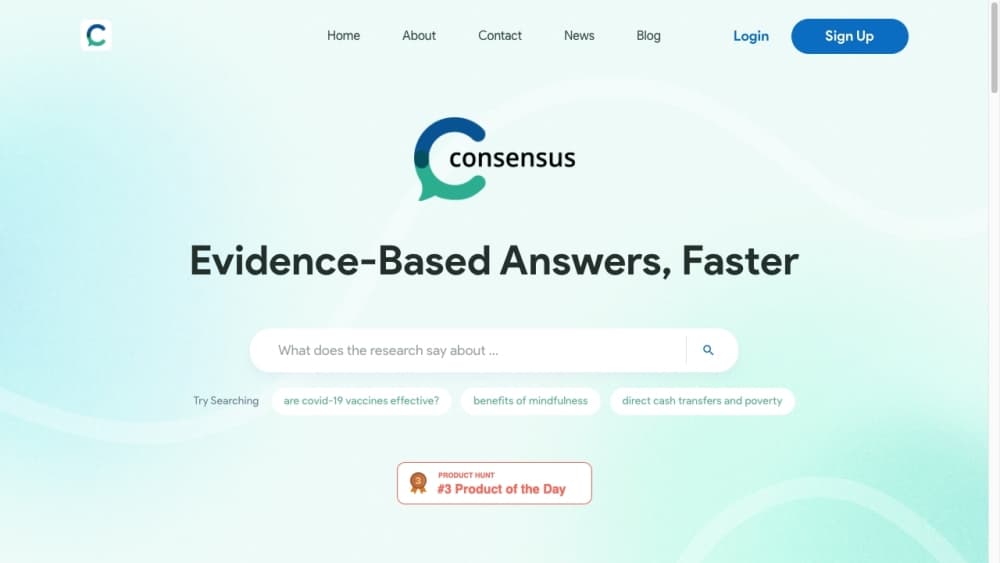
Consensus について
What Is Consensus
Consensus is a research tool built around one constraint: only scholarly literature counts. Where a general chatbot answers from whatever it absorbed during training, Consensus runs a scientific paper search over actual journal articles, conference papers, and preprints, then summarizes them with links back to each source. That difference matters most when you need to defend an answer to a supervisor, a reviewer, or a patient.
Consensus, the company behind it, was founded in 2021 by Christian Salem and Eric Olson and now based in San Francisco. The product works as a web app, with a mobile app on Google Play and iOS, plus integrations that let you run Consensus searches inside ChatGPT, Claude, and Microsoft 365 Copilot. Its corpus comes from Semantic Scholar, OpenAlex, and the company's own crawl of the scholarly web. The team describes coverage as nearly all high-impact journals plus the full PubMed index.
The obvious limit? Scope. Consensus won't tell you the capital of Germany, and it won't help with anything outside peer-reviewed research. It also isn't a writing tool. It hands you evidence and citations, not finished prose. If your question is medical, legal, or personal rather than scientific, you're using the wrong instrument. And the free tier caps the number of Deep reviews and AI messages you get each month, so heavy users run into the paywall quickly.
Getting Started
- Create an account at consensus.app, or sign in through the ChatGPT or Claude integration if you'd rather stay inside a tool you already use.
- Type a research question in plain language. Keywords work ("cash transfers and poverty"), full research questions work, and yes/no phrasing works best because it triggers the Consensus Meter.
- Narrow the results with filters for publication date, study type, sample size, journal quartile, citation count, open-access status, and academic field.
- Open individual papers to read extracted findings, or use Ask Paper to ask follow-up questions about a single study.
- Save papers into Collections, then export citations in RIS, BibTeX, or CSV format for whatever reference manager you use.
AIツール情報
Consensusの料金、対応プラットフォーム、性能を簡単に確認できます。
こんな人におすすめ
このツールが最も力を発揮するユーザー、タスク、シーン。
ユーザー
- Students and grad students
- Clinicians and health professionals
- Researchers and R&D teams
タスク
- Checking whether a claim is actually settled
- Building a literature review
- Interrogating one paper
シーン
- Before a journal club or a supervisor meeting
- Early-stage project scoping
- Fact-checking a claim you saw in the news
主な機能
AI Answers Grounded in Peer-Reviewed Papers
Every response starts with retrieval, not generation. Consensus scans its corpus using semantic search and keyword matching, picks the most relevant papers, and only then writes a summary that cites each source. That means you can trace any sentence back to the study it came from. It's the main reason people pick this over a general AI chatbot.
Consensus Meter and Consensus Snapshot
Ask a yes/no question. The Meter shows the split of scientific opinion, backed by an overview of the papers on each side. The Snapshot view goes further and reports four quality indicators for each position: how recent the papers are, how many are meta-analyses, systematic reviews, or randomized controlled trials, the average journal rank, and citation counts. It's a blunt instrument. A one-paper position still looks like a position. Still beats guessing.
Pro Search and Deep Review Modes
Pro Search is the everyday literature review tool: it answers questions with citations in a conversational format. Deep Review takes longer. It produces a full literature review across a larger set of studies, which you want when you need the state of a field rather than a single answer. Think hours of reading, compressed. Plan tiers are largely defined by how many Deep reviews you get: 3 on Free, 15 on Pro, 200 on Deep, and 50 per user on Teams.
Ask Paper
Ask Paper turns one study into a conversation. Instead of skimming a 20-page PDF for the sample size or the measurement method, you open the paper and ask. Done. It saves the most time on a narrow question, and it behaves least like a search engine.
Study Snapshots, Citation Graph, and Collections
Study Snapshots pull out key findings and the methods behind them so the results list is scannable. The Citation Graph shows how papers relate to one another. That helps when you're hunting the foundational work behind a recent result. Collections hold papers you want to keep, and everything exports to RIS, BibTeX, or CSV.
Filters and Complex Queries
Filters cover publication date, study type, sample size, journal quartile, citation count, academic field, country, and open-access status. You can also ask comparative questions ("carbon taxes vs cap-and-trade") or request a format like a pros-and-cons list. Filtering for human randomized controlled trials is the difference between a useful answer and a pile of animal studies.
API and MCP Access
The Consensus API is a single REST endpoint. It returns ranked papers with titles, authors, journals, publication years, citation counts, and links, and it supports the same filters as the web app. It shares a monthly call pool with MCP usage. That pool is 30 calls on Free, 500 on Pro, 2,000 on Deep. Extra calls cost $0.05 each for paid users. Not free, but cheap. API keys are self-serve from your account dashboard.
メリットとデメリット
メリット
- Every AI answer carries citations back to the original paper, so claims stay checkable.
- The corpus covers more than 220 million papers, drawing on Semantic Scholar, OpenAlex, and Consensus's own crawl. Full PubMed coverage is included.
- The Consensus Meter gives a quick read on whether a yes/no question is actually settled in the literature.
- Filters for study type, sample size, and journal quartile let you exclude weak evidence. No scrolling required.
- A free tier and a self-serve API make it cheap to test before committing. Low risk.
デメリット
- Anything outside peer-reviewed literature returns nothing useful. It can't replace a general search engine for everyday questions.
- The free tier is thin for real work: 3 Deep reviews, 10 Pro messages, and 30 API calls a month won't carry a thesis.
- Deep reviews burn through credits fast, and the jump from $20 to $65 per month is steep for occasional users.
- Consensus summarizes and links. It doesn't draft your paper, so you still do the writing.
よくある質問
Consensus is used to answer research questions with peer-reviewed evidence. It searches scientific papers, summarizes what they found, and cites each source. That makes it useful for literature reviews, evidence checks, and coursework where claims need backing. It isn't built for general knowledge questions.
関連コンテンツ
Consensusに関連するツール、スキル、記事を探す。
Consensusの代替ツール
Forefront
Forefront · コーディングForefrontはオープンソースAIで構築するためのウェブプラットフォームだ。主要なオープンソース言語モデルを自分のデータで微調整し、性能を評価し、API経由で実行したり、エクスポートして自分でホストしたりできる。クローズドなプラットフォームの手軽さを求めつつ、モデルとデータの所有権にはこだわる開発者が対象だ。

Startkit
StartKit.AI · コーディングStartkitは、AI SaaSとAIラッパー製品を作るためのボイラープレートだ。面倒な部分をあらかじめ配線済みにしたAIスタートアップボイラープレートと考えればいい。認証、StripeとLemon Squeezyの決済、利用制限、トランザクションメール、そしてOpenAI、Anthropic、Groq、Llamaと通信するAI APIスターターキットが含まれる。リポジトリをクローンして価格を設定し、ユーザーが実際にお金を払う部分に取りかかれる。ReactとTailwind上のNext.jsで作られているため、ボイラープレートコードの多くはすでに見慣れたものだ。
Testim
Tricentis · コーディングTestimは、Web・モバイル・Salesforceアプリ向けにエンドツーエンドテストを構築して実行するAIテスト自動化プラットフォームだ。機械学習を頼りに、インターフェースが変わってもテストを安定させ、チームが壊れたセレクターの修正に費やす時間を減らす。今日から使い始められる自動テストツールとしては悪くない。ブラウザで操作を録画してテストを作り、より細かい制御が必要なときはJavaScriptを足す。忙しいQAチームにとって堅実な選択肢である。