

Codeium
Codeium (Exafunction, now part of Cognition) · Programação
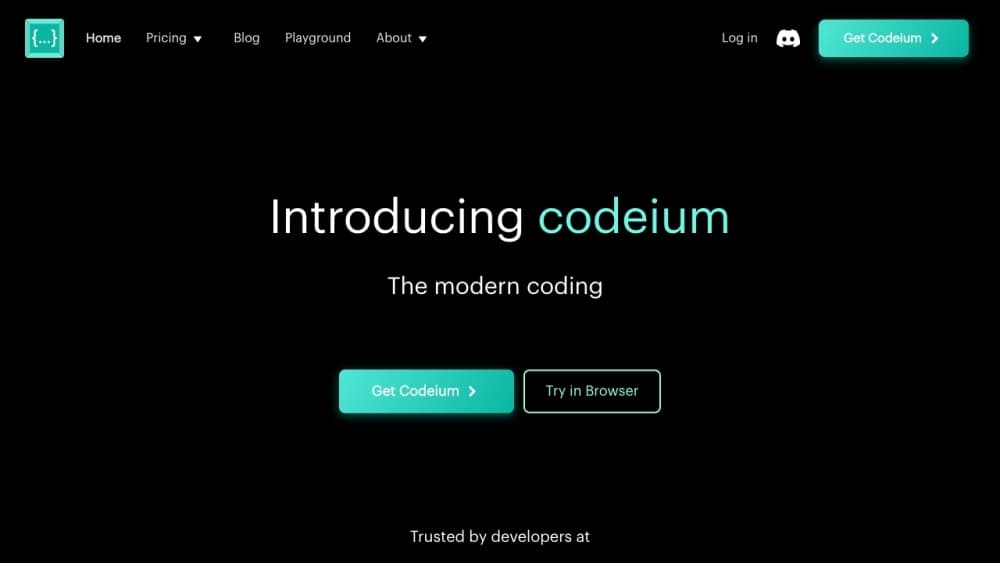
Codeium is a free AI coding assistant that plugs into the editor you already use and suggests code as you type. It covers 70+ programming languages and installs across 40+ editors, including VS Code, JetBrains, Vim and Neovim, Emacs, and Xcode. If you want AI autocomplete without a subscription, this is one of the few tools that still delivers it. The extension line was renamed Windsurf Plugins in April 2025, and the free tier still gives individual developers unlimited completions, in-editor chat, and natural language code search.
Sobre Codeium
What Is Codeium
Codeium started life at Exafunction, a company founded in 2021 to speed up GPU workloads. The team rebranded to Codeium in 2022 and shifted to the application layer, betting that inline AI code completion should cost individual developers nothing. Teams and enterprises pay instead, mostly for governance, analytics, and private deployment.
That bet worked. Codeium became the plugin you installed alongside GitHub Copilot rather than instead of it, mainly because it didn't send a bill at the end of the month. The product does three things: it fills in code as you type, it answers questions in a chat panel about whatever you're working on, and it finds the exact function you're looking for when you can only describe what that function does. Nothing more.
Then the company changed shape. In November 2024 it launched the Windsurf Editor, a standalone AI-first IDE. In April 2025 the whole company rebranded to Windsurf and the original extensions became Windsurf Plugins. In 2026 the editor line moved on again, renamed Devin Desktop after Cognition acquired the company, while the extensions kept the Codeium ID in the VS Code marketplace and the Codeium vendor name on JetBrains.
The limits are real. Free-tier completions come from a smaller model than the paid tiers, so long-context or tricky suggestions miss more often. That gets annoying on big files. Codeium reads files in your open project to build context, and the free tier's context window is narrower than what you get after paying. Enterprise features like VPC deployment sit behind a sales conversation, not a checkout page.
Getting Started
- Install the extension from your editor's marketplace. Search "Codeium" in VS Code, JetBrains Marketplace, or your package manager for Vim and Neovim and Emacs. Xcode support comes as a separate download.
- Sign in. Codeium gives you a choice between GitHub, Google, and email. The free individual account activates without a credit card.
- Open a project and start typing. Completions appear inline in grey, and Tab accepts them. Nothing else needs configuring.
- Use the chat panel for questions that span files. Ask it to explain a function, write a test, or refactor a block, and it reads the files it needs from your workspace.
- If you want team features, an admin creates an organization from the web dashboard and invites seats from there.
Informações do produto
Uma visão rápida dos preços, das plataformas compatíveis e do desempenho de Codeium.
Ideal para
Os usuários, tarefas e cenários em que esta ferramenta se encaixa melhor.
Usuários
- Students and bootcamp learners
- Solo developers and freelancers
- Engineering teams that need governance
Tarefas
- Writing repetitive code
- Learning an unfamiliar codebase
- Explaining someone else's code
- Drafting unit tests
Cenários
- Working offline or on a locked-down network
- Juggling two editors
- Late-night debugging
Principais recursos
Inline code completion
This IDE plugin is the core of the product. As you type, Codeium predicts the rest of the line and often the rest of the block, and you press Tab to accept. The free tier doesn't cap how many suggestions you take, which is the single biggest reason developers tried it over GitHub Copilot. Suggestions appear fast because the model runs on Codeium's servers, not your laptop.
In-editor chat
A sidebar panel answers questions about your code without a trip to the browser. It reads the files it needs from your open workspace, so you can ask it to explain a function, spot a bug, or rewrite a block in a different style. The chat sits next to the completions rather than in a separate app, which keeps you from context-switching mid-task.
Natural language code search
Instead of remembering a function name, you describe what the code does and Codeium finds the matching lines. If you've ever grepped for the wrong variable name for ten minutes, this is the feature you'll notice. It works across your project, not just the open file.
70+ language support
The completion engine covers Python, JavaScript, TypeScript, Java, C++, Go, Rust, PHP, Ruby, Swift, and dozens more. Config and markup languages show up too, since real projects are never written in one language alone. Coverage is broad rather than uniform, and languages with less training data get weaker suggestions. That's true of every assistant in this category.
40+ editor integrations
Codeium ships as an extension rather than a whole IDE, which is the point. It installs into VS Code, every JetBrains IDE, Vim and Neovim, Emacs, Xcode, Sublime Text, and Eclipse. Nobody has to switch editors.
Team and enterprise controls
Paid tiers add the things a manager asks for: an admin dashboard with usage analytics, centralized billing, SSO, and audit logs. Enterprise customers can deploy inside their own virtual private cloud, and Codeium states that enterprise data isn't used for training. Solo developers won't miss any of this.
Self-hosting option
Enterprise customers can run Codeium inside their own infrastructure, up to and including a VPC on major cloud providers. For regulated industries where source code legally can't leave the network, this is often the deciding factor between Codeium and a purely cloud-based rival.
Prós e contras
Prós
- The free tier covers unlimited completions, chat, and code search for individual developers, with no card required.
- Wide editor coverage means you don't have to abandon VS Code, Neovim, or a JetBrains setup to use it.
- Setup takes a marketplace install and a sign-in. There's no project configuration step on the free tier.
- Codeium pricing stays at zero for individuals, so trying it against a paid rival costs you nothing.
- Paid tiers include admin analytics, SSO, and VPC deployment for teams that need to show an auditor where their code lives and who touched it.
- The extension kept its Codeium ID and vendor name after the rebrand, so existing installs keep working.
Contras
- Free-tier completions use a smaller model with a narrower context window, so suggestions on complex or long files miss more often than the paid tiers do, and the fix is a subscription rather than a setting you can toggle.
- The product line has been renamed twice in two years, first to Windsurf Plugins and then to Devin Desktop. If you follow a tutorial written in 2024, the names won't match what you see.
- API availability isn't documented for the extension itself, so you can't assume you can wire Codeium completions into your own tooling.
- Enterprise features sit behind a sales call, which makes pricing hard to plan for before you've talked to someone.
Perguntas frequentes
Yes, for individual developers. Codeium pricing starts at $0 and the free tier keeps unlimited AI autocomplete, chat, and code search, with no credit card required. Teams and enterprises pay for admin controls, analytics, SSO, and private deployment.
Conteúdo relacionado
Explore ferramentas, skills e artigos relacionados a Codeium.
Alternativas a Codeium
Forefront
Forefront · ProgramaçãoO Forefront é uma plataforma web para construir com IA de código aberto. Você ajusta os principais modelos de linguagem de código aberto com seus próprios dados, avalia o desempenho deles e os roda por uma API ou os exporta para hospedar por conta própria. Desenvolvedores que querem a conveniência de uma plataforma fechada, mas fazem questão de ser donos dos modelos e dos dados, são o público-alvo aqui.

Startkit
StartKit.AI · ProgramaçãoStartkit é um boilerplate para criar produtos de SaaS com IA e wrappers de IA. Pense nele como um boilerplate para startups de IA com as partes chatas já conectadas: autenticação, pagamentos com Stripe e Lemon Squeezy, limites de uso, e-mail transacional e um kit inicial de API de IA que conversa com OpenAI, Anthropic, Groq ou Llama. Você clona o repositório, define seu preço e começa pela parte do produto que as pessoas realmente pagam. Ele é feito em Next.js sobre React e Tailwind, então boa parte do código boilerplate já parece familiar.
Testim
Tricentis · ProgramaçãoO Testim é uma plataforma de automação de testes com IA para criar e executar testes de ponta a ponta em aplicações web, mobile e Salesforce. Ele se apoia no aprendizado de máquina para manter os testes estáveis quando uma interface muda, então as equipes gastam menos tempo consertando seletores quebrados. Nada mal para uma ferramenta de testes automatizados que você pode começar a usar hoje. Você cria testes gravando ações no navegador e depois adiciona JavaScript quando precisa de mais controle. É uma escolha sólida para equipes de QA ocupadas.