

Galileo AI
Galileo AI (acquired by Google in May 2025; product now Google Stitch) · 画像 · コーディング
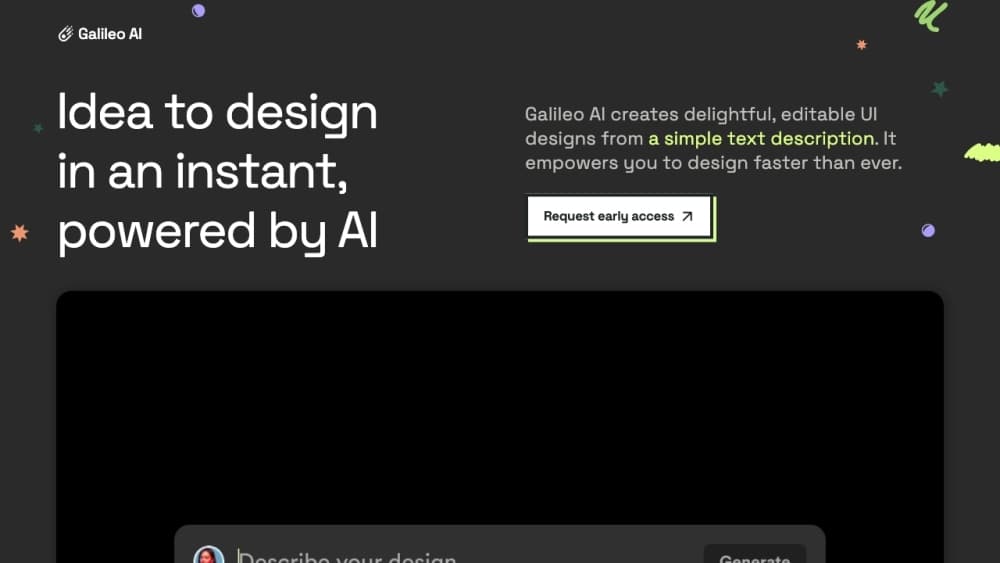
Galileo AI is an AI UI design generator that turns plain-language descriptions and reference images into high-fidelity, editable interface designs. Launched in 2022 as a text-to-UI startup, it became known for generating polished app and web screens from a single prompt and exporting them into Figma as editable layers. Google acquired the company in May 2025, and the standalone product was retired and folded into Google Stitch.
Galileo AI について
What Is Galileo AI
Galileo AI was a design tool built around one idea: describe the interface you want, and get a finished-looking screen back in under a minute. You typed something like "a friendly booking app home screen with a search bar and nearby listings," and the tool returned several layout options with real UI elements, images, and placeholder copy already filled in. It handled mobile apps, web dashboards, landing pages, and e-commerce layouts, and it also accepted a screenshot or hand-drawn wireframe as the starting point.
The product mattered because it attacked a specific bottleneck. Designers spent hours on first-draft mockups that often got thrown away, and non-designers had no way to show anyone what they were picturing. That's the gap it filled. Its Figma export was the detail that earned it a following, because the output arrived as editable vectors and grouped components rather than a flat image you couldn't touch.
The biggest limitation is that the product no longer exists on its own. Google acquired the team in May 2025 and relaunched the technology as Google Stitch, running on Gemini models. The original usegalileo.ai site and its $19 and $39 monthly plans were wound down, and the service shut down for existing users on June 20, 2025. Anyone searching for Galileo AI today should expect to land on Stitch instead. That's not a small caveat. It means reviews, tutorials, and pricing tables written about Galileo AI before mid-2025 describe a product you can't sign up for.
Getting Started
- Recognize that Galileo AI itself is closed. New accounts were never reopened after the acquisition, so you can't create a Galileo AI login today.
- Go to stitch.withgoogle.com and sign in with a Google account. Stitch runs through Google Labs and doesn't ask for a credit card.
- Describe the screen you want in the chat box, or upload an image, sketch, or code snippet as context. Pick Gemini 2.5 Flash for speed or Gemini 2.5 Pro for more considered layouts.
- Refine on the canvas. Adjust theme colors, fonts, and corner radius, then connect screens into a clickable prototype.
- Export what you like. Stitch copies designs to Figma and hands off HTML and CSS, and it can package your design rules as a DESIGN.md file.
AIツール情報
Galileo AIの料金、対応プラットフォーム、性能を簡単に確認できます。
こんな人におすすめ
このツールが最も力を発揮するユーザー、タスク、シーン。
ユーザー
- Product managers
- Startup founders building an MVP
- UI/UX designers
- Non-designers with an idea
タスク
- Text to UI drafts
- Image to UI conversion
- Prompt to UI prototyping
- Figma handoff
シーン
- Pitching a concept in a meeting tomorrow
- Modernizing an outdated internal tool
- Early project research
- Building a deck or proposal
主な機能
Text to UI Generation
The core of the product. You describe the interface in natural language, and Galileo AI returns high-fidelity screens within roughly 30 to 60 seconds, usually as several variations you can compare side by side. Output quality tracks how specific your prompt is. A request for "a nice login screen" produces something generic, while naming the fields, the layout order, the theme, and the target platform gets you something closer to a real design. So what actually works? Specific prompts. It understands common patterns like dashboards, feeds, and checkout flows, and it handled data-heavy dashboard layouts better than most of its contemporaries.
Image to UI and Wireframe Conversion
Screenshots, existing UI captures, and hand-drawn sketches all work as inputs. The tool reads the layout structure, component arrangement, and visual hierarchy from the reference, then rebuilds it with editable elements, often filling in details the sketch left out, like icons, avatars, or chart placeholders. This made it useful for modernizing an aging interface without redrawing it from scratch. Upload quality matters more than people expect: a sharp screenshot with clear separation between elements converts noticeably better than a blurry or heavily compressed one.
Editable Figma Export
This was Galileo AI's strongest differentiator. Generated designs didn't leave the platform as screenshots. They arrived in Figma as editable vectors, text layers, and grouped components that followed the layout logic of the original, so you could select a button and change it rather than tracing over a picture. Designers who tested it repeatedly called out the layer structure as unusually clean. That's the difference between a throwaway mockup and a usable starting file.
Style and Theme Controls
Before exporting, you can adjust the global look of a generated design: fonts, accent colors, and corner radius, applied consistently across every screen in the project. That consistency is what stopped the output from looking like a pile of unrelated AI images. It's less granular than editing a full design system, which is exactly why it stays approachable for people who don't do design work.
Multiple Variations Per Prompt
Every prompt returns several options rather than a single answer. You pick the closest one, or borrow a header from one and a card layout from another. The team behind the tool described this as one of the most valuable things they learned internally. Seeing four directions at once helped people decide faster than iterating on one design through many rounds.
Design System Extraction
The current Google Stitch version of the technology can pull a design system out of any URL and store your rules in a DESIGN.md file, an agent-readable document you can move between projects and developer tools. It's a meaningful step past one-off screen generation, since it means the tool can keep brand rules consistent instead of rebuilding the same decisions each session. If you need to apply the same visual language across several projects, this is the feature that saves the most time.
メリットとデメリット
メリット
- Generated screens arrived in Figma as editable components with clean layer grouping, which made them usable for real project work rather than reference only.
- Image to UI handled sketches and screenshots well, cutting out a lot of repetitive redrawing for teams modernizing existing interfaces.
- Returning multiple variations per prompt sped up early decisions, since comparisons happened before any polishing work began.
- The prompt box carried a short learning curve, and non-designers could produce presentable screens without design training.
デメリット
- The standalone product is gone. Google acquired Galileo AI in May 2025 and retired it in favor of Google Stitch, so older pricing and reviews no longer apply to anything you can sign up for.
- Output quality depends heavily on prompt detail, and vague descriptions produce generic layouts that need substantial rework before they're usable.
- It never aimed at pixel-perfect production design. It isn't a replacement for a full design tool, and the results still need a designer's pass. Not a dealbreaker, but worth knowing before you pitch its output to a client.
- Legacy paid tiers placed privacy and additional Figma exports behind the $19 and $39 monthly plans, and the free tier capped exports at three. Current Stitch access runs under Google Labs beta terms, which permit Google to use inputs for model improvement, so privacy-sensitive teams should check those terms first.
よくある質問
No. Google acquired Galileo AI in May 2025, and the standalone service shut down on June 20, 2025. The team and technology became Google Stitch, available at stitch.withgoogle.com.
関連コンテンツ
Galileo AIに関連するツール、スキル、記事を探す。
Galileo AIの代替ツール

X Ray Interpreter
X-ray Interpreter · 画像X Ray Interpreter は、X 線、CT、MRI、超音波、PET の画像を平易な言葉のレポートに変えるウェブベースの AI 放射線ツールだ。スキャン画像をアップロードすると、X 線の予備的な読影結果がすぐに返ってくる。説明が必要な箇所があれば、その後で追加の質問もできる。位置づけはセカンドオピニオンと学習の補助であり、医療診断ではない。

Aieasypic
AIEasyPic · 画像AIEasyPicは、単純なテキストプロンプトを数秒で完成したアート作品に変えるAI画像生成ツールだ。自分の写真でカスタムモデルを訓練したり、既存の画像の顔を交換したり、テキストから短い動画クリップを作ったりもできる。すべてブラウザだけで完結する。手早くビジュアルが欲しい気軽なクリエイターにも、コードを一切触らずに個人モデルを作りたい趣味の人にも向く。

Chargen
Chargen · 画像ChargenはDungeons & Dragonsやその他のテーブルトークRPG向けに作られたAIキャラクター生成ツール兼ワールドビルディングツールキットだ。一行のアイデアを描き上げたキャラクター肖像に変え、同じセッションでNPC、モンスター、マップ、遭遇を生み出し、すべてのクリーチャーの詳細を手元に置く。テーブルトークRPGアートの部分はGoldと呼ばれるクレジット制で動き、テキスト生成ツールは誰でも無料のまま使える。