Dek: Google's newest model won an independent math benchmark, and the cost column beside the score makes the win awkward to sell. The sticker price never moved. The bill did.
What Gemini 4 Carbon Won on MathArena
The benchmark Carbon topped runs outside Google, which is the only reason the result deserves a second read. MathArena hands models competition-style math problems they haven't seen, scores them on whether the final answer is right, and records what each attempt cost to produce.
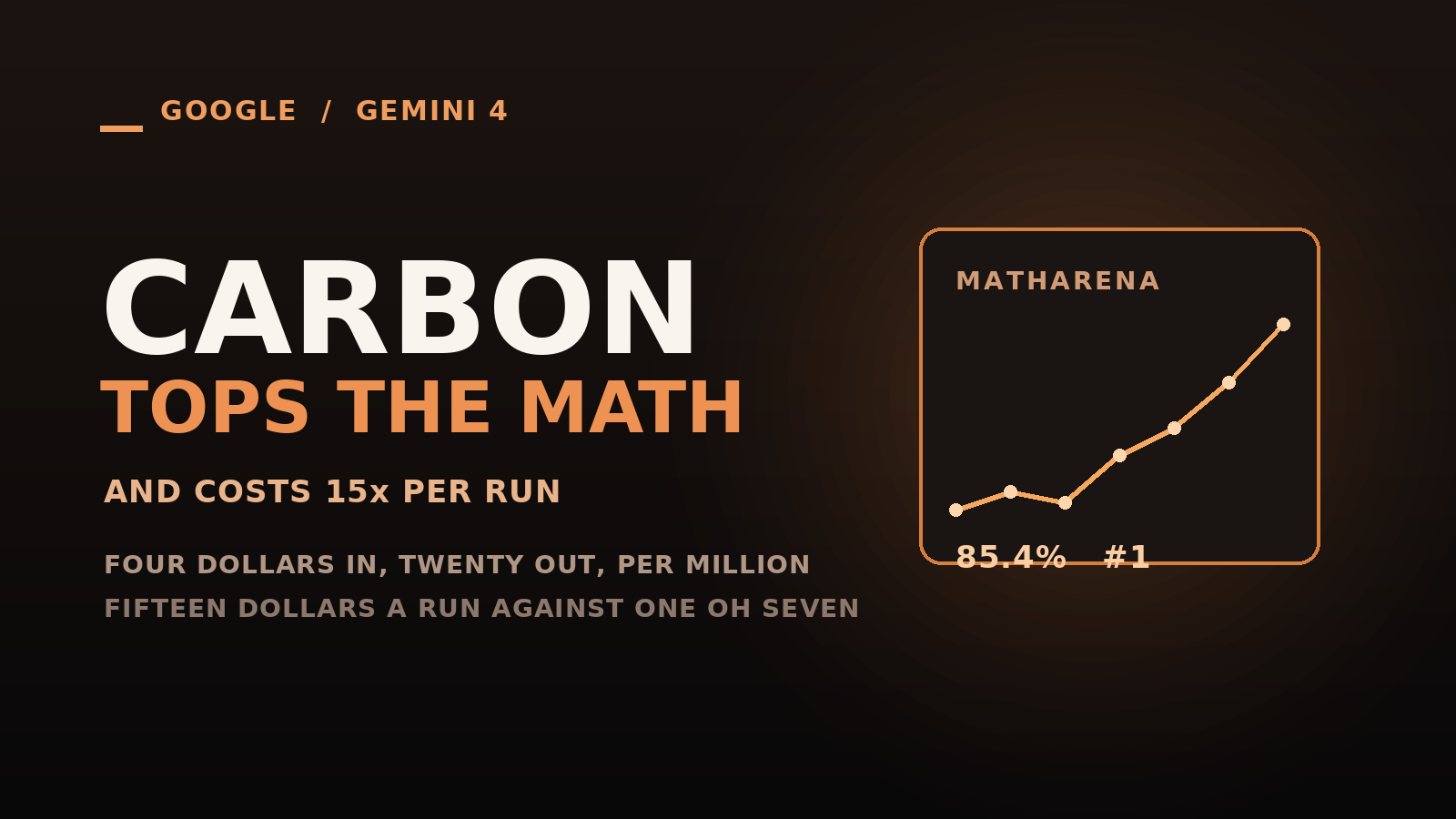
The Decoder published the ranking on 14 November. Gemini 4 Carbon, released four days earlier, finished first at 85.4 percent. Claude Fable 5.2 took second at 82.8, and GPT-6.1 Sol, the model that had been holding the top spot, landed third at 80.6.
Less than three points separate first from third. That gap is the story, because the last column of the same table shows Carbon spending far more than Sol to get there.
Kimi K3.1 Pro from Moonshot AI, the strongest open model in the group, sits at 54.3 percent, which says more about the problem set than about anyone's engineering.
The 15 Times Figure Is a Run Cost, Not a Token Price
Two numbers get blended together in most summaries of this launch, and they answer different questions. So which one should you plan around? It depends on whether you buy tokens or finished work.
Model | MathArena score | Cost per full run |
|---|---|---|
Gemini 4 Carbon, high effort | 85.4% | $15.70 |
Claude Fable 5.2, max effort | 82.8% | $40.20 |
GPT-6.1 Sol, max effort | 80.6% | $1.07 |
Kimi K3.1 Pro, max effort | 54.3% | $3.70 |
Sticker price: unchanged.
Carbon's list price is $4 per million input tokens and $20 per million output tokens. Gemini 4 Argon charges exactly the same. The $15.70 is what one complete pass through the benchmark cost at the reasoning settings used in testing, so it prices an outcome rather than a unit of text.
An Artificial Analysis test from roughly two weeks before the launch put the same trade in per-task terms. Carbon needed $7.76 to solve one task at standard pricing, against $10.04 for Opus 5.5 Max and $26.50 for Fable 5.2 at max effort.
Carbon is cheaper per solved task than Anthropic's flagship and pricier than GPT-6 Astra Max at $6.25. The 15 times headline covers one particular run, not every job you'd hand it.
Why Claude Fable 5.2 Spent $40.20 for Second Place
Paying more doesn't make a model worse, and the Anthropic entry is the clearest example in the table. Fable 5.2 ran at max effort, the most expensive setting Anthropic offers, and still came within 2.6 points of a model that spent a third as much.
It also posted the widest error bar of the four, at 5.3 points. The gap between first and second is smaller than the uncertainty around either score, which is why Anthropic can point at the same week's independent rankings and claim the top spot overall.
Benchmarks measure a slice, and MathArena slices competition mathematics: a model tuned for long verification loops will look strong there while losing elsewhere.
Gemini 4 Carbon Almost Never Gives Up
The spending has a cause: how the model fails. Carbon's most common failure mode is running past the time limit. It rarely abandons a problem.
In one documented case it launched a script that ran for more than eleven hours without checking whether it was making progress. Nobody stopped it, because nothing in the setup was watching.
That's a design decision rather than a defect. Google says Carbon uses more tokens because it reasons more deeply and runs longer verification loops, and a model that keeps working widens its own search before it commits to an answer.
The practical effect lands on your bill. A job a cheaper model abandons after two minutes can become a long, costly attempt that either arrives at a correct answer or produces nothing at all.
Where Gemini 4 Argon Still Makes More Sense
Google is explicit that Carbon doesn't replace its sibling, and the company's own guidance points most work the other way. Argon remains the better pick for everyday software engineering and knowledge work, with Carbon reserved for open-ended research and stubborn debugging.
Carbon is generally available now, after a closed testing phase of about two weeks with selected security experts. Treat the pairing as a routing decision: routine work to Argon, work that needs a model to grind to Carbon.
Google's Own Benchmarks Put Carbon First on CursorBench 4.0
Everything in this section comes from Google, so read it as a company claim. Carbon took first place on CursorBench 4.0 with a score just under 60 percent, and first on Perplexity's WANDR and Zapier's AutomationBench at less than half the per-task cost of the next-best model, which Google names as Fable 5.2.
On a new Multimodal Knowledge Agent benchmark built with Artificial Analysis, Carbon finished second behind Fable 5.2 while costing under a sixth of what the leader spent.
The security results are the ones worth noting. During the Fairwind early-access programme, Carbon found real zero-day vulnerabilities while scanning two large SaaS providers in under two hours for Wiz's Scan for Good. Google's cloud security team also used it to write working proof-of-concept exploits for two known bugs in a popular open source project.
How to Buy Gemini 4 Carbon Without Blowing the Budget
Paid-tier developers reach the model through the Gemini API, Google AI Studio, Android Studio and Gemini for Business. Standard pricing is $4 per million input tokens and $20 per million output, with an introductory rate of $2 and $10 that Google hasn't said will last.
Google also previewed a /swarm feature in Antigravity that turns a single prompt into a coordinated team of agents. Carbon handles architecture, coordination and auditing while lighter models run in parallel workspaces and act as adversarial verifiers.
OpenAI and Anthropic have both warned recently that multi-agent swarms burn tokens for little quality gain, and outside researchers reached similar conclusions. A swarm of Carbon instances is the most expensive way to use the most expensive setting on the most token-hungry model in the family.
One habit is worth building. Budget per finished task and not per token, watch the second and third attempt on the same problem, and set a spend ceiling before you point Carbon at a research question. The score is real. So is the invoice.