Dek: Google's fast model is now the one answering your searches, and the price stays the same at 100 tokens or 900,000. The interesting part is what the announcement stopped short of saying about the model it replaces.
What Gemini 4 Hydrogen changes in the box you already use
Google published "Introducing Gemini 4 Hydrogen" on 12 November and opened the rollout the same day. It lands in AI Studio, the Gemini API, Gemini for business, the Gemini app, Google Search, and Antigravity.
The part you can feel without opening a settings menu sits in the search box. Ask something messy, with a typo in the middle and a date buried at the end, and Hydrogen is meant to break it into pieces, answer each one, then return a single reply.
That's the claim. The proof is a query of your own, not a launch demo.
Where Gemini 4 Hydrogen sits next to Carbon and Argon
The line-up finally has a shape you can explain to someone else. Gemini 4 Carbon and Gemini 4 Argon are the slow, deep-reasoning pair, the models Google points at hard math and long agent runs. Hydrogen is the fast one, built to answer before you lose interest.
It also takes the job Gemini 3.8 Flash used to do. The older model was the default workhorse of the previous generation and had been losing ground on cost to cheaper rivals for months.
Google's post says teams are migrating from Gemini 3.8 Flash. It doesn't say when the old model gets switched off, and a migration note isn't a shutdown date.
Gemini API pricing is flat across the whole 1M window
Most model pricing punishes long inputs, because the rate climbs as the context grows. Hydrogen doesn't work that way.
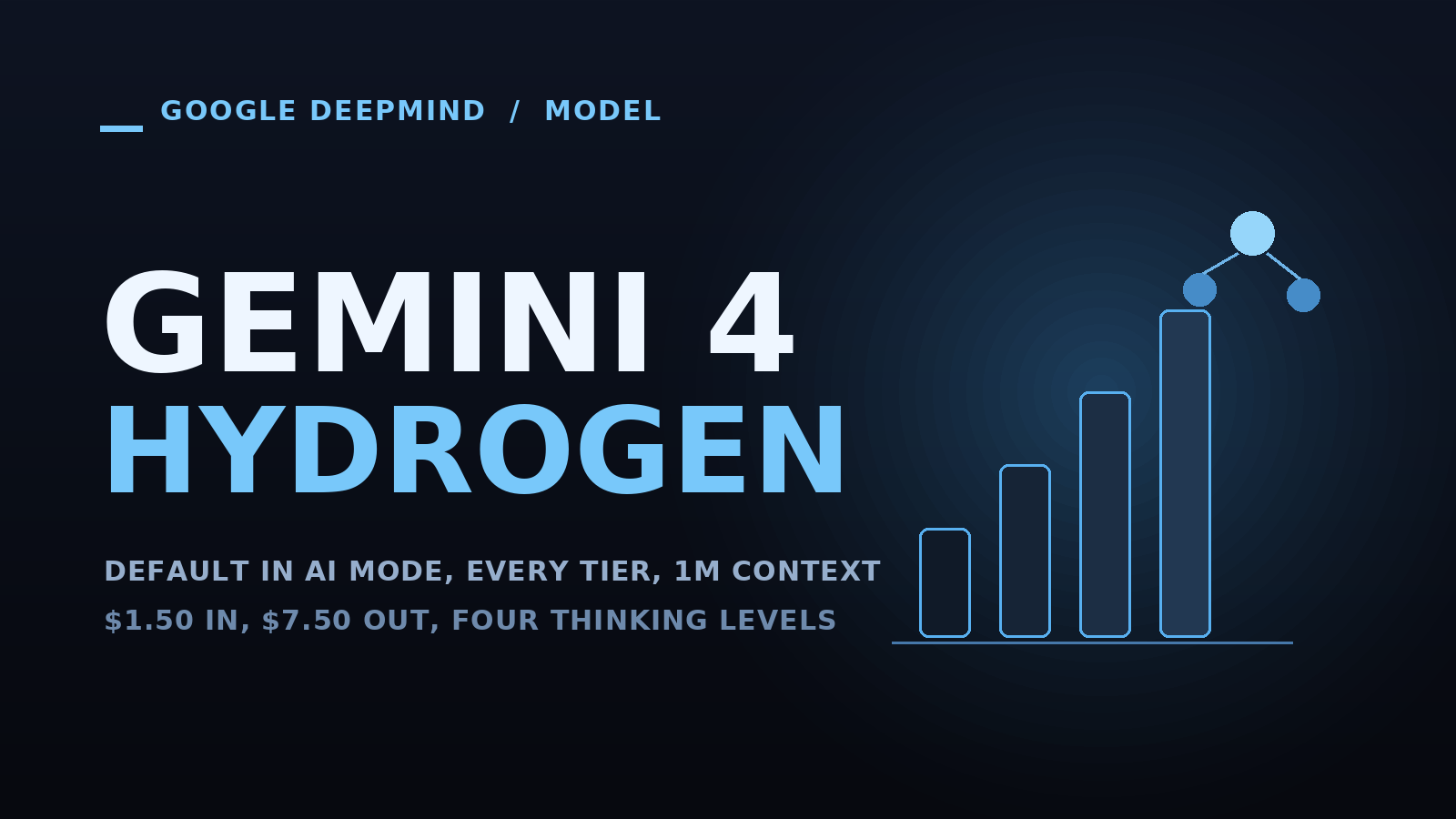
Google charges $1.50 per million input tokens and $7.50 per million output tokens. Those rates hold across the full 1M-token context, so a 900,000-token prompt costs the same per token as a 9,000-token one.
Same rate at both ends.
For a team that feeds a whole codebase or a stack of contracts into one call, that's the number that decides the budget. Output still costs five times input. Long generated answers remain the expensive half.
Four Gemini 4 Hydrogen thinking levels, including xhigh
Hydrogen ships with low, medium, high and xhigh settings, and high is the default. The new top tier buys more reasoning time before the answer starts.
Google says xhigh isn't free. It spends more tokens, which means more money and more waiting, so it's a switch you flip for a hard question rather than leave on all day.
Google AI Mode gives its hardest questions to Hydrogen
Robby Stein, vice president of product for Google Search, said on 12 November that Hydrogen is now the default model in AI Mode and handles the hardest questions inside AI Overviews.
In practice that means better handling of multi-part questions, more patience with bad typos, and a wider fan-out of queries behind each answer. Google also says more results come back with visuals attached.
The fan-out point matters more than it sounds. A model that searches more widely can cite more sources, and a model that cites more sources is easier for a reader to check.
The Gemini app follows your tone now
Inside the app, Google claims better instruction following, more reliable tool calls, and context pulled from uploads, Gmail, Drive and connected apps such as Airtable and Dropbox.
Anyone who has asked a chatbot for a two-line answer and received six paragraphs will want to test the format instruction first. Whether it sticks on your account is a five-minute experiment, and no blog post can run it for you.
Orchestrator in Antigravity mixes Carbon and Hydrogen
Developers get the more interesting tool. Orchestrator, inside Google Antigravity, can switch between models such as Carbon and Hydrogen in the middle of one session.
Google says the mix reached near-Carbon success on Terminal-Bench 4.0, which tests command-line work, while using 24% less quota and finishing 19% faster. That's the company's own test rig, and the company's own numbers.
Access is limited to paid AI Pro and Ultra subscribers, so free users can't try the routing yet.
The benchmark claims behind the Gemini 3.8 Flash replacement
Google says Hydrogen finishes tasks 2.5 times faster than Gemini 3.8 Flash at the high setting, lifts Terminal-Bench 4.1 from 18.2% to 57%, and cuts fabricated claims by more than five times.
On the Artificial Analysis Intelligence Index, an independent leaderboard, Google places Hydrogen at 51 at the default high setting against 50 for Argon, and 54 at xhigh.
The Verge reported that Hydrogen matches or beats Claude Sonnet 5.5 and GPT-6.1 on several tests, while Artificial Analysis measured it just below both at roughly a third of Sonnet's cost.
Hold onto one caveat through all of that. Most of these figures come from Google's own testing, and the company didn't commission an outside audit of the results.
What to watch in the next Google Gemini update
Free users get the standard tiers. Not unlimited use, and not xhigh. How many requests a day does the free tier allow? Google didn't say.
Availability is the other gap. The post promises nothing about every country or every product on day one, and Antigravity stays behind a subscription.
The next real data point is usage. If AI Mode answers get longer, slower and more heavily sourced over the next two weeks, Hydrogen is doing what the blog describes. If they don't, the model is probably fine and the marketing simply ran ahead of it.