Dek: Google's first pair of Gemini glasses arrives three weeks from now, and the decision is mostly about which frame you like and which phone is already in your pocket.
What $395 buys in the Intelligent Eyewear line
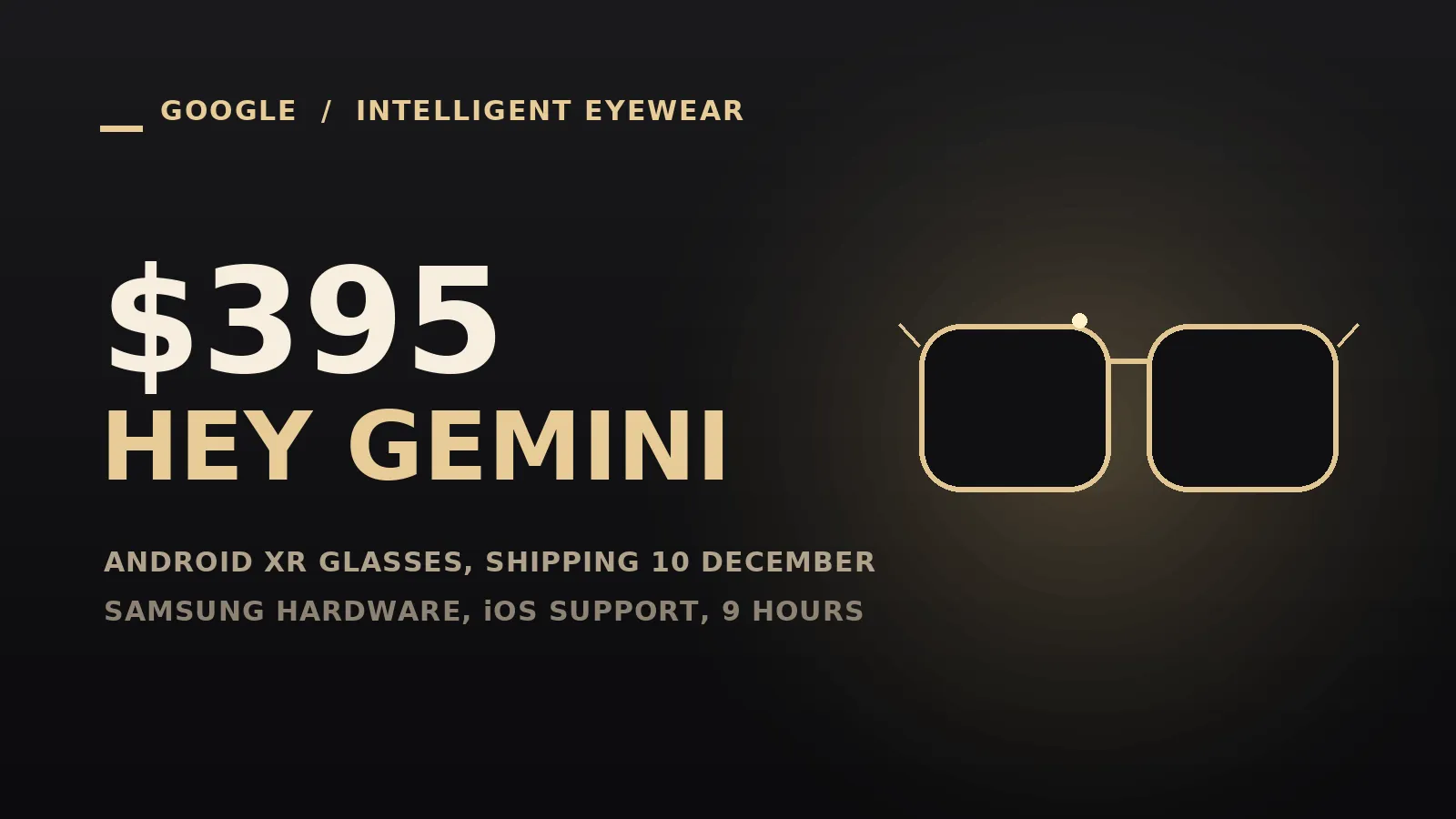
Google announced its Intelligent Eyewear collection on 12 November with Samsung, Gentle Monster and Warby Parker, opened pre-orders the same day, and set retail for 10 December.
The entry price is $395 for Warby Parker optical and sun styles. That covers three shapes, Alden, Reid and Wren, spread across 14 variations in Pine, Saddle and Jet Black.
Step up to $449 and the Gentle Monster range opens: six frames, 16 variations, bolder colours, and tinted, clear, blue or brown lenses. That range is sold in the US and South Korea at launch.
Prescription lenses are extra on top of either price. Budget for them before you compare the two tiers, because the gap between them is smaller than a good pair of lenses.
Android XR glasses specs without the spec-sheet voice
The hardware is Samsung's work, running Android XR on a Snapdragon AR1 Gen 1 with 2GB of RAM and 64GB of storage. Bluetooth 5.4, Wi-Fi 6E and IPX4 water resistance round out the connectivity and the sweat tolerance.
Each pair weighs between 40 and 44 grams with the weight spread evenly, which is the number that decides whether you wear them past the first week. Sunglasses that press on the bridge stop being fun by lunchtime.
There's a 12MP ultra-wide camera shooting 3K at 30fps or 1080p, with stabilisation and HDR. Four microphones capture spatial audio, and two open-ear speakers handle playback without blocking your ears.
Hey Gemini replaces the touchpad for most things
You control the glasses with taps and swipes on a touchpad, with voice commands, or with the new Hey Gemini hotword. In practice the hotword does most of the work, and the touchpad handles volume and the small corrections.
Google also added wrist gestures for Pixel Watch owners. Double pinch to play or pause, turn your wrist to go back, and a palm-up double pinch calls Gemini from your wrist. Fitbit Air support is promised for next year.
There's a physical on and off switch on each pair. That matters more than it sounds, because it lets you wear them as ordinary glasses on a day you don't want a microphone nearby.
The Intelligent Eyewear privacy design around the camera
Google spent a large part of the launch on this, and the details are specific enough to list.
A white indicator light shows whenever a photo or video is being captured. Recording stops if someone covers the light or tries to disable it, and the glasses run a hardware check while charging to catch tampering. Recording also stops when you take them off.
Camera commands such as visual search and translation don't save images or video to Gemini history. Google says those captures aren't used to train models or target ads, and that it redacts bystanders' faces before Gemini processes the visuals.
None of that has been independently audited, and none of it makes covert recording impossible. It's a design claim from the company that built the thing, and you should weigh it that way.
Which phone your Android XR glasses need
This is the section that decides the purchase for a lot of people. These are phone accessories, not standalone computers.
The companion app supports Pixel 7 and newer, the Galaxy S, S FE, Z Fold, Flip and Fold Ultra lines on One UI 9.0 or higher, and iPhone 13 Pro and up. The glasses are Made for iPhone certified.
If your phone is older than that list, the glasses won't pair, and no software update will fix it. Check the model before you check the frame colours.
A normal day wearing Intelligent Eyewear
The useful features are the boring ones. Turn-by-turn directions in your ears while your phone stays in a pocket. Live Translate across more than 70 languages, which is the single feature most likely to make someone keep the glasses after the novelty fades.
Messages and calls work hands-free. Guided Vision gives audio descriptions to blind and low-vision users, and that's the capability with the clearest daily value in the whole list.
Music comes from YouTube Music, Spotify, Apple Music and Audible. Visual search answers "what is this" questions about plants, labels and buildings without you reaching for a screen.
Warby Parker and Gentle Monster split the market in two
Warby Parker is the sensible half. Three shapes, muted colours, optical and sun in the same price band, and a retail network where you can try a frame on before ordering.
Gentle Monster is the fashion half. Six frames, 16 variations, and lens colours that read as a statement. So who is that tier for? People who already wear the brand's sunglasses, mostly, and anyone who wants the glasses to look like the point rather than a side effect.
Both use the same internals, so the choice is fit, colour and whether you want to look like you're wearing eyewear or wearing a gadget.
What this Intelligent Eyewear collection doesn't do
There's no display and no AR overlay. Nothing floats in front of your eye, no notifications appear in the corner of your vision, and there are no standalone apps running on the glasses.
Battery is 245mAh, rated at nine hours, with a case that holds seven full charges through contact pins under the nose bridge.
Nine hours, one workday.
A weekend away needs the case in your bag, and the case is another thing to charge.
That's the honest shape of the product. It's a camera, a speaker and a microphone with Gemini attached, worn on your face.
Pre-orders, prescriptions and the 10 December date
Pre-orders are open now through Google and the two eyewear partners, with retail availability starting 10 December. Launch markets are the US and South Korea, so anyone elsewhere is waiting.
Order the frames first and the prescription second, because lens turnaround usually outlasts shipping. And try a shape on if you can, since 40 grams on a stranger's nose tells you nothing about 40 grams on yours.