Dek: The library developers learned in 2022 helped them wire a model to the web, to APIs and to a database. The round announced on Friday is a bet that the money has moved to running those agents, and to proving what they did.
LangChain's Series C: $300M at a $3 Billion Valuation
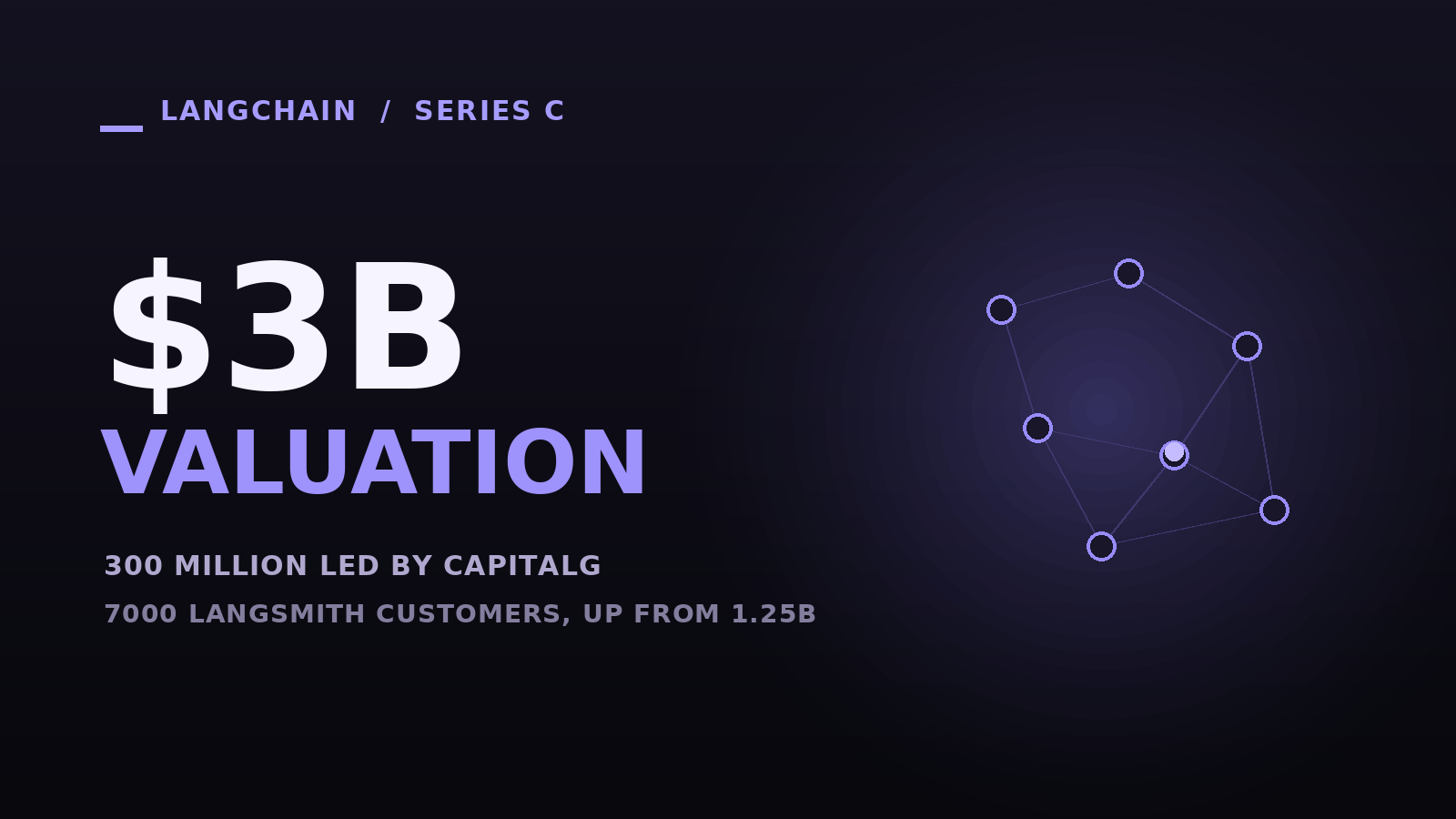
LangChain announced on Friday 13 November that it raised $300M at a $3 billion valuation, more than double the $1.25B figure attached to its $125M round about a year earlier. TechCrunch reported the deal the same day and noted the jump.
CapitalG, already an investor, led the round. GIC and DFJ Growth came in as new backers, with IVP and Sapphire Ventures returning. LangChain's own post also thanks Salesforce Ventures, Insight Venture Partners, QuantumLight and MongoDB Ventures as new investors, and names Sequoia, Amplify and Benchmark among the firms that increased their positions.
For a company whose product most developers first met as a free package, that's a large number attached to a name they associate with import statements. What the money changes depends on what you think the company sells now.
Why LangChain Moved From Wiring Agents to Running Them
The company started in 2022 as an open-source project that handled chores early models couldn't manage alone: searching the web, calling an API, reading from a database. That work was valuable precisely because the models couldn't do it.
Then the labs shipped their own versions of those chores, and the gap LangChain filled got narrower. The company's answer was to move up a layer, from connecting an agent to the tools it needs toward operating the agent once it exists.
That's a different business with a different buyer.
Different buyer, different budget.
Connecting a model is a job for one developer on a Tuesday afternoon. Running thousands of agents, knowing what they did, and stopping one that misbehaves is a job for whoever signs the invoice.
What LangSmith Actually Does for 7,000 Organisations
LangSmith is the product carrying that argument. It's a place to run, improve and govern agents, and it works with models from any vendor rather than only LangChain's own code.
The company says more than 7,000 organisations rely on it. Named users include Harvey, Rippling, Listen Labs, Nvidia, Toyota and Salesforce. Clay monitors hundreds of millions of agent runs a month through it, and Workday cut the time needed to deploy a new agent from five months to under a day.
That Workday figure is the one to sit with. Five months is the sound of a security review, a procurement cycle and a team learning a new tool. Under a day means the tooling absorbed most of that work, or that the process around it got simpler.
LangChain sorts the product into three parts. Agent Runtime covers the pieces that execute work: Deep Agents, LangGraph, LangChain, Agent Server, Sandboxes, Managed Agents and Fleet. Agent Improvement is the measurement side: observability, evaluation, an engine and fine-tuning. Agent Governance is the gatekeeping: gateways for models and for tools.
The Pitch Behind the Valuation: Own Your Intelligence
So what does $3 billion buy in a market where every cloud provider and every lab sells an agent platform? The answer LangChain gives is neutrality.
The company's stated mission is to let every company own its intelligence, choose its own models and keep control of its data and infrastructure. For an enterprise buyer, that translates into a place to set budgets, enforce data rules and decide which tools an agent may touch, without asking a model vendor for permission.
That's a real worry for anyone who has watched a lab change pricing or retire a model with two weeks' notice. It's also the easiest promise in this market to make, because it costs nothing to say and a great deal to run.
TechCrunch notes that plenty of other startups pitch the same neutrality and governance story, and points to agent-identity company Mintive as one example. Differentiation, in other words, has to come from the product rather than the positioning.
CapitalG Led, and the Register Says a Lot About Who's Betting
The investor list reads like a map of where enterprise software money expects agent tooling to land. CapitalG is Alphabet's growth fund, which means the lead cheque comes from a firm with a view on how AI gets bought inside large companies. GIC is Singapore's sovereign wealth fund, and DFJ Growth has spent two decades backing infrastructure.
Returning investors matter as much as new ones. IVP led the round a year ago at $1.25B and came back at more than twice that. Sapphire Ventures did the same. Neither move tells you anything about revenue, but both say the people with the most information chose to keep their position.
What a $3 Billion Valuation Doesn't Tell You About LangChain
Here's the part the announcement leaves out. LangChain hasn't published revenue, annual recurring revenue, burn rate, headcount or profitability, and none of those numbers appeared in the round's materials.
A valuation is a price negotiated between a company and its investors. It isn't a measure of how much customers pay, and open-source adoption is a different quantity from paid seats. The 7,000 organisations are organisations that rely on LangSmith, which isn't the same as 7,000 paying enterprises.
None of that makes the round a bad sign. It does mean anyone reading the number as a proxy for the business is reading it wrong.
The LangSmith Release Event on 20 November
LangChain says it will share new LangSmith capabilities at a release event on Friday 20 November. That's the next real datapoint, because it's where the three pillars either turn into features customers can use or stay a diagram on a slide.
If you already build with the library, the practical question is narrower than the valuation. Watch whether the governance side, the gateways and the budget controls, ships something you'd put in front of a security team. That's the part of the pitch your finance department will actually test.