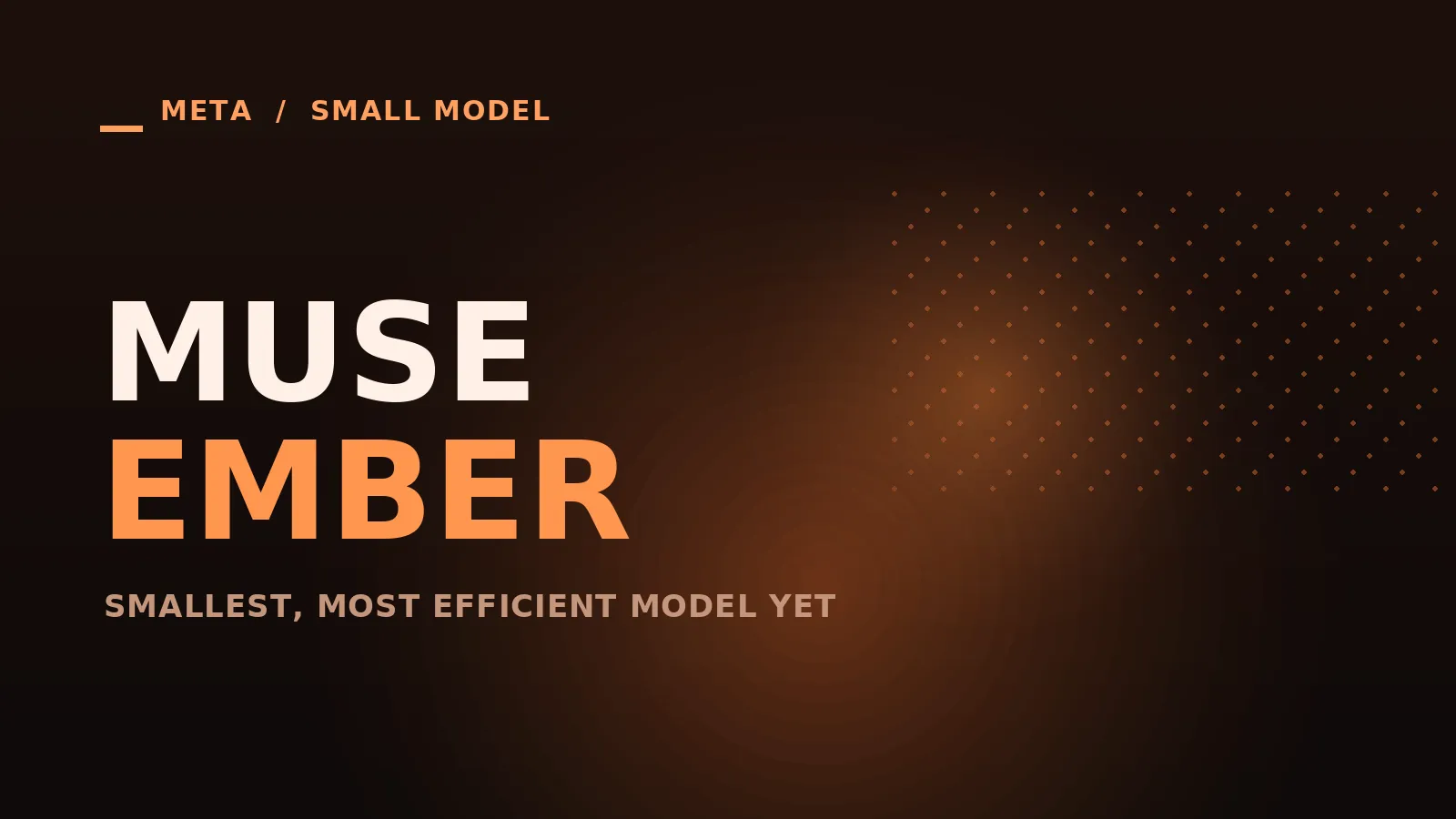
Dek: Meta calls Muse Ember the smallest and most efficient model in its family. Size is the claim. Whether small is the right shape for agent work is the part worth arguing about.
What Meta published about Muse Ember
The post went up on November 9 at research.meta.ai/blog/muse-ember, under a title that states the pitch: "Our Smallest, Most Efficient Model." That's the company's own description, and it's the only description with any weight behind it so far.
The Hacker News submission climbed past 200 points and sat on the front page for a while. For a research blog post on a Monday, that's a strong signal that developers were waiting for something in this shape.
Here's what the post gives you. A model in the Muse family, smaller than everything else in that line, pitched as the efficient option. Here's what it doesn't give you: a spec sheet you can compare against anything else on the market.
Why a Meta small model changes the agent math
An agent is a loop. The model reads a task, picks an action, looks at the result, and picks again. A job that takes 30 steps is 30 model calls, and every one of them costs money and time.
That loop rewrites the usual model math. A big model that answers one hard question well can be the wrong tool for a task made of 30 easy ones, because you pay the big-model price 30 times.
Small models flip the ratio. Lower latency per call means the loop finishes sooner, and a lower price per call means you can afford more loops before the bill becomes the argument. Anthropic, Google and OpenAI all sell small models for exactly this reason.
Meta showing up with one is less about a new capability than about where the company thinks the work is going. Agents are the workload. Muse Ember is sized for it.
Muse Ember agent work: many cheap steps instead of one expensive one
Picture a support queue. An agent reads a ticket, pulls the order record, checks a policy page, drafts a reply and files the outcome. Five steps, maybe eight if the ticket is messy.
Run that on a frontier model and each ticket costs real money. Run it on a small model and the cost per ticket drops far enough that you stop triaging which tickets get an agent and which get a person.
The same logic applies to parallel work. Ten small jobs at once fit on hardware that one big job would occupy alone. For a team processing thousands of documents overnight, throughput matters more than whether any single answer is the best possible one.
That's the case Meta is making, at least implicitly. The post doesn't publish throughput numbers, so treat the reasoning as a hypothesis about workload shape rather than a measured result.
Where Muse Ember sits in the Meta AI model 2026 lineup
The family has a shape readers already know. Muse Wonder at the top, the one you reach for when the task is hard and you only get one shot. Muse Spark Open as the open member of the line. Muse Ember now at the bottom, smallest and cheapest.
Bottom doesn't mean worst. In a lineup built for different jobs, the small model is the one you call most often, which makes it the one that decides your monthly bill.
Nothing in the announcement retires anything. Meta didn't say Ember replaces Wonder, and there's no signal that the bigger models are going away. A lineup gets wider, not shorter.
The Muse Ember questions Meta hasn't answered
Four gaps, and each one blocks a decision.
Weights and licence come first, because they decide whether you can run the model yourself or only through Meta's endpoints. Meta didn't confirm either, and Ember shouldn't be read as open just because another model in the family is.
Context length comes second. An agent that loses the thread after a few steps is a toy, and the window size tells you how much history survives the loop.
Parameter count comes third, mostly as a sanity check on the efficiency claim. And benchmark scores come last, because "most efficient" needs a denominator: efficient per token, per task, or per dollar.
None of those numbers appeared in the post. That's not a scandal. Research posts often ship before the model card does. It does mean the claim is currently unfalsifiable from the outside.
How the Muse Ember efficiency claim gets tested
Efficiency claims are easy to make and hard to check, because they depend on the test rig. A model measured on short, well-formed tasks looks cheap. The same model on a messy real workload with retries can cost more than the estimate.
So watch for independent runs rather than vendor charts. Someone will put Muse Ember through a multi-step agent loop with real tool calls, count every token across all 30 steps, and publish the bill alongside the task list they used. That result will settle more than any launch post.
Not yet measured, then.
Until then, the useful question for a builder is narrower. Does your workload look like a loop of small decisions, or one decision that has to be right? If it's the first, a Meta small model belongs on your shortlist. If it's the second, wait for the numbers.
Keep an eye on the research blog for the model card, and on the licence line in particular. That single line decides whether Ember is infrastructure you own or a service you rent.