Dek: The first mainstream consumer agent to reach the telephone network is here, and it costs the same as the tier you probably already pay for. The question is whether anyone picks up.
What Meta Muse does with a phone number
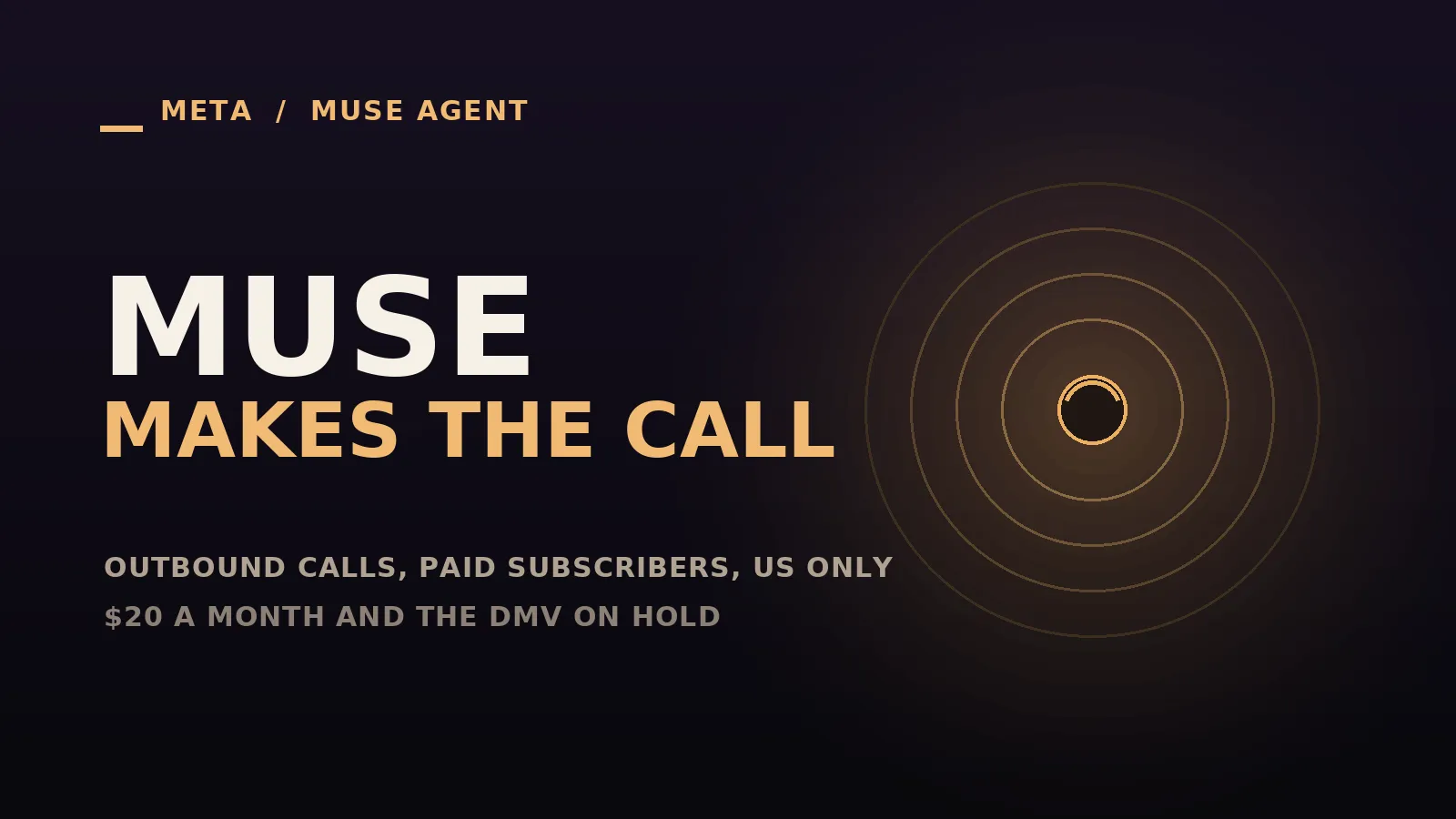
Meta said on 12 November that its consumer agent can now place calls to US businesses on a user's behalf. The feature had been in testing with early adopters since September.
The job description is mundane in the way that only genuinely useful tools are. It dials, works through the phone tree, sits on hold, and books whatever you needed booked.
No app to install.
It's limited to paying subscribers in the United States. Meta has published no success rate, no average call length, and no list of businesses that accept agent calls.
The Meta AI subscription tiers that pay for it
The Meta AI subscription starts at $20 a month for 500 million Muse tokens a week, and runs to $100 a month for 3 billion tokens.
Phone calls sit inside that paid boundary, which makes this the first time a Meta agent feature has been gated rather than given away. Free users are getting something too, just not this. Alexandr Wang said a Muse email address will roll out to free users soon, with no date attached.
Meta says Muse passed 10 million users in October. Reach isn't the same as willingness to pay, and a feature someone opens twice a month is a hard sell at any subscription price.
Alexandr Wang named the calls himself
The clearest explanation of the product came from Meta's chief AI officer and head of Superintelligence Labs. Wang listed insurance companies, cable providers, the DMV and dinner reservations as the calls Muse should take over.
That list does real work. Every item on that list is a call where the person waiting is a queue position rather than a negotiator, and none of those calls end with anyone feeling good about the outcome. Nobody enjoys them.
The reservation is the odd one out, because it's the only call where a human on the other end might actually want to talk.
Why businesses hang up on AI phone calls
Here's the friction nobody puts in a launch post: a Muse AI agent has to get past a person before it can do anything. Receptionists and staff hang up once they realize the caller isn't one of them.
Payment-industry reporting said Meta tested human callers for Muse after merchants kept hanging up. That detail tells you where the engineering effort went. Voice quality, turn-taking and the ability to sound like a person on a bad line are the actual product, and model intelligence is the cheap part.
So the feature works best where the other end is already a machine. An airline's automated system doesn't care who's calling. A dentist's front desk does, and that desk is exactly the barrier the launch glosses over.
Who carries the risk when Muse agrees to something
The etiquette questions arrive later than the technical ones, and they're harder.
If the agent accepts an appointment slot, a fee or a renewal, who agreed? The user did, in the sense that they asked for the call, but an agent that answers "that's fine" on your behalf is committing you to terms you never read and probably couldn't have negotiated faster yourself.
There's also the consent question on the other end. Does the business have to be told it's talking to software, and does it get to refuse? No rule covers that in the US today, and Meta hasn't described a policy.
Then there's the card number. If an agent is asked to confirm a payment detail to hold a booking, what does it do? That's a decision about what to hand an autonomous system, and it deserves a setting rather than a guess.
Meta Muse isn't alone in this market
Meta didn't invent the category. Startup Instinct has offered a similar calling feature, and Google tested letting Gemini place calls for US Pixel owners.
What Meta brings is distribution. Ten million Muse users and a subscription that already exists is a different starting position from a standalone app nobody has installed.
Distribution is the difference.
That's also why the receptionist problem matters more for Meta than for a startup. A small agent calling twenty plumbers a day is a curiosity. A platform doing it at scale gets a reputation with the businesses it calls, and businesses adapt.
Is $20 a month worth it for AI phone calls?
If you have recurring calls you dread, the arithmetic is simple. Two hours a month spent on hold is worth more than $20 to most people, and Muse only has to succeed at the boring ones to pay for itself.
If you don't, this is a feature you'll try once in December and forget by January.
The honest test is the first month. Pick one call you've been putting off, hand it over, and see whether the other end cooperates. That result tells you more about the product than any launch demo, because a demo can pick the business that answers.