Kevin Bond and Ethan Byrd aren't astronomers. They ran AI tools over public telescope archives on their own time, and professional observers are now checking the signals they turned up.
A 13.8-day dip in Kepler data, found by an OpenAI engineer
Kevin Bond builds software at OpenAI and photographs the night sky for fun. He pointed Codex at public observations of roughly 100,000 stars from the Kepler space telescope, which stared at one patch of sky from 2009 to 2018.
Kepler stopped observing in 2018 when it ran out of fuel, and the archive it left behind is still the deepest continuous brightness record anyone has for a single patch of sky. That search returned more than 200 signals. Ten of them belonged to planets already confirmed, which is the check every new pipeline needs: if a method can't find the planets you already know about, its new finds mean very little.
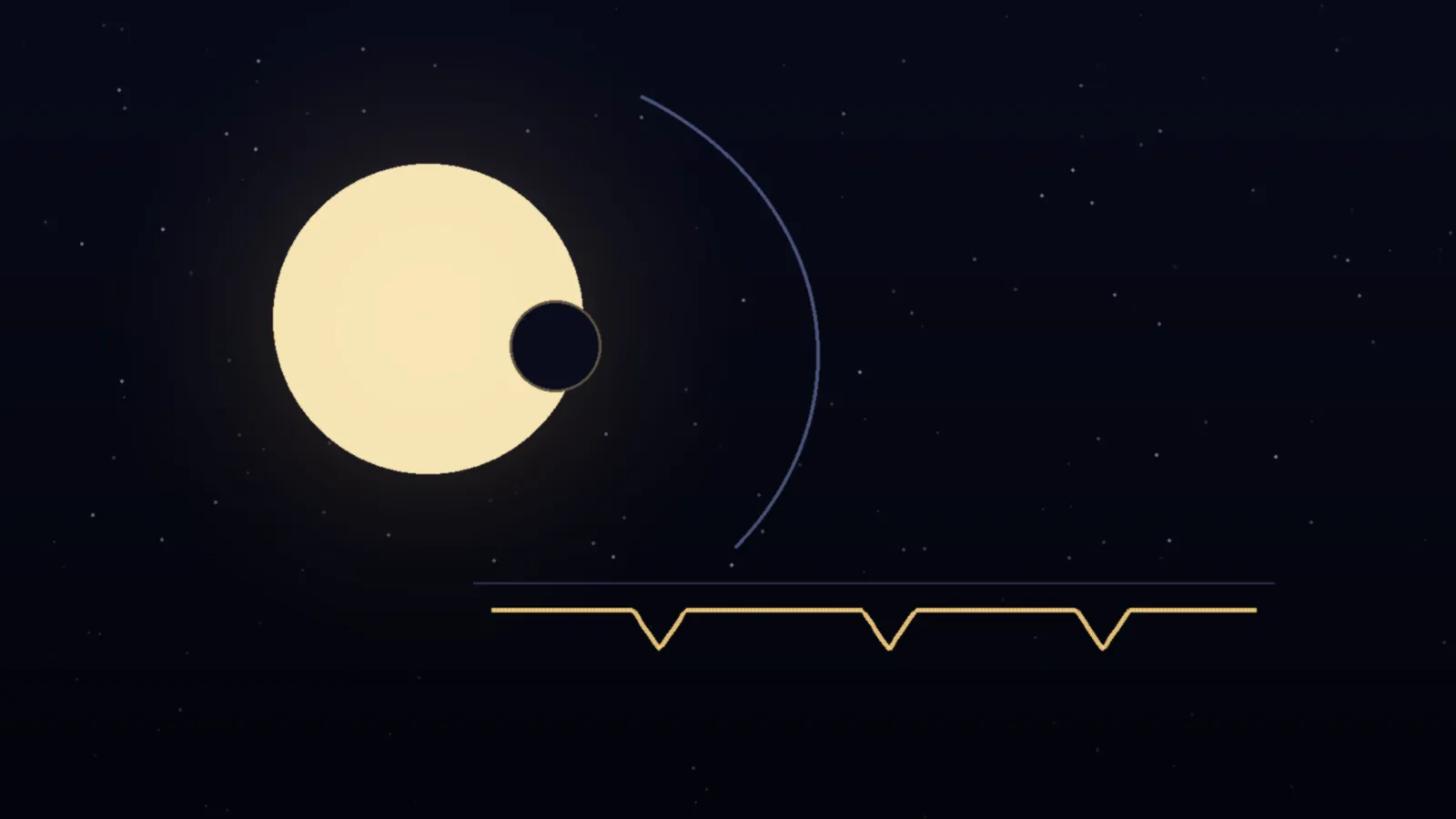
Two stood out. KIC 5689121, a cool star about half the Sun's size in the constellation Lyra, dims on a 13.8-day cycle. If a planet causes that dip, the amount of blocked light points to a body about 2.4 times Earth's diameter.
KIC 5689121 and KIC 6691030: the two Kepler standouts
The pair make a neat contrast, one slow and one fast, one bright and one faint.
Star | Dip period | Implied size |
|---|---|---|
KIC 5689121 | 13.8 days | about 2.4 times Earth's diameter |
KIC 6691030 | 4.8 days | smaller than Neptune |
KIC 6691030 sits in the northern sky and is faint enough that few people have spent telescope time on it. Its dip repeats every 4.8 days and, read the same way, would fit a planet smaller than Neptune.
Two candidates from 100,000 stars is a small return. That's the point of a first pass: keep the list short enough that somebody with a spectrograph can work through it.
Ethan Byrd's 49 candidates from TESS and other archives
Ethan Byrd runs Primitive, an email infrastructure startup, and did his search without talking to Bond. He used OpenAI Astra to design two searches, one broad and one aimed at habitable zones, drawing on data from TESS and other public archives.
TESS is NASA's survey satellite and it scans the sky in overlapping sectors, which is why its archive suits a broad sweep. The data is public, so a founder with a laptop can run an exoplanet hunt over a weekend.
Byrd's first pass turned up 49 candidates. He sent his strongest to researchers working on the TESS mission, where it's waiting for analysis, with two more queued for submission.
What 'candidate' means between a dip and a planet
A dip in starlight is evidence, not proof, and a transit only ever gives you a planet's size relative to its star. Mass has to come from somewhere else.
Size, never mass.
Two stars orbiting each other can produce a nearly identical curve, and so can a temperature wobble in the detector or a background eclipsing pair sitting in the same pixel.
Confirmation takes longer than detection. Astronomers check the statistics, collect more observations, and measure the star's radial velocity, which means watching its light shift as an unseen planet tugs it back and forth. Then the work goes through peer review, a process OpenAI says can run for months or years.
The word candidate is doing a lot of work in this story. It means a lead worth a telescope's time. It doesn't mean a planet, and it certainly doesn't mean 49 of them.
The SETI Institute check that makes the case readable
An astronomer at the SETI Institute ran an independent search over the same public data and found two of the same signals. Vishal Gajjar, the institute's associate director for international SETI programs, described the early checks as encouraging.
Independent agreement on two signals is thin evidence in absolute terms. It's useful evidence in context, because it means the pipeline isn't producing artifacts only its author can see.
Why does that matter for a reader who will never open a light curve? Because the whole promise of citizen science rests on other people being able to rerun the work.
Why amateur exoplanet hunting works now
Three things changed at once. Public archives now hold years of calibrated photometry that anyone can download. Compute is cheap enough to rent for a weekend. And models write the search code, which used to be the part that kept hobbyists out.
There's precedent for AI in this field. In 2017, a neural network trained on 15,000 Kepler signals that had already been examined helped identify an eighth planet at Kepler-90.
What's different is who runs the pipeline. That 2017 work came from a NASA and Google collaboration. Byrd's version is one founder, one model and a spare weekend.
The caveats around Kepler, TESS and 49 candidates
None of this is published research. Both searches are still running, so both candidate lists will change. False positives are expected in any first pass, which is exactly why the counts should be read as a starting point.
The 49 figure is the one most likely to escape into headlines, and it's the least solid number here. It came from one broad sweep, and the share that survives follow-up will be smaller.
Bond's pipeline has its own open question. Ten confirmed planets among 200-plus signals is encouraging, and it also means most of what the search returned is something other than a planet.
What to watch after the Kepler and TESS follow-up
No date is set for either verdict. The TESS team's reading of Byrd's strongest candidate is the first real test, and radial velocity measurements will decide the Kepler pair.
If KIC 5689121 turns out to be a planet, the papers will say so slowly and carefully, months after the posts that announced it. Until then, the fair reading is that two people with public data and a general model produced leads worth a professional's time.