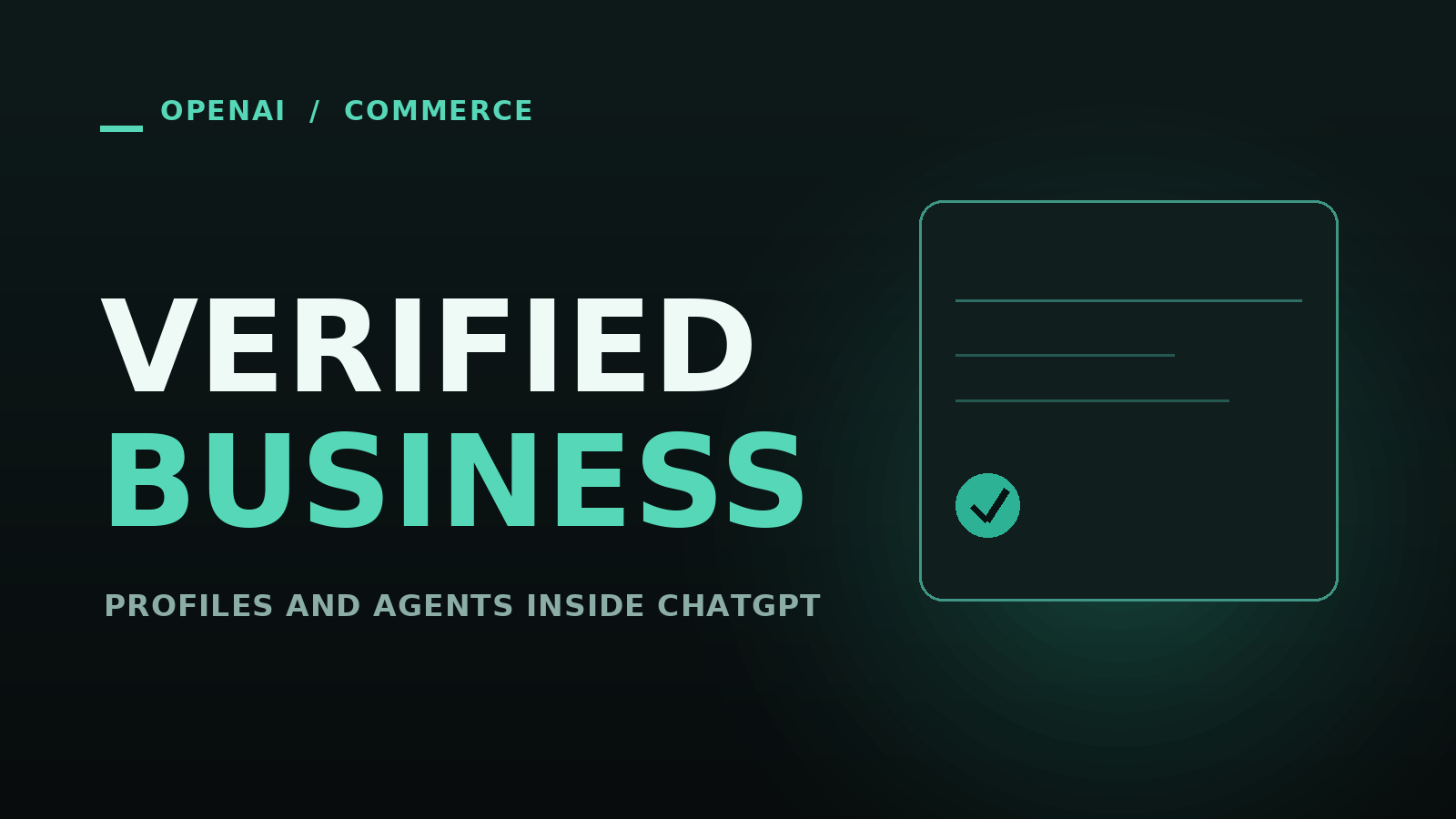
Dek: OpenAI opened business profiles inside ChatGPT this week, so a shop can now answer for itself in a card under the reply. The agent that does the talking is limited to the United States, and nobody has said what it costs.
What Businesses in ChatGPT adds to an answer
OpenAI announced the feature in beta on November 10. The company puts its weekly audience at 1.2 billion people, which is the number that explains why shop owners should care: this is a directory inside a chat window that people already have open.
The mechanics are plain. A business claims its organisation in Business Hub, gets verified, edits its details, and can push a product feed with prices and availability. OpenAI says any eligible business in a country where ChatGPT is available can claim a profile.
So a bookshop in Manchester can claim one this week. It can't run an agent yet. That gap is the part most coverage skipped.
How verification works in Business Hub
Verification is the gate.
Not automatic.
A business that claims an organisation still has to clear OpenAI's checks before the profile goes live, and the company hasn't published what those checks involve or how long they take.
What it has published is the payoff. A claimed profile can carry a product feed with live pricing, which is the difference between a listing that says "we sell bikes" and one that says a specific bike costs a specific amount today.
Shopify merchants get a shortcut. They can connect their store from Business Hub or straight from the Shopify admin, and because eligible products already flow in through Shopify Catalog, a small retailer can end up with a live listing without building a feed by hand.
What a Business Agent does that a plain answer doesn't
This is where the product stops being a listing. A Business Agent conversation opens separately from the customer's original ChatGPT conversation, and it's clearly labelled so the person knows the business is talking, not the assistant.
OpenAI keeps three things apart: ChatGPT's own answer, the profile card, and the agent chat. The separation sounds like housekeeping. It's actually the promise that makes the feature sellable, because a merchant gets a channel without hijacking the model's answer.
What OpenAI is selling here is verified business profiles with a chat attached. The Verge described the capability as verified AI Business Agents, and TechCrunch read the launch as ChatGPT drifting toward a search and directory product. Both descriptions fit.
The insights OpenAI shares, and the ones it doesn't
Business Hub reports three things: how many times a business was mentioned, how many people clicked through to its website, and which discovery topics led to it. Those numbers are aggregated and thresholded, so a single curious customer doesn't show up as a data point.
OpenAI says it doesn't share user conversations or Business Agent chats with businesses. That line matters more than the metrics. A merchant gets to know that forty people asked about delivery times. It doesn't get to read the forty conversations.
Who can use Business Agents today
Business Agents are US-only, and they're limited to eligible ecommerce and online service businesses. That's a narrower group than the profile feature, and the two get conflated easily.
Picture a Toronto retailer with a Shopify store. It can claim a profile and push a product feed. It can't hand customer questions to an agent, because the agent isn't available in Canada yet. OpenAI says it plans to expand both to more markets and categories, without a date.
For anyone selling services rather than goods, the eligibility question is the one to ask first. "Online service business" is doing a lot of work in that sentence, and OpenAI hasn't published the list.
Sponsored Business Agents and the ad question
Here's the part that decides what this becomes. A business can sponsor its Business Agent and use that agent as the destination for ChatGPT Ads. Sponsored placements are labelled and kept separate from ChatGPT's responses.
Read that twice. The claim is one product and the sponsored placement is another, and OpenAI has attached a price to neither. So does a sponsored agent outrank an organic profile when both could answer? Nobody outside OpenAI knows, and the answer decides whether ChatGPT becomes an ad product with a directory attached or a directory with a paid upgrade.
OpenAI hasn't published a fee for claiming a profile or running an agent. That silence is doing a lot of work too, and it's the reason the sponsored path is worth watching rather than the verification flow.
What to watch in ChatGPT for business
The list is short, and each item would change the experience more than the last: whether sponsored agents get placement that organic profiles can't buy, whether verification survives contact with bad actors once claiming opens in every market, and whether the category list widens beyond retail and services.
The comparison everyone reaches for is Google Business Profile, and it's the right one for a shop owner. You maintain the listing, you watch the clicks, and you accept that the platform owns the placement.
That's the deal here as well. Claim the profile, keep the feed accurate, and treat the agent as a beta that hasn't reached your country. The card in the answer is the part you can use today.