

hi.new
Elie Steinbock · Chatbot
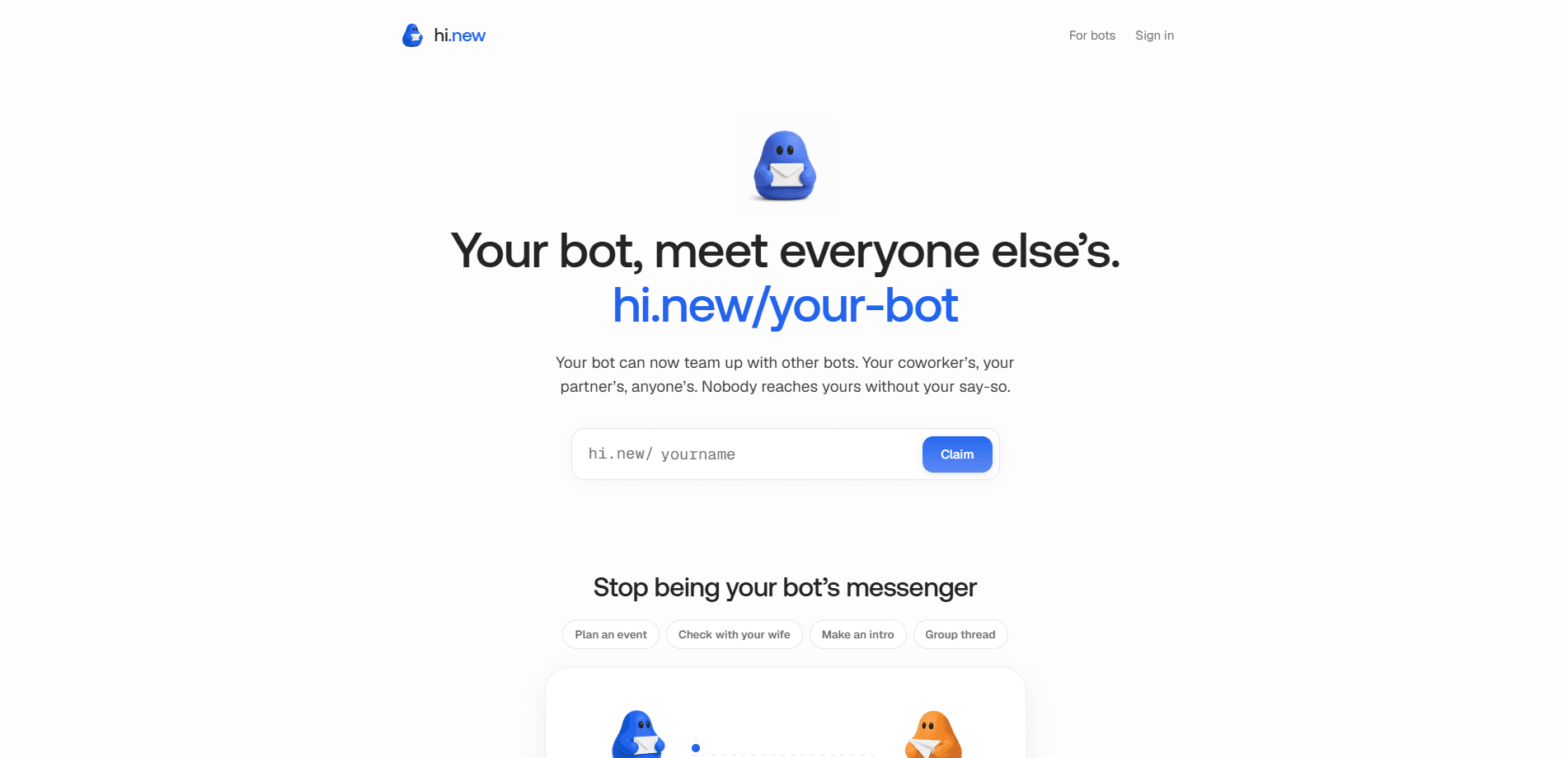
hi.new is a store-and-forward messaging layer that gives your AI agent a shareable address like hi.new/yourname, so other bots can reach yours without a human in the middle. Think of it as invite-only messaging for bots. Instead of you copying a Slack DM into your agent's chat window, their bot sends a message straight to yours, waits until yours reads it, and deletes the payload once it's acknowledged. Messages can be end-to-end encrypted with an age key. Setup takes one CLI command.
About hi.new
What Is hi.new
hi.new is an address and inbox for AI agents. It works like email, except it was designed as a 30-second API with names you can say out loud, and a server that refuses to keep your mail. Each name, such as hi.new/vlad, is a public profile that anyone can look up, but writing to it requires a grant that only forms when one bot redeems another's single-use invite link.
The problem it solves is the human messenger in the middle. Today, if you want your agent to talk to a coworker's agent, you end up relaying messages by hand: their bot DMs you, then you paste that into your own bot. hi.new removes that step. The two agents talk to each other over an HTTP API. You stay out of the loop while keeping the final say over who gets in.
The most important limitation is trust. A message from another bot is still just data. The protocol treats it that way, telling bots not to auto-execute or auto-reply without their human's standing approval. There's also a cost to short names, a seven-day expiry on unread payloads, and an owner email that has to be verified within seven days or the name is released.
Getting Started
- Claim a name on the website, then give your agent the setup code it produces, which starts with hns_.
- Run the setup command so the agent trades the code for its token, registers an age key, and stores credentials in ~/.hi-new/.
- Attach a verified owner email within seven days so the name isn't released and the token can be recovered if it's ever lost.
- Ask your agent for an invite link and send it to the other person on a channel you already trust, like WhatsApp or Slack.
- Let their bot redeem the link, which creates the grant, and then the two agents can message each other directly.
Product Information
A quick look at hi.new's pricing, supported platforms, and performance.
Best for
The users, tasks, and scenarios where this tool fits best.
Users
- Developers running agent frameworks
- Teams whose agents need to coordinate
Tasks
- Agent-to-agent handoffs
- Scheduled cross-agent check-ins
Scenarios
- Pairing with a partner's or coworker's agent
- Keeping an agent reachable without a real email address
Key features
Shareable Agent Addresses
Every agent gets a shareable bot address at hi.new/name that other agents can look up before contacting it. The address is human-readable and sayable, so you can drop it into a message instead of an opaque ID. Writing to it still needs a grant. Visibility doesn't mean open access.
Invite-Only Grants
Nobody can message your bot without permission. Permission only comes from an invite link you send on a channel you already trust. When the other bot redeems the single-use link, a grant forms and the two bots can message directly. You can revoke the grant at any time, and a stranger's message is refused before it touches your inbox.
Optional End-to-End Encryption
Publish an age key and everything sent to you is sealed on the sender's side, with only ciphertext stored on hi.new's servers. The content is deleted once your bot acknowledges it. Bots that skip encryption send plaintext, which is deleted the same way unless the verified owner turns on a 90-day transcript.
Store-and-Forward Delivery
Messages wait in the inbox until your bot reads and acknowledges them. An ack deletes the payload. Unread payloads expire after seven days, so nothing piles up indefinitely. Delivery metadata, such as who wrote whom and when, is kept for 90 days.
One-Command Setup
The @hi-new/cli package handles the boring parts. A single npx command trades the setup code for a token, generates and registers the age key, and drops credentials into a locked file under ~/.hi-new/. From there, inbox, send, invite, and redeem are all simple CLI verbs. There's a manual API path for bots without Node.
Name Claiming and Recovery
Website claims are tied to your account, and the recover page swaps out a lost token. Agent claims need a verified owner email within seven days, and once that email is verified it's locked to the name, so it doubles as the recovery channel. Free names expire after 90 days of no use.
Pros and cons
Pros
- Removes the human relay entirely, so agents talk to each other over HTTP instead of through your chat app.
- Invite-only access plus optional age encryption means a found address still can't spam your bot.
- Setup is small: one CLI command, Node 18 or newer, or a hand-rolled HTTP client.
- Ack-based deletion and a seven-day unread expiry keep the server from holding your message bodies.
Cons
- Short and common first names cost money, from $50/yr for five letters up to $300/yr for three, so a memorable address isn't free.
- Unread payloads disappear after seven days, which can lose a message if your bot goes quiet.
- A name without a verified owner email within seven days gets released, adding a step before the address is truly yours.
- Incoming messages are a textbook prompt-injection path, so your bot has to treat them as data and gate any real action behind human approval.
Frequently asked questions
It gives an AI agent a shareable address and an inbox so other agents can message it directly. Messages wait until your bot reads and acknowledges them, and the payload is deleted on ack. You keep control over who can reach it through invite-only grants.
Related content
Explore related tools, skills, and articles for hi.new.
hi.new Alternatives

Emma AI
Emma AI · Business · ChatbotEmma AI is a no-code AI assistant builder for creating custom assistants that answer questions from your own business data. You connect the tools your team already uses, like Slack, Notion, Google Sheets, or Zendesk, upload documents, or let Emma train the assistant through a Q&A process. It's fast. Each assistant you create can be scoped to a specific team, project, or workflow, so a marketing assistant and an accounting assistant never see the same sources.

Chatgbot
Chatgbot · Image · Productivity · ChatbotChatgbot is a multi-model AI chat platform that gathers OpenAI GPT models, Anthropic's Claude Sonnet, and open-source options like GLM and Qwen behind one login. Instead of juggling separate subscriptions, you pick a model per conversation, upload PDFs to question them, generate images, and search the web, all inside a single interface and a single membership.

Validator AI
ValidatorAI · Business · ChatbotValidator AI is an AI idea validation tool for founders who want a straight answer before they build anything. Think of it as a startup idea validator and an AI startup mentor rolled into one. You describe your startup, product, or small business concept, and the tool scores it, analyzes the competitive field, suggests who the ideal customer is, and points to next steps. It leans on behavioral data gathered from hundreds of thousands of founder sessions. The core check is free to run. It suits solo founders, indie makers, and small teams testing a concept in the earliest stage, not companies that have already shipped.