

AI Job Board
Not publicly disclosed · Business
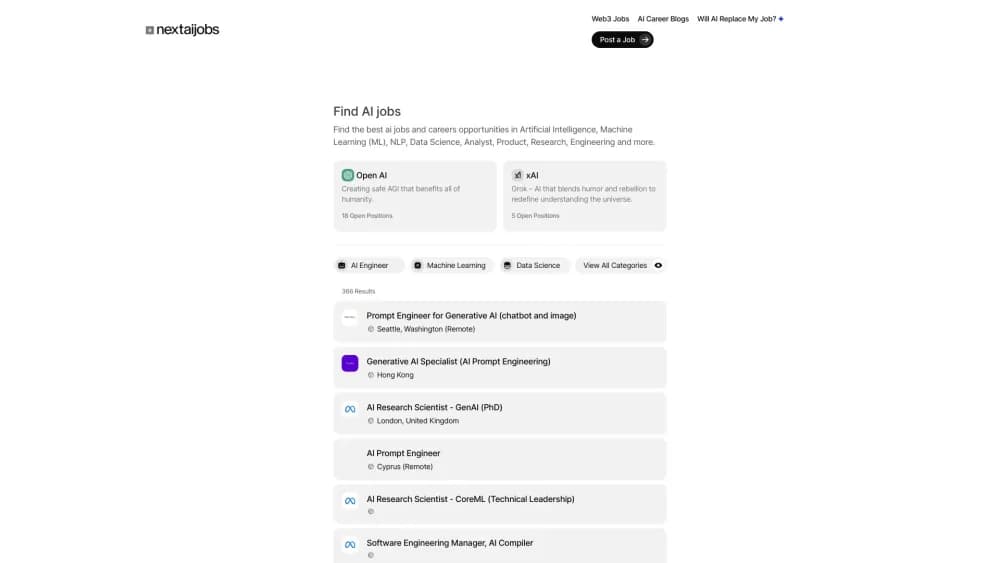
AI Job Board (nextaijobs.com) was a niche board for AI and machine learning roles. The site is offline as of 2026, so treat it as a reference, not a place to apply.
About AI Job Board
What Is AI Job Board
The name described the product. AI Job Board was a web job board built around AI work: machine learning engineering, data science, research, and the product roles that sit next to them. Rather than mix those listings into a general tech job board, it kept the AI slice separate. That's the pitch of every niche board, and it solves a real annoyance when your search terms return thousands of unrelated postings elsewhere.
The problem it aimed at was noise. A machine learning engineer searching a general board gets "AI" attached to sales roles and analyst jobs that have nothing to do with models. A dedicated AI career site narrows the pool before you start filtering. For a small team hiring its first ML engineer, the same logic runs in reverse: fewer applicants, and more of them relevant.
The main limitation is status. As of October 2026, nextaijobs.com resolves to a domain marketplace page with a buy-now button. There's no login, no listing feed, and no support address. Archived copies weren't reachable when I checked, so the notes below describe how boards of this kind work and what this one set out to do. They aren't a verified spec sheet from a live product.
Getting Started
- Open nextaijobs.com and create an account with an email address.
- Set role, skill, and location filters, then save the search.
- Turn on email alerts so new listings arrive without a daily check.
- Open a listing, read the requirements and salary band, then apply on the employer's own site.
- Keep your own record of applications, since a board this size doesn't replace an applicant tracker.
Product Information
A quick look at AI Job Board's pricing, supported platforms, and performance.
Best for
The users, tasks, and scenarios where this tool fits best.
Users
- Machine learning engineers
- Data scientists moving into model work
- Recruiters hiring for small AI teams
Tasks
- Finding machine learning jobs by specialization
- Comparing salary bands across employers
- Setting up a standing search
- Researching which companies are hiring for AI
Scenarios
- A first job search after a bootcamp or master's
- Hiring a single ML engineer without a recruiting budget
- Relocating to a new market
Key features
AI-Only Listings
The board carried AI jobs and little else, which was the whole reason to visit. In practice that means machine learning engineering, applied research, data science, MLOps, and the product and policy roles that support them. A focused feed is faster to scan than a general tech job board, and it's the feature that made the site worth bookmarking.
Role and Skill Filters
Boards of this type sort listings by function, seniority, and stack, so you can drop from hundreds of postings to a shortlist in a few clicks. The useful part is the skill filter: searching for PyTorch or LLM inference returns roles that name those tools, not roles that mention AI in passing. Filters only help when the inventory is deep, which is the hard part for a small board.
Salary Ranges on Listings
Pay transparency was part of the appeal. Listings that publish a band let you compare offers before the first interview and skip roles that were never going to clear your number. Where ranges are missing, you're back to guessing, and that gap is common on smaller boards that let employers post without a salary field.
Saved Searches and Alerts
A saved search with email alerts turns the board into a standing feed. You set the criteria once, and new postings arrive in your inbox. For anyone currently employed and looking quietly, that's the difference between a weekly check and a search that runs itself.
Employer Posting
The other side of the board is the employer form: write a listing, pick a category, set a location and salary, and publish. Pricing for that isn't documented anywhere I could reach, and the site's own checkout is gone, so I can't tell you what a posting cost or whether the first one was free.
Browser-Only Access
There was no app and nothing to install. The whole product ran in a tab, which meant it worked on any laptop or phone browser. That's normal for job boards, and it also means there's nothing left to download now that the domain is parked.
Pros and cons
Pros
- A single focus on AI work, which cuts the irrelevant listings you have to scroll past.
- Salary ranges on many postings, useful for comparing offers before the first call.
- Saved searches and alerts, so new roles arrive without a daily visit.
- No software to install, and no account cost for job seekers while the site was live.
Cons
- The service is offline. The domain is listed for sale, so there's no sign-up, no listings, and no way to recover an account.
- Nothing about the operator is public, which makes data handling and listing quality impossible to check now.
- No API or integration was documented, so the board couldn't feed an applicant tracking system or a personal dashboard.
- A niche board lives or dies on inventory, and a small AI-only site often has far fewer postings than a general tech job board.
Frequently asked questions
No. As of October 2026, nextaijobs.com redirects to a domain marketplace page with a buy-now option. There's no working login or job feed, so anyone who bookmarked it needs somewhere else to search.
Related content
Explore related tools, skills, and articles for AI Job Board.
AI Job Board Alternatives

Claude for Google Workspace
Anthropic · Writing · Productivity · BusinessClaude for Google Workspace puts Claude in a sidebar inside Google Docs, Sheets, and Slides, where it reads the file you have open and edits it in place.

KloudMate 2.0
KloudMate · Coding · BusinessKloudMate 2.0 is an AI observability platform that keeps logs, metrics, traces, and incidents in one place, with KloudMate Assistant investigating alerts and proposing the fix.
Cekura Bench
Cekura · Voice & Language · BusinessCekura Bench is a public benchmark that runs speech-to-speech models and deployed voice agents through 82 simulated phone calls, three times each, then publishes pass rates, latency and cost.