

PromptScan
Suppliflex · Business
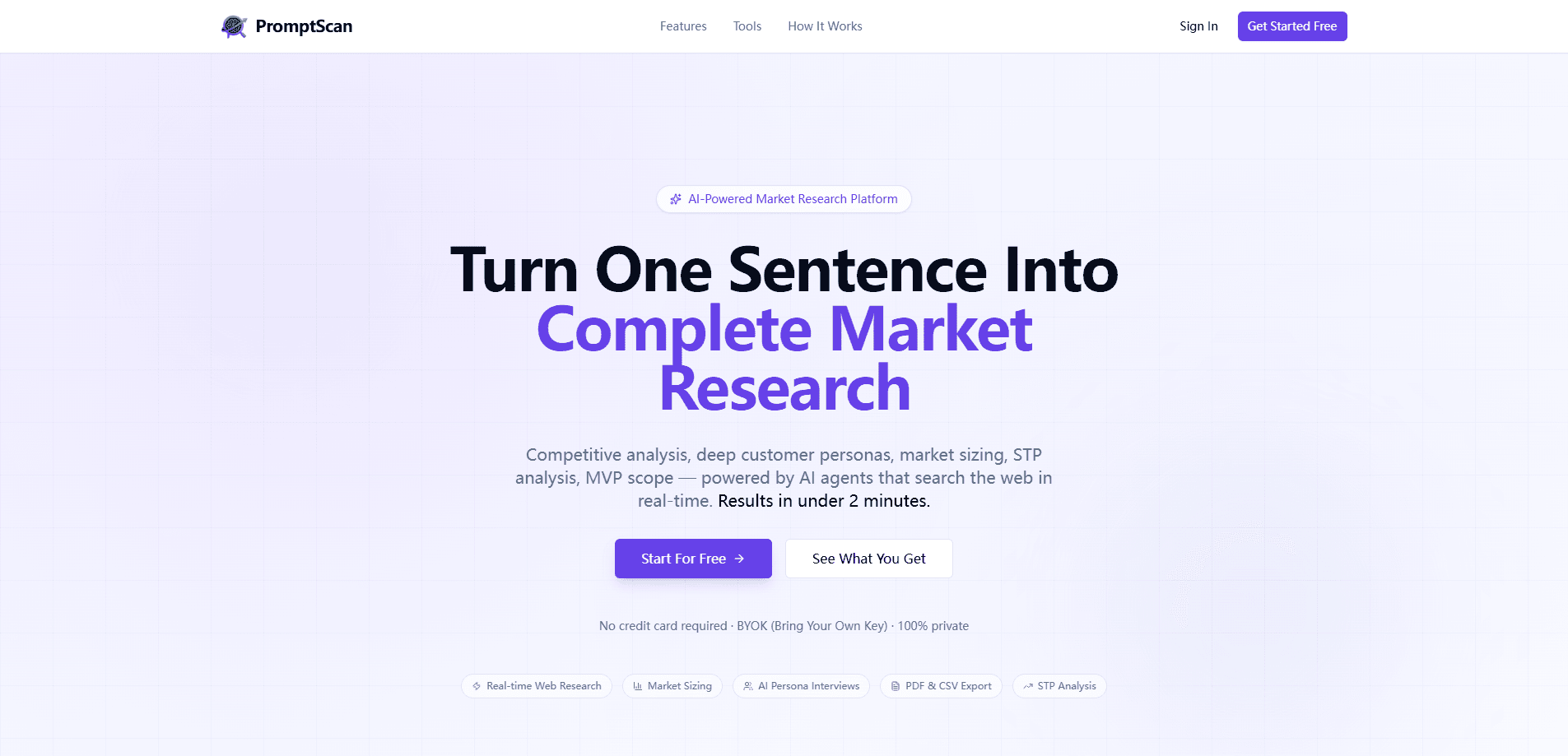
PromptScan is an AI market research platform that turns a single sentence about your product idea into a full research pack. You describe the idea, pick an industry and region, and its AI research agents browse the web in real time to build a market research report, competitive analysis, customer personas, market sizing, and an MVP scope. It's aimed at founders, product managers, and students who need answers fast without hiring an analyst. Results come back in under two minutes, and you watch the agents work through a live terminal view. One sentence in, a research pack out.
About PromptScan
What Is PromptScan
PromptScan is a web-based market research tool from Suppliflex. It replaces the usual weeks of manual desk research with a set of connected AI agents that search the web, read competitor pages, and synthesize the findings into structured documents. The pitch is simple: one sentence in, a research suite out. That's it.
The platform ships twelve tools, and they build on each other. You start with a broad market research report, then go deeper with a competitor drill-down, a customer persona document, and market sizing. For a solo founder validating an idea on a weekend, that pipeline is the real draw. You don't need a research background. That helps a lot.
There are limits worth knowing up front. PromptScan uses a bring-your-own-key model, so you supply your own Tavily API key in settings before the agents can search. The quality of your output depends on the model and key you plug in, and the tool doesn't verify the numbers it collects, so you still have to sanity-check anything you'd put in a pitch deck. Worth noting if you're comparing it to a research service that stands behind its data.
Getting Started
- Create an account on the PromptScan site and open the settings page to connect your own Tavily API key.
- Describe your idea in one sentence, then choose the industry and target region the research should cover.
- Run the market research report first, or launch all twelve tools at once as a background job and keep browsing while they work.
- Watch the live terminal view as the agents search, then open each dashboard for competitive analysis, personas, market sizing, and STP.
- Export any finished report as a PDF or structured CSV before you share it with your team.
Product Information
A quick look at PromptScan's pricing, supported platforms, and performance.
Best for
The users, tasks, and scenarios where this tool fits best.
Users
- Early-stage founders
- Product managers
- Students and bootcamp learners
Tasks
- Startup idea validation
- Competitive analysis
- Market sizing
- Persona building
Scenarios
- Weekend idea sprints
- Investor prep
- Pivot decisions
- Course projects
Key features
One-Sentence Idea Input
Type a single sentence about your idea, pick an industry and region, and the platform takes it from there. There's no long intake form and no data you need to gather first. Just one line. The one-line prompt is enough for the agents to scope the research, which is what makes the tool feel faster than a traditional research service. No prep needed.
Twelve Connected Research Tools
PromptScan bundles a market research report, competitive analysis, customer personas, market sizing, STP analysis, MVP scope, and more into one AI market research tool. Each tool builds on the previous one, so the persona documents reference the competitive field you already generated. That chain is why you get a coherent pack instead of twelve disconnected outputs.
Real-Time Web Research Agents
Six AI agents search the web as you watch, with a live terminal view showing every query and page they read. The research draws on current sources rather than a frozen training snapshot. You can follow the reasoning and catch where an agent went off track, which matters when you're about to act on the findings. Trust matters here.
Competitive Analysis and Competitor Drill-Down
Every competitor gets a ten-dimension review covering positioning, pricing, go-to-market, traction, and strategic bets. A separate competitor drill-down pulls product details, tech stack, funding, team, and weaknesses for whichever rival you pick. Both tools are built for founders who need to know who they're up against, not a vague overview. Know your rivals.
Deep Customer Personas With Chat
The persona tool maps jobs-to-be-done, pain points, buying processes, and willingness to pay, then sorts customers into psychographic groups. You can also chat with each persona as if it were a real person, and the conversation history sticks around. It's a useful rehearsal before you run actual user interviews. Practice first, ask real people later.
Market Sizing With TAM, SAM, SOM
The market sizing tool runs both bottom-up and top-down estimates and writes out the assumptions behind each number. It also projects growth so you can see the direction of the market. You get an auditable estimate, not just a headline figure. That distinction matters when an investor asks how you got the number, because you can point to the assumptions the tool wrote out instead of shrugging at a magic total that came from nowhere.
MVP Scope Document
The MVP tool turns your research into a practical build plan with goals, in-scope features, success metrics, and a prioritized backlog. It bridges the gap between validating an idea and deciding what to actually ship first, which is exactly the step most founders get stuck on. What do you build first? The backlog gives you an order.
PDF and CSV Export
Any report exports as a formatted PDF or a structured CSV, ready to drop into a deck or hand to a teammate. Export runs from inside the dashboard, so you don't have to copy-paste tables by hand. The CSV keeps the data structured for anyone who wants to rework it in a spreadsheet. Clean handoff.
BYOK Privacy Model
PromptScan runs on a bring-your-own-key model with no default keys, meaning you control your own Tavily API key and your searches stay under your account. The site calls it 100% private. The trade-off is that you set it up yourself, and your results depend on the key you bring.
Pros and cons
Pros
- Turns a one-line idea into a full research pack in about two minutes, with no research experience needed.
- Twelve tools connect into a pipeline, so competitive analysis, personas, and MVP scope stay consistent with each other.
- The live terminal view shows each search and analysis step, so the research is traceable.
- BYOK model keeps your API key and data under your control, with no default keys on the platform.
- PDF and CSV export make the output usable in a deck or a shared spreadsheet.
Cons
- You need to supply your own Tavily API key before any research runs, which adds setup work and a third-party dependency.
- The platform doesn't verify the numbers its agents collect, so market sizing and pricing figures need your own cross-check.
- There's no API for developers who want to call the tools programmatically, so it's dashboard-only for now.
- Research quality shifts with the model and key you connect, so two users can get different results from the same idea.
Frequently asked questions
It takes a one-sentence product idea and generates a market research suite from it, including a market report, competitive analysis, customer personas, market sizing, STP analysis, and an MVP scope. The AI agents search the web in real time and synthesize what they find. You watch the process and then review the dashboards.
Related content
Explore related tools, skills, and articles for PromptScan.
PromptScan Alternatives

Claude for Google Workspace
Anthropic · Writing · Productivity · BusinessClaude for Google Workspace puts Claude in a sidebar inside Google Docs, Sheets, and Slides, where it reads the file you have open and edits it in place.

KloudMate 2.0
KloudMate · Coding · BusinessKloudMate 2.0 is an AI observability platform that keeps logs, metrics, traces, and incidents in one place, with KloudMate Assistant investigating alerts and proposing the fix.
Cekura Bench
Cekura · Voice & Language · BusinessCekura Bench is a public benchmark that runs speech-to-speech models and deployed voice agents through 82 simulated phone calls, three times each, then publishes pass rates, latency and cost.