AgiBot previewed GO-3, a model it says handles reasoning, outcome prediction, and motion in one chain. It also proposed a new unit for measuring whether any of that turns into work.
What AgiBot Showed in Shanghai
AgiBot used its Innovation Day in Shanghai on October 29 for a stack of announcements: a foundation model, a hardware architecture, an industrial robot, and an operating system.
The piece that matters most outside the company is GO-3 Preview, the next generation of AgiBot's embodied AI foundation model: the software layer that turns a spoken instruction into movement in a physical machine.
A foundation model, in this context, means one system trained broadly enough to handle many tasks instead of one model per job. AgiBot's claim is that GO-3 does that for robots, without reteaching each new motion from scratch.
The company plans to open source the full model before the end of 2026, so everything here runs on its own demonstrations and benchmarks for now.
GO-3 and the WRAM Chain
The architecture has a name: WRAM, short for World Reasoning Action Model. The label describes three jobs stitched into a single sequence.
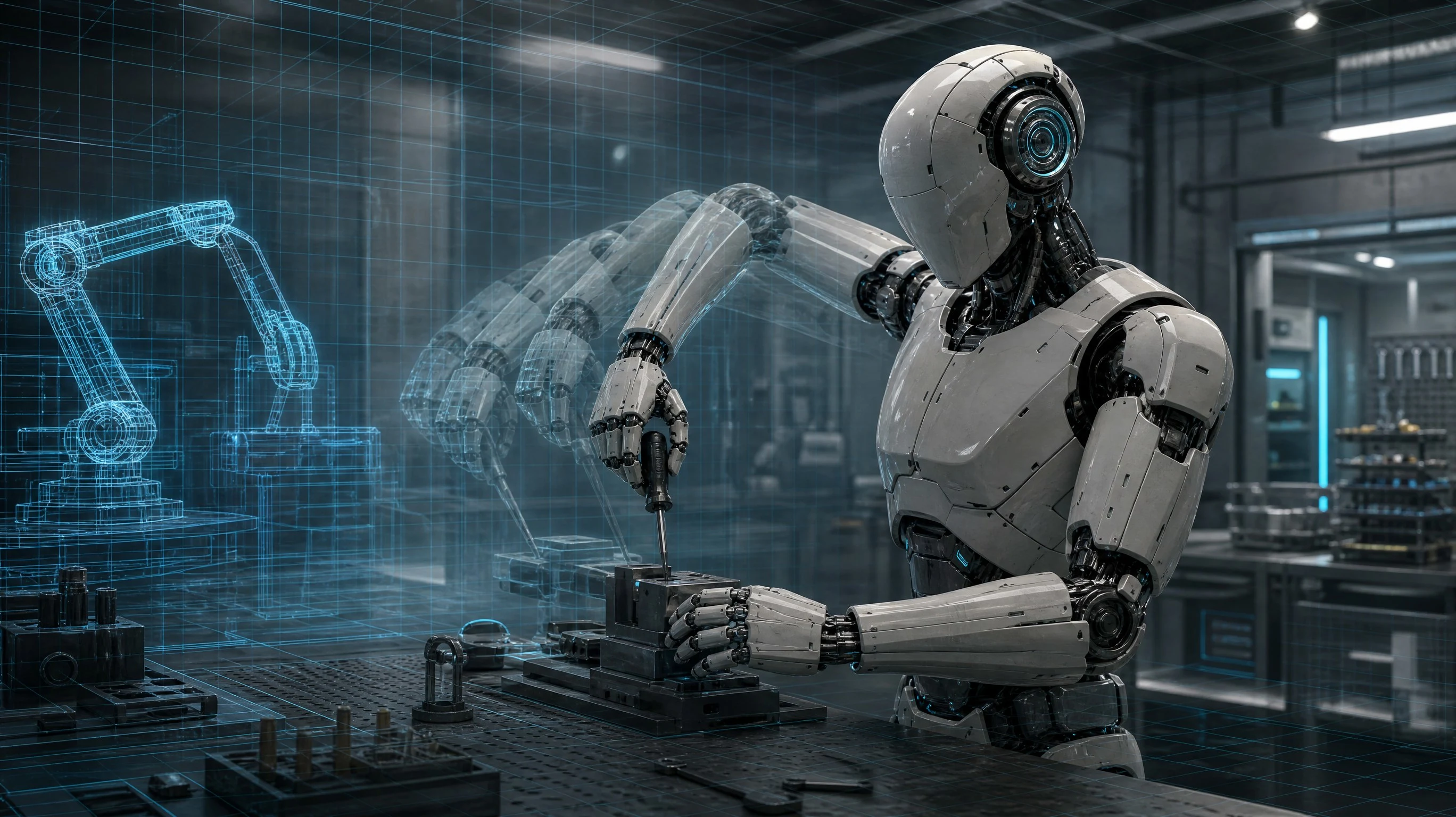
First the model reads the instruction and the scene. Then it predicts what will happen if it acts a certain way. Then it converts that prediction into an actual motor command.
Most robot systems split those steps across separate components, with a planner handing tasks to a controller. Splitting works, but errors compound at each handoff.
WRAM's promise is fewer handoffs. One model reasons, predicts, and acts, so a bad prediction gets caught before the arm commits to it.
Whether that's a real architectural advance or a renamed pipeline is hard to judge from a launch video. AgiBot says it has results.
The Benchmarks AgiBot Is Claiming
The company says GO-3 ranks first on three embodied AI leaderboards: RoboDojo, RoboTwin, and RoboColiseum. It also puts real-world task success around 85%.
Both numbers come from AgiBot. No outside lab has reproduced them, and the leaderboard results are self-reported.
That's not a reason to dismiss the numbers, just to hold them loosely until the open-source release lets someone else check the work.
How the Model Learns: Human Video and Robot Tracks
GO-3 trains on two kinds of data, and the pairing is the interesting part.
The first is first-person human video. Footage of people picking things up, folding laundry, clearing a counter. Humans are good at this and there's a lot of footage, but a camera strapped to a person doesn't record forces, grip pressure, or the exact joint angles a robot needs.
The second is robot trajectories, where every visual observation is paired with the physical action taken and the result that followed. That data is expensive to collect and directly usable.
Combine them and the goal is transferable skill. The human video teaches what a task looks like and roughly how it unfolds. The robot data teaches what the same task costs in motors and torque. A model trained on both can recognize a new kitchen mess and have some idea how to attack it.
AgiBot describes three stages: pretraining across household, kitchen, and multi-robot settings; post-training; then deployment. The claim attached to pretraining is the ambitious one. It says the model can attempt unfamiliar tasks without a separate fine-tuning run for each new motion.
Genie Evolver and the Hundred-Robot Loop
Post-training is where the company puts most of its engineering.
The system is called Genie Evolver. It takes data from roughly a hundred physical robots and mixes it with physics simulation and world models, then lets robots practice, get scored, and improve inside the simulated environment.
Simulation is how robotics dodges the cost of real practice. A robot that drops a cup in simulation learns something without breaking a cup, and it can run that attempt a thousand times overnight.
The catch is the gap between simulated physics and the real thing. A model tuned to a simulator's friction model can be excellent in the sim and clumsy on a real counter. AgiBot's answer is to keep a hundred real robots feeding the loop, so the simulation keeps getting corrected by actual outcomes.
The Demos AgiBot Showed
Four demos, all filmed by AgiBot.
A robot played tabletop curling and, after four hours of online practice, beat the average of the humans it was tested against. Another pulled five blocks in a row out of a stacked tower without the tower falling, which requires judging how the remaining blocks will shift after each removal.
A third made jianbing, the Chinese crepe, from a small number of demonstrations. Multi-step cooking is a decent test because the steps are ordered, the ingredients deform, and a mistake early on ruins the result.
The fourth assembled LEGO after fine-tuning, with an AI agent coordinating the individual steps.
A separate framework called Genie Master ties decision, execution, and feedback together, so a robot can notice its own errors and keep what it learned. In the demo, a G2 robot worked a real convenience store.
None of these prove general competence; what they show is a system that can be pointed at tasks with visible success criteria and left alone to practice.
Worken: Counting Hours Instead of Units
The most interesting idea at the event wasn't a robot. It was a metric.
AgiBot proposed Worken, a word built from work and token, defined as Effective Intelligent Work Hours. The formula multiplies three things: the number of active robots, the hours each works autonomously, and an output efficiency ratio.
Each term carries a rule that quietly excludes the flattering interpretation. Only robots actually doing work count, not units built or sitting in a warehouse. Only autonomous working time counts, not time switched on. The efficiency ratio normalizes output against what a human worker would produce under the same operating standard.
The point is to move the industry's scoreboard from how many humanoids a company shipped to how much useful work they did. Delivery counts are easy to inflate, while hours of acceptable output aren't.
It's also self-serving, since AgiBot gets to define the third term. A metric proposed by a vendor is a marketing document until someone else adopts it.
What the Claims Still Need
What would turn this launch into evidence? Three things.
Independent benchmark runs, which the open-source release makes possible for the model but not for the hardware. Long-duration deployments where a robot works a full shift with nobody resetting it. And cost per hour, which no humanoid company has put on a slide next to Worken.
Until then, the honest summary is that AgiBot has shown a coherent design and a set of controlled demos. That's more than most humanoid launches deliver. It isn't proof that the machines are ready for a store with no staff.
The Rest of the Shanghai Launch
The other announcements fill out the picture. AHA3 is the third generation of AgiBot's humanoid hardware, described as the first commercial platform unifying mobility, interaction, and manipulation.
WITA-Omni is a full-modal interaction model. The G2 Max is a heavy-duty dual-arm industrial robot with 21 degrees of freedom and 40 kilograms of payload per arm. Link-U OS 1.0, the robot operating system, also opens up by the end of 2026.
The pattern across all of it comes down to vertical integration. AgiBot wants to own the model, the body, the operating system, and the way its work gets measured. That's a strong position if the robots work. It's an expensive one if they don't.