Dek: A book that's several times full tells you how a deal was sold, not how it will trade. Anthropic's roadshow is a lesson in that gap, and in how far apart the valuation estimates have drifted.
What the Anthropic IPO order book looks like this week
Bloomberg reported on November 11 that Anthropic's IPO was multiple times oversubscribed as the roadshow got under way, and Quartz reported the same demand picture the same day. Investors have asked for several times the shares on offer, at the indicative range.
None of them have bought anything yet. Orders in a book are indications of interest, and they can be cut, repriced or pulled before the deal prices.
What Anthropic oversubscribed actually means
Start with the mechanics, because the word gets used as a verdict when it's a measurement.
A bookrunner collects orders during the roadshow, sorts them by price and by size, then uses that list for two decisions. Where to set the final price, inside the range or above it. And who gets shares when the deal is four times covered and there isn't enough to go round.
That's the signal. It's a statement about marketing and allocation. Yahoo Finance and other commentary made the same point this week, and it's the least exciting and most useful part of the story.
Bookbuilding, not fortune telling.
A hot book also has a cost for the company. Every share sold to a flipping hedge fund is a share not held by a long-only fund that would have stayed, and bookrunners know it. Allocation is where they try to fix that.
The arithmetic behind the Anthropic valuation fight
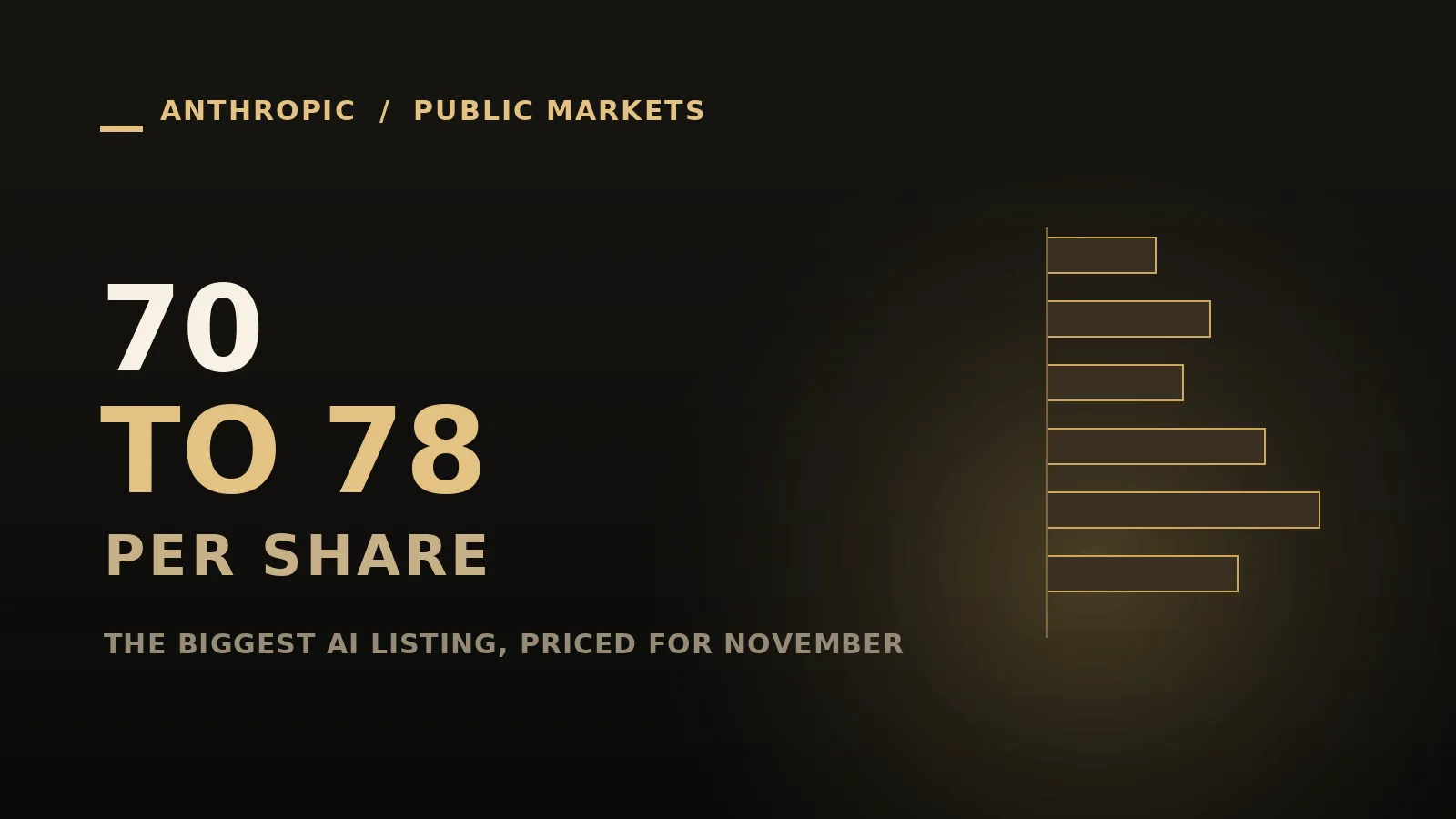
The filing gives us numbers to work with. On November 10 it showed 825 million shares at $70 to $78, which is up to about $64.4 billion, plus a separate $26 billion private placement. Add the two and the deal moves up to roughly $90.4 billion of stock.
Then there's what the company itself is worth, and here the reporting splits. Reuters said the filing targeted a valuation of up to about $1.02 trillion, below the $1.5 trillion that had been discussed. CNBC reported that investors now see $1 trillion to $1.25 trillion as the more likely landing zone. The Financial Times reported on November 11 that bankers were preparing to lift the number to $1.5 trillion or more.
Why is the range still $70 to $78 if demand runs several times over? Because a range gets set before the book closes. Lifting it comes later, once the bankers can see the orders.
Three outlets, three numbers, one roadshow. Treat the Anthropic valuation as a live argument rather than a fact you can look up.
Why the Anthropic Nasdaq listing pulls in two kinds of buyer
Demand this deep needs an explanation, and there are two candidates.
The first is scarcity. No listed company is a pure play on frontier model development, so a fund that wants the exposure has almost nothing else to buy. Index inclusion adds a mechanical bid on top: once a company this size joins a major index, passive money has to own it whether or not a manager likes the price.
The second is strategic. Coverage reports that Nvidia and Alphabet each agreed to buy about $10 billion of stock at the IPO price. Neither company has confirmed that, and the figures come from reporting rather than from a filing.
If those commitments are real, a supplier and a cloud partner are buying into a customer. Keep that in mind when the Anthropic stock starts trading, because strategic holders behave differently from index funds on the day the lock-up expires.
The listing itself is on the Nasdaq Global Select Market under the ticker ANT, following an S-1 filed in late October.
The case against chasing Anthropic stock at any price
The bull case writes itself. Revenue went from about $11.6 billion in the second quarter to about $17 billion in the third. First-half revenue came in at $16.29 billion, roughly 14 times the same period a year earlier.
Now the other column. The amended filing on November 2 disclosed about $895 billion of purchase commitments and leases, almost all of it tied to compute and infrastructure. Compute reached roughly 58% of revenue in the third quarter. Those two numbers describe a business that has to keep spending to keep growing, at a moment when the market has started asking whether the spending pays.
The first-half net loss of $80.7 billion looks terrifying until you read the note underneath it. About $72.4 billion is non-cash fair-value accounting on convertible notes, derivative liabilities and SAFEs. That's an accounting mark, not cash leaving the building. It still tells you how much of the capital structure is priced off the share price.
Then there's the market it lists into. The Nasdaq fell more than 5% on November 5, its deepest one-day drop in 19 months, as investors questioned AI infrastructure spending after the US midterms. A deal this size doesn't arrive in a calm room.
What to watch when the Anthropic IPO prices
Three things matter more than the headlines.
The final price, because a lift to the top of the range, or above it, gives the clearest public sign of how the book was read. The first-day close, because that's the only measure of whether the buyers who missed out on allocation are still interested at the new level.
The third is the lock-up. An Australian retail offer through broker Stake was scheduled to open on November 12 and close on November 17, and trading has been reported as expected in the second half of November. Employees and early investors get free to sell months later, and a full book today says nothing about how crowded that exit becomes.
One more number worth holding onto: Dario Amodei will control 50.1% of shareholder voting power after listing, and a long-term benefit trust will elect a majority of the board. Buyers get the economics and very little of the control.
A hot book is good news for Anthropic's bankers. It's a weak basis for deciding what you'd pay, and the difference between those two things is the whole story.