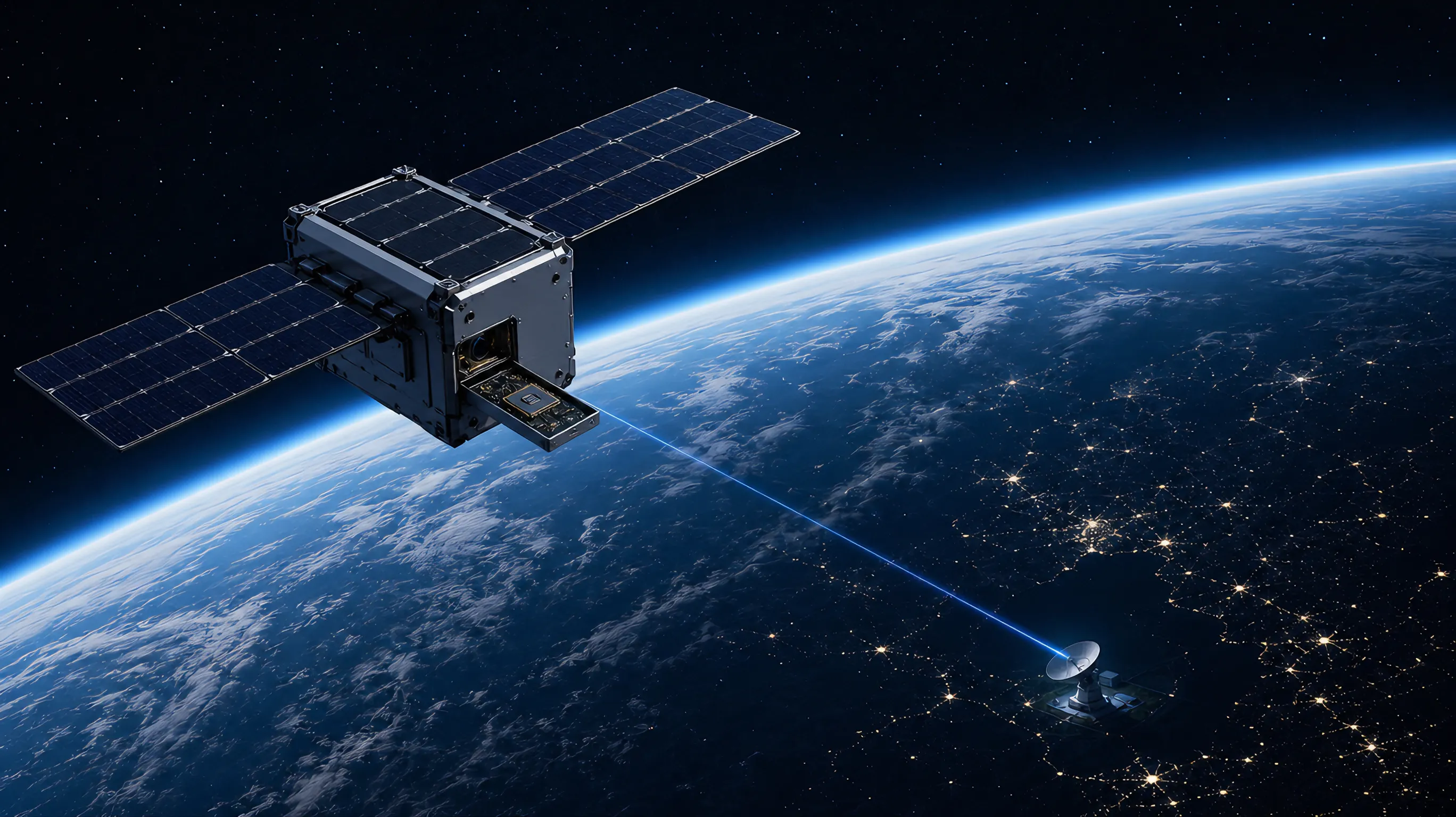
A prototype satellite ran a language model in orbit this week and sent back a poem. The test was small by design. Speed isn't why Google wants data centers in orbit.
Project Suncatcher Got Its First Reply From Orbit
Google says it has received an AI response from a data-center-class chip in orbit, a first for the company. The prototype launched on October 1 aboard a SpaceX Falcon 9, in a rideshare that carried more than 100 spacecraft.
The satellite holds four Tensor Processing Units, the chips Google designs for machine learning work. Power on board peaks near 1 kilowatt, which is enough to run one chip at a time for roughly 20 minutes per pass.
Google calls the result a Hello World milestone: the smallest proof that the parts work together. None of this sells anything yet, and the company doesn't pretend otherwise.
How the Orbital TPU Test Worked
The team spent about three weeks on basics before a model ran. Power delivery came first, then the tray that holds the chips, then early machine learning checks. Small problems, each one solved from the ground.
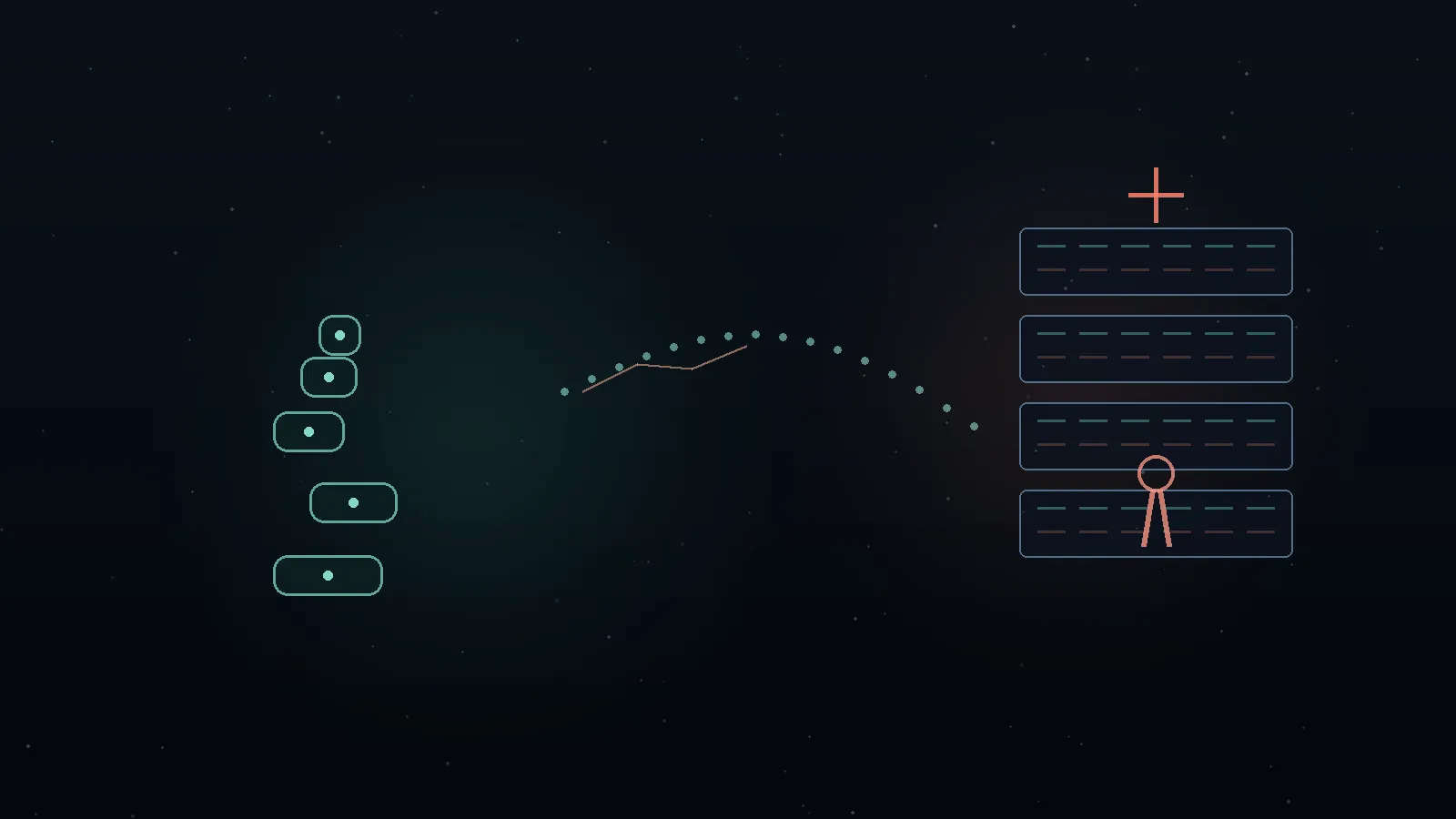
For the first prompt, a ground station uploaded a single request to Gemma 4, an open model Google preloaded on the satellite. The task was to write a haiku about being in space. The reply came down when the satellite passed a ground station in Svalbard, Norway, well inside the Arctic Circle.
Blue marble below Data streams in silent grace Starlight feeds my core.
Two more prompts followed. One asked for a space-themed limerick. Another asked for a telemetry-style report on the status of the payload systems, the kind of message a satellite operator reads every day. A Google spokesperson told TechCrunch the satellite is operating nominally.
Why Google Wants Data Centers in Space
The usual assumption is that space hardware exists to cut latency. That isn't the argument here. Google's case rests on power and cooling, the two costs that squeeze terrestrial data centers hardest.
Solar panels in orbit collect without weather, night or land disputes. Heat radiates into empty space instead of into a cooling plant. The Suncatcher team frames orbital infrastructure as something that becomes economical in the 2030s, not next year.
There's a cost floor that has to fall first. A peer-reviewed analysis from the team estimated that SpaceX would need roughly 1,800 Starship flights to reach the learning-curve savings that early rockets achieved. TechCrunch reported the figure in October and noted that the article's headline said 1,600 while the body said 1,800. Treat both as estimates.
Alphabet, Google's parent company, holds a large stake in SpaceX, which doesn't make the economics work on its own but does shape who Google talks to about launch capacity.
The Radiation Problem TPUs Face in Orbit
Space is hard on electronics in a way that labs can't fully copy. Charged particles strike memory cells and flip bits, turning a stored 1 into a 0 without any error flag. On the ground, that's a rare event. In orbit, it's routine.
Google tested this at particle accelerators before launch. Those runs suggested radiation hurts inference less than it hurts training. Inference is the cheaper job: run a finished model and produce an answer. Training updates billions of weights over days, so one corrupted value can poison the whole run.
Now the team wants the real environment. The next round of tests looks at thermal stress and at radiation effects on working chips, with monitoring designed to catch corruption that doesn't announce itself.
How Suncatcher Differs From Other Space Compute Plans
Google isn't alone up there, and the approaches split cleanly.
Google's Project Suncatcher
- Goal: many satellites joined by high-speed optical links
- Workload: coherent distributed load, where chips share one job
- Timeline: two satellites in 2027, economics in the 2030s
Single-satellite inference
- Who: Starcloud, Cowboy Space and similar outfits
- Workload: one satellite running one model on its own
- Trade-off: simpler to build, but no shared pool of compute
SpaceX also uses laser links for its own data center plans. Google's team argues the orbital spacing is too wide for that to work as a shared pool. Two satellites hundreds of kilometers apart can talk to each other. They can't pretend to be one machine. Closing that gap is the engineering problem Suncatcher exists to solve.
What Has to Happen Before Orbital AI Pays Off
The near-term roadmap hinges on the current chips. If they hold up under radiation and heat, Google plans to launch two satellites in 2027 carrying more advanced processors, with more power available and a demonstration of the optical link between them.
That link is the whole point. One satellite running a model is a curiosity. A constellation that shares work across spacecraft is infrastructure, and infrastructure is what Google says it's building.
There's a long stretch between those two things. Power budgets, thermal design and launch cadence all have to improve, and only one of the three sits inside Google's control.
What the Suncatcher Test Doesn't Prove
The milestone is real, and it's small. One chip ran for about 20 minutes at a time. The model answered three prompts. No customer traffic touched the hardware, and no service depends on it.
What the test does show is that the plumbing works: power, thermal control, uplink, downlink, and a model running on silicon that sits outside most of Earth's atmosphere. That part had never been done before.
So is this the start of orbital cloud computing? Not yet. Everything beyond the demo is a question of scale, cost and time, and Google's own timeline puts the answer in the next decade. If the 2027 satellites fly and the optical link holds, orbital compute stops being a thought experiment. Until then, the honest reading is a satellite that can write a poem and a plan that runs to the 2030s.