
OpenAI dropped hundreds of math papers on an already startled field. There's just one problem: nobody outside the company can fully verify them yet, and the model behind most of the work doesn't have a name.
What OpenAI Put in Its Math Repository
On October 6, a GitHub repository called openai/math appeared, and it held more than a title and an abstract. The catalogue contains 722 manuscripts grouped into 372 research families, where a family bundles a main result with the arguments, consequences, or alternative proofs that support it. OpenAI published the collection the same day as a post titled "Sharing AI progress in mathematics."
The papers span pure mathematics, theoretical computer science, and mathematical physics. OpenAI says the results solve or meaningfully advance important open problems in those areas. If that claim holds, it would rank as one of the largest single contributions to the field in recent memory. What's unusual is the packaging. Alongside the manuscripts sit formalizations of many proofs in Lean. That's a programming language built to check, step by step, whether a proof is valid.
The Unnamed Model Behind the 722 Papers
The most striking detail is who did the work. According to OpenAI, a single unnamed internal frontier model produced the manuscripts. No product name. No pricing. No API. The company calls it "unreleased" and gives no timeline for when that changes.
OpenAI drew a careful line around its own role. It says it helped prepare the manuscripts and formalized the proofs. It takes responsibility for their correctness, while the mathematical arguments themselves were generated by the system. In plain terms, OpenAI is vouching for the write-up and the machine-checkable proof, not for every mathematical idea as human-authored insight. That distinction is the one to keep in mind when you read the headline claims.
Why Lean Proofs Matter for AI Math
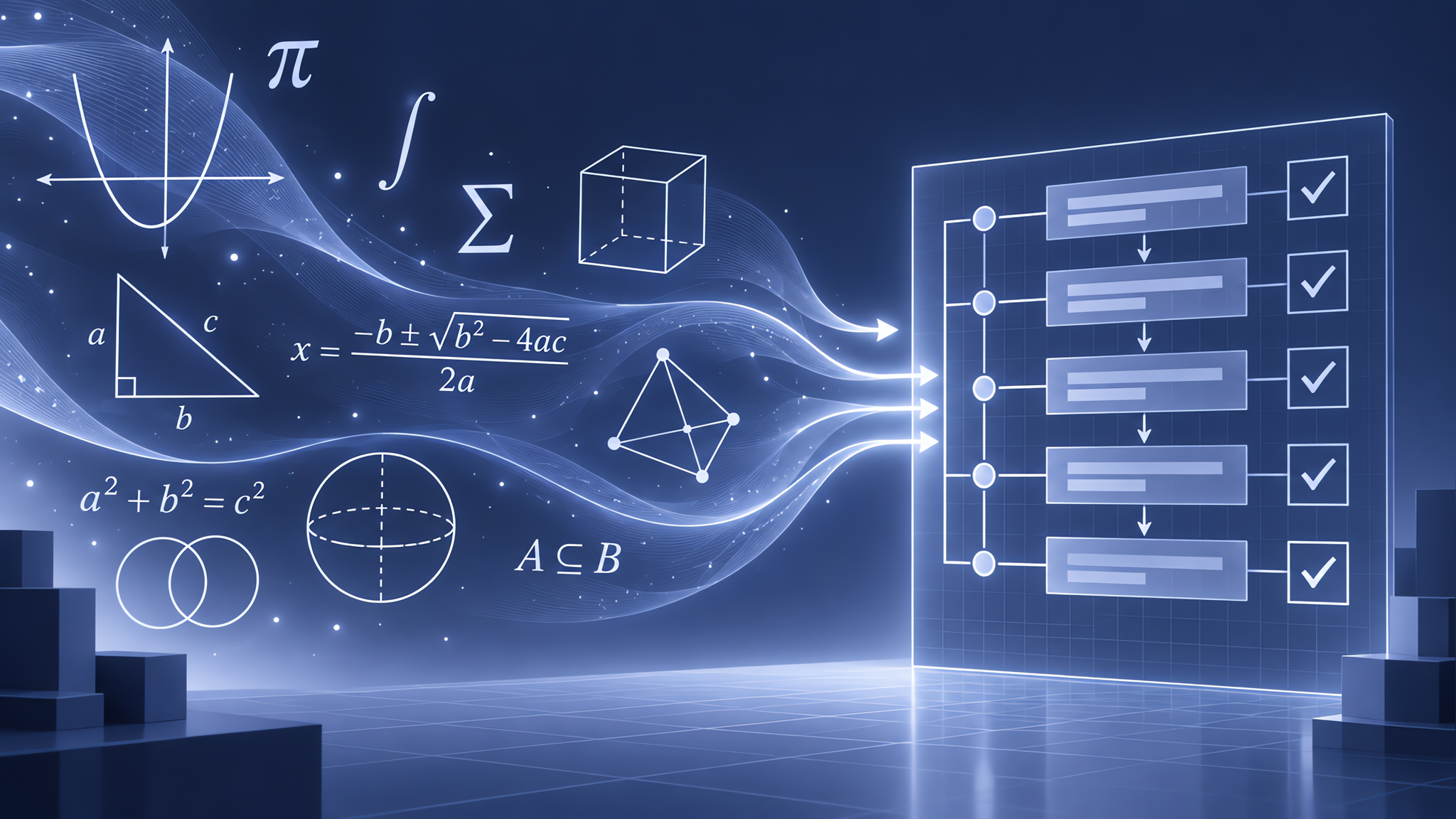
What does Lean have to do with math papers? Here's the short version. A Lean proof is a chain of steps a computer can verify, one by one, without trusting the author. That's why it's a big deal for AI-generated math. A model can write a convincing-sounding proof that's subtly wrong, and Lean is one way to catch it.
But formalization is imperfect as a filter. Not every manuscript has a Lean proof attached, and reports note that independent checks of the formalizations haven't been done evenly across the set. OpenAI formalized many proofs, not all of them. So the collection is best read as a mix. Some results carry machine-checkable backing. Others rest on the paper's argument alone.
What the Math Community Is Saying About OpenAI
The reaction has been somewhere between curiosity and whiplash. Scientific American framed the release as a shake-up for "a field already in shock," a nod to how fast AI has moved into territory mathematicians once considered their own. The repository adds hundreds of new claims to a discipline that moves slowly by design. A single proof can take years to absorb.
Independent verification is the sticking point, and it's slow by design. Math moves at its own pace, and 722 manuscripts can't clear peer review overnight. Until reviewers and proof-checkers work through the set, the honest stance on many results is "promising, unconfirmed." Reports also suggest OpenAI shared an AI-generated take on the Navier-Stokes millennium problem, complete with a Lean proof. Claims of that size invite the closest scrutiny.
What Comes Next for AI Mathematics
The immediate task is verification, and it will take time. Mathematicians will work through the Lean formalizations for months to come. Some results will fall. Others will hold. OpenAI says future releases will improve citations and how results are presented, which points to a series, not a one-off. The bigger question the repository raises isn't whether AI can generate math, but whether anyone can check it fast enough to trust it.