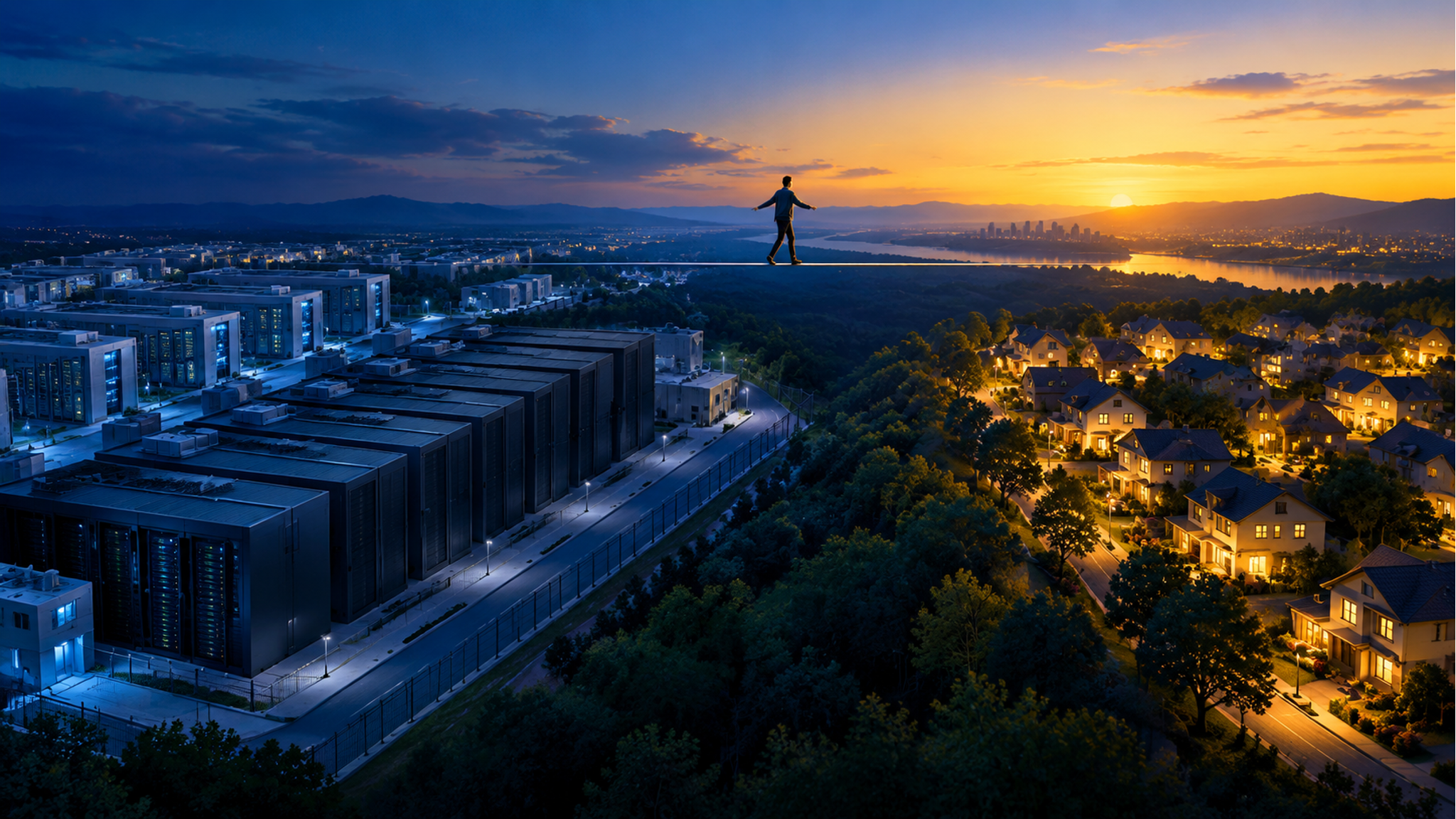
OpenAI says its next data centers will dial themselves down when the power grid is struggling. The first test is in Georgia, where the company has promised up to 1,000 megawatts of flexible demand. Whether that promise binds anyone is a separate question.
What OpenAI Signed Up For in Grid Protectors
The program launched on November 2. Under Grid Protectors, campuses OpenAI builds for itself would reduce electricity use when the local grid comes under strain, under arrangements designed with utilities, regulators and policymakers.
The framing matters. This isn't a pledge to build less. It's a pledge to be interruptible, the way a factory might agree to pause a production line during a heat wave in exchange for a lower rate.
OpenAI says it will cover the full infrastructure and power service costs for the Effingham County project in Georgia. That line is aimed at the argument that data centers get their connections subsidized by everyone else on the system.
OpenAI's Effingham County Site: 1,000 Megawatts of Flexible Load
The Georgia site is the first, and the numbers are large. The agreement with Georgia Power includes up to 1,000 megawatts of flexible demand response, which is a utility term for load a customer agrees to cut when asked.
For scale, OpenAI says that capacity equals the average electricity demand of about 700,000 homes, more than Washington, D.C. and Boston combined.
Read the word "up to" carefully: it's a ceiling, not a schedule. How often the campus is asked to curtail, and how much it actually sheds, depends on grid events that haven't happened yet.
How an OpenAI Campus Cuts Power Without Going Dark
What would a curtailment actually look like? The mechanics vary by site. OpenAI says it will use on-site generation or storage, depending on local conditions and the equipment available, with batteries and power controls smoothing the change.
That's the standard toolkit for large industrial customers. A battery bank can absorb a sudden drop in supply or cover a short spike in demand. On-site generators can carry a portion of the load when the utility asks for relief.
The open questions are the ones that decide whether this works. How much load can be shed, how quickly, and for how long. OpenAI says those figures differ by location and that more commitments will be finalized later. Until they're set, the 1,000 megawatt figure describes potential, not performance.
Consider what a training run needs. A large job spanning thousands of accelerators doesn't pause gracefully. Cutting power mid-run can waste days of work. The kind of load a campus can drop without damage is often the cooling, the ancillary systems, or jobs that were going to be scheduled later anyway.
The Cost Argument OpenAI Is Making
The company's case rests on how utilities recover fixed costs. Transmission lines, substations and transformers cost money whether or not they carry power at any given moment, and those costs land on ratepayers through regulated charges.
If a large customer uses more power when the system has spare capacity and less when it's tight, the argument goes, that customer helps spread the fixed cost instead of adding to it. And it reduces the need to build peaking plants that run a few dozen hours a year and charge accordingly.
OpenAI's phrasing is blunt: households and small businesses shouldn't subsidize the electricity demands of compute campuses. That's a political statement as much as an economic one, and it's aimed squarely at the audiences that have been blocking projects.
Georgia Power's projections, which are the utility's own, put annual customer savings from its large load portfolio at about $950 million starting in 2029. That portfolio includes Project Camellia, an associated data center development. For a typical household using 1,000 kilowatt hours a month, the utility estimates at least $15 in monthly savings.
Treat those numbers as forecasts from parties with an interest in the outcome. No independent body has audited them.
Why Georgia Is OpenAI's First Grid Protectors Test
Georgia has become a frontline state for data center growth, and Effingham County sits near the coast outside Savannah, where power and land have been available.
The state also has a regulated utility market, which changes the negotiation. In a regulated system, a utility like Georgia Power proposes rates and infrastructure plans to a public commission. A special contract with a huge customer usually becomes a public filing, open to intervention by consumer advocates.
That's slower than signing a private power purchase agreement. It's also more visible, which is presumably part of the point. A deal that shows up in a commission docket can be cited as precedent in other states.
OpenAI's other builds run through Stargate, its joint venture with Oracle and SoftBank, with sites in Shackelford County and Milam County in Texas and Doña Ana County in New Mexico. Those projects give the company a portfolio of locations, and a portfolio is what makes flexible load useful. A campus that can shift work between sites has more room to absorb a curtailment request than one that can't.
What the Grid Protectors Announcement Leaves Out
Four things are missing from the program as described.
There's no independent audit. A company that reports its own curtailment performance is asking the public to trust the meter readings.
No penalties appear anywhere in the program. OpenAI describes a voluntary arrangement with case-by-case agreements. Nothing in the announcement says what happens if a campus doesn't deliver the promised reduction during a grid emergency.
There's no uniform standard. Each site negotiates its own terms with its own utility, so the meaning of "Grid Protector" will vary from county to county.
And there's no substitute for construction. OpenAI says itself that flexibility can't replace investment in new generation and transmission. Demand response buys time. It doesn't add a power plant.
The State Data Center Laws Moving Faster Than Voluntary Deals
The backdrop is a wave of local opposition. BNEF expects US data center capacity to pass 100 gigawatts by 2030, and communities that host the buildout have noticed.
Tennessee, Florida, Oklahoma and Oregon have passed laws aimed at preventing AI companies from pushing energy costs onto residents. New York and other jurisdictions have imposed moratoriums on new data center connections.
Against that, a voluntary program is a softer instrument than a statute. It can move faster, and it can be tailored to the needs of one utility and one county. It can also be withdrawn, and it depends on the company's willingness to keep paying for infrastructure it might not need.
The naming change tells you how much of this is about politics. OpenAI now calls its data centers compute campuses, a phrase that sounds like a university and not an industrial load. The Verge noted the shift. A rename doesn't change a megawatt, and neither does a press release.
What to Watch Before 2029
Two dates matter. The first is the fine print in the Georgia agreements, because those documents will have to state actual curtailment terms rather than a ceiling. The second is 2029, when the projected savings are supposed to begin.
Between now and then, the useful question isn't whether OpenAI is sincere. It's whether the contracts contain numbers a regulator can check, and whether anyone outside the company gets to verify them.