

24/7.ai
[24]7.ai · Marketing · Chatbot
[24]7.ai is an enterprise customer engagement platform that pairs AI virtual agents with an omnichannel agent console, so companies automate self-service and resolve support queries faster.
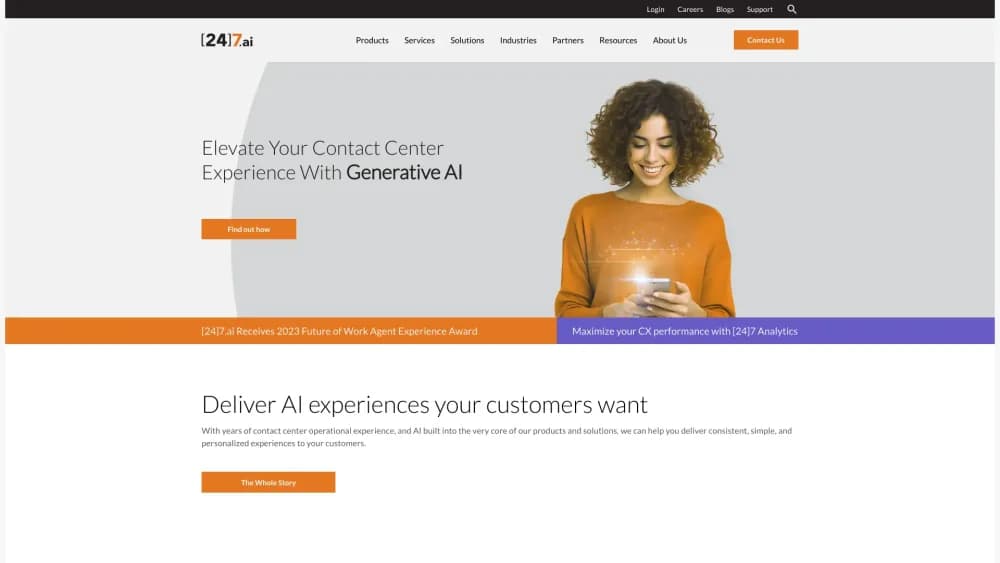
About 24/7.ai
What Is [24]7.ai
[24]7.ai is a customer experience platform that large brands use to handle support and sales conversations across voice, chat, messaging, email, and social channels. It puts two things on one system: AI virtual agents that answer customers on their own, and a console that helps human agents pick up the harder cases. The company sells it as [24]7 Engagement Cloud.
The problem it targets is cost and wait time in contact centers. A large share of incoming questions are repetitive, and routing every one to a person is expensive. [24]7.ai answers those automatically, hands off anything tricky to a live agent with the full conversation history, and gives supervisors dashboards and recordings to check quality.
The limit is what it is not. This is enterprise software aimed at companies with real contact center volume, not a plugin a solo site owner installs in an afternoon. Pricing is quoted rather than published, deployments involve integrations with existing CRM and telephony systems, and the self-service tooling assumes you have intents and content to model. Smaller teams usually do fine with lighter chat tools.
Getting Started
- Talk to [24]7.ai about your channels, call drivers, and current contact center stack. The product is scoped and priced per engagement, so there is no self-serve signup.
- Connect your systems. The platform integrates with CRMs, telephony, and messaging channels so conversations and customer context flow into one place.
- Build virtual agents. Teams model intents from prebuilt vertical ontologies, write dialogue with a code-free builder, and publish to voice and digital channels from one model.
- Turn on the agent console for live support. Human agents handle the escalations, with AI next-best actions, knowledge at hand, and automatic summaries.
- Measure and tune. Conversation Insights records calls and screens, scores agents, and surfaces where automation should be extended.
Product Information
A quick look at 24/7.ai's pricing, supported platforms, and performance.
Best for
The users, tasks, and scenarios where this tool fits best.
Users
- Large contact centers
- Telecom, retail, and financial services teams
- Customer experience and operations leaders
Tasks
- Deflecting routine support queries
- Handling overflow and after-hours demand
- Quality assurance across channels
- Running outbound and personalized campaigns
Scenarios
- A retailer facing seasonal call spikes
- A telecom provider modernizing its IVR
- An airline managing a disruption
Key features
Conversation Automation and Virtual Agents
The core of the platform is conversational AI that handles customer questions on voice, chat, and messaging without a person. It uses natural language processing to read intent rather than keywords, so a bot keeps the thread when a customer phrases a request loosely or makes a typo. Teams build dialogue once with a code-free builder and publish it to every channel, updating content in seconds instead of shipping new integrations. The company reports that virtual agents handle around 500 million inquiries a year across its clients.
Natural Language IVR and Multimodal CX
[24]7.ai rebuilds the phone menu around AI rather than touch-tone options. The voice system understands accents, dialects, and slang, and it can push interactive visuals to a caller's smartphone so a complex task gets finished without waiting for an agent. Voice2Messaging routes voice callers into chat where it makes more sense. For any company still running a legacy IVR, this is usually the fastest place to cut cost and frustration.
Agent Experience and Copilot
The agent console handles voice, video, messaging, email, and SMS in one screen, with an operational dashboard for queue lengths, wait times, and staffing. [24]7 Copilot layers generative AI on top: it suggests next-best actions, retrieves relevant content as an agent talks, summarizes each conversation into a short note, and scores performance in real time. The pitch is that agents resolve issues faster with fewer transfers, and the company cites double-digit gains in resolution, sales conversion, and satisfaction.
Conversational Intelligence and Analytics
[24]7 Conversation Insights aggregates structured and unstructured conversation data from any source, regardless of the vendor that ran the call. It records 100 percent of calls and screens, supports keyword and full-text search of transcripts, and produces dashboards on agent and contact center performance. Generative AI powers automatic scoring and conversation summaries, so QA teams assess every interaction rather than a sample, and compliance teams catch breaches faster.
Generative AI with BotSafe
The Generative AI suite adds self-serve bots driven by large language models, plus agent assist, auto summary, and conversation simulation for training. Because generative models can drift, [24]7.ai pairs them with BotSafe, a guardrail layer meant to keep answers accurate and safe before they reach a customer. Second-pass classifiers handle uncommon intents and topic drift, which is where plain generative bots tend to fail.
Campaign Management with [24]7 Target
[24]7 Target is the outbound and marketing side. It applies machine learning to personalize web pages, display banners, video ads, SMS offers, and social ads, tuning messages by intent and context. It connects to Facebook and Instagram through APIs, and the company has published client results including higher return on ad spend. For teams that see acquisition and support as one journey, that ties marketing to the same platform as service.
Pros and cons
Pros
- Self-service across voice, chat, and messaging is the core, and the company reports about 40 percent of queries resolved without a human agent.
- Prebuilt intent models for retail, telecom, financial services, and other verticals shorten the path to a working bot.
- Conversation Insights records and scores every interaction, which gives QA and compliance teams full coverage instead of a sample.
- The same platform covers automation, the live agent console, analytics, and outbound campaigns, so teams integrate one vendor rather than several.
Cons
- Pricing is quoted per engagement and not published, so there is no self-serve trial and no way to estimate cost without a sales conversation.
- It is enterprise software. Companies without real contact center volume will find the deployment and integration work hard to justify.
- BotSafe and prebuilt ontologies reduce risk but also lock you into the vendor's models and tooling rather than an open stack.
- Performance depends on the quality of your own intents and knowledge content. Weak source material limits what the virtual agents can resolve.
Frequently asked questions
[24]7.ai is used to run customer support and sales conversations at scale. Businesses automate routine questions with AI virtual agents, hand harder cases to live agents through a unified console, and analyze every interaction for quality and improvement.
Related content
Explore related tools, skills, and articles for 24/7.ai.
24/7.ai Alternatives

ngram 2.0
ngram · Video · Marketingngram 2.0 is an AI video generator for teams. It turns a prompt, a screen recording, or a product URL into a narrated explainer, product demo, or AI avatar video, and every scene stays editable.

shippedit.me
Krawlup · Marketing · Businessshippedit.me now redirects to Krawlup, a web platform that audits SEO, AEO and page speed every week, then hands the fixes to AI coding agents over MCP.

MePersona
MePersona, Inc. · Writing · Productivity · MarketingMePersona is an AI unified inbox for creators. It learns your voice, drafts replies to fan messages from 12 platforms, and sends only what you approve.