
A2A Protocol
Google, donated to the Linux Foundation · Coding
The A2A Protocol is an open standard from Google, now hosted by the Linux Foundation, that lets AI agents from different vendors discover each other and work together.
About A2A Protocol
What Is A2A Protocol
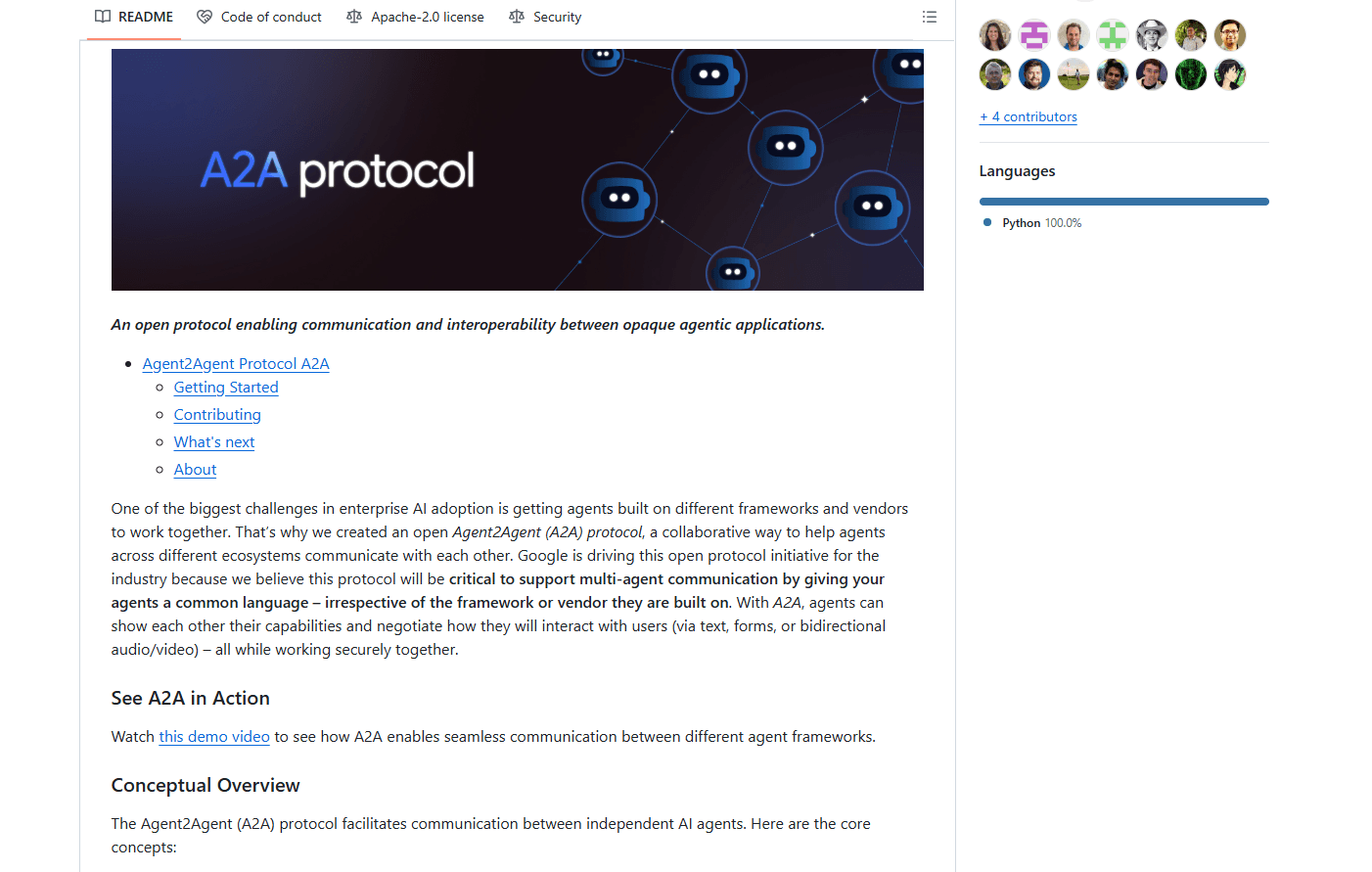
The A2A Protocol, short for Agent2Agent, is an open standard that defines how AI agents talk to one another. It gives agents a common language whether they were built with LangGraph, CrewAI, Semantic Kernel or a custom stack. Google released it in April 2025 and handed governance to the Linux Foundation that June, so no single vendor controls the spec.
The problem it targets is messy in practice. A single assistant often can't finish a real job alone, and stitching together a flight agent, a hotel agent and a currency agent usually means writing custom glue code for each pair. A2A replaces those one-off integrations with a shared set of rules. An agent publishes a JSON Agent Card describing what it can do, and other agents read that card to decide whether to hand off a task.
Two limits are worth knowing before you adopt it. A2A governs communication, not the agent itself, so you still pick a framework to build with and you still handle identity and trust on your side. And because the remote agent stays a black box, you can't inspect its tools or memory, which is the point but also a real constraint when a task fails.
Getting Started
- Pick an official SDK for Python, JavaScript, Java, C#/.NET, Go or Rust, or build against the spec directly
- Define your agent and publish an Agent Card at a well-known URL so clients can discover its skills and endpoint
- Wire up the transport, JSON-RPC 2.0 over HTTP with server-sent events for streaming and webhooks for long jobs
- Test against the sample clients and servers in the A2A GitHub repo, then connect your first remote agent
Product Information
A quick look at A2A Protocol's pricing, supported platforms, and performance.
Best for
The users, tasks, and scenarios where this tool fits best.
Users
- Backend and platform engineers
- Enterprise architects
- AI product teams
- Integration and IT staff
Tasks
- Multi-agent orchestration
- Cross-vendor delegation
- Long-running jobs
- Multimodal exchange
- Capability discovery
Scenarios
- A travel request needs flights, hotels and tours
- A support desk spans three vendors
- A research task runs overnight
- An enterprise replaces a legacy integration
- Two companies partner on a workflow
Key features
Agent Cards for Capability Discovery
Every A2A agent publishes an Agent Card, a JSON file that describes its identity, endpoint, skills and authentication needs. Clients read the card to learn what an agent can do and how to reach it, so discovery doesn't depend on a central registry. The card is the first thing you write when you expose an agent.
Task Management with a Defined Lifecycle
A task is the core unit of work, with a unique ID and a full lifecycle from submitted to working, completed, failed or canceled. That structure lets agents coordinate long jobs and pick up multi-turn conversations, and it produces an artifact, the concrete output of the work. It's the piece that separates A2A from a plain request-response call.
Built on Proven Web Standards
A2A runs on HTTP, JSON-RPC 2.0 and server-sent events, technologies most teams already know how to deploy and secure. You don't need a new stack to adopt it, which cuts the learning curve and makes it easier to fit inside an existing IT environment. It works across cloud providers and on-prem setups alike.
Streaming and Push Notifications
For tasks that take a while, clients can subscribe over server-sent events and receive status and artifact updates in real time. When a client is offline, the server can push a webhook notification on a significant update instead. Together these cover quick jobs and the long ones that run for hours or days.
Opaque Collaboration and Enterprise Security
Agents work together without sharing internal memory, tools or proprietary logic, so each side keeps its own intellectual property. A2A assumes enterprise-grade authentication and authorization by default and treats the remote agent as a black box. That design fits the reality of AI agent communication between companies that each own their own stack, and it keeps the two sides' agent interoperability intact without a shared codebase.
Multimodal, Framework-Neutral Exchange
Messages carry parts that hold text, file references or structured data, so agents can swap more than plain strings. The protocol doesn't care which framework or language built an agent, which is what makes it useful across a mixed environment. If you already use MCP for tools, A2A sits alongside it rather than replacing it.
Open Governance and Official SDKs
The spec lives under the Linux Foundation with vendor-neutral governance, backed by founding members like AWS, Cisco, Google, Microsoft, Salesforce, SAP and ServiceNow. Official SDKs cover Python, JavaScript, Java, C#/.NET, Go and Rust. A public GitHub project carries samples, and a command line tool lets you discover and message agents from a terminal.
Pros and cons
Pros
- Vendor-neutral and open source, so no single company can change the spec on its own
- Reuses HTTP, JSON-RPC and server-sent events, which makes rollout fit existing infrastructure
- Keeps agents opaque, so partners collaborate without exposing internal tools or proprietary logic
- Official SDKs in six languages lower the effort to build and integrate
- Complements MCP rather than competing with it, so you can adopt both
Cons
- It standardizes communication only, so you still pick a framework and handle trust and identity yourself
- Because the remote agent is a black box, debugging a failed task is harder than in a shared-code setup
- The tooling is still young, so not every platform ships a full A2A implementation yet
- Adoption takes real engineering, since a spec and SDKs alone don't run a production agent
Frequently asked questions
The A2A Protocol, or Agent2Agent, is an open standard that defines how AI agents communicate. It lets agents built with different frameworks or by different vendors discover each other, delegate tasks and share results, all without exposing their internal memory or tools. Google released it in April 2025.
Related content
Explore related tools, skills, and articles for A2A Protocol.
A2A Protocol Alternatives

Base Code
Base44 (Wix) · Coding · ProductivityBase Code is a shared cloud development environment from Base44. Teammates describe changes to an existing GitHub codebase in chat, preview them live and send them back as pull requests.

Google EmbeddingGemma 2
Google DeepMind · Writing · Image · CodingGoogle EmbeddingGemma 2 is a 740M-parameter open model that turns text, code, images, audio, and video frames into vectors in one 768-dimension space, running on phones and laptops.

GitGlow
GitGlow · Coding · ProductivityGitGlow is a local-first desktop Git client that lets independent developers review their own code and their AI agents' changes in one place before shipping.