

ActiveCampaign AI
ActiveCampaign, LLC · Writing · Coding · Marketing
ActiveCampaign AI, branded Active Intelligence, adds campaign drafting, predictive sending, and segment discovery to an email marketing and CRM platform.
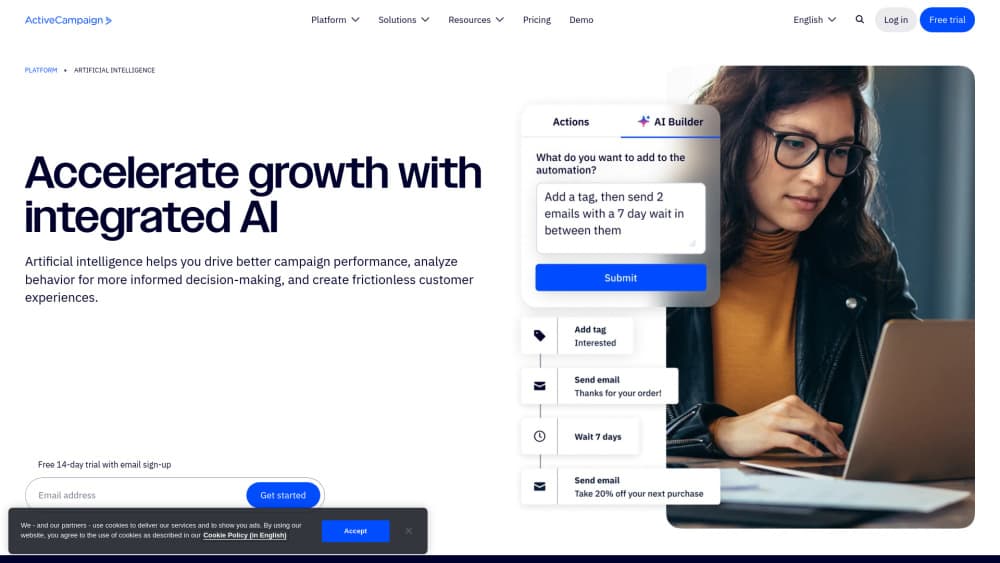
About ActiveCampaign AI
What Is ActiveCampaign AI
ActiveCampaign AI is the set of AI features inside ActiveCampaign, an email marketing software platform that also ships marketing automation and a built-in CRM. The current release is called Active Intelligence. It reads your brand kit, your written instructions, and your past campaigns, then produces campaigns, automations, and segments that already sound like your business.
The product targets a specific kind of drag. Small marketing teams can usually build a flow, but they lose days writing copy, testing subject lines, and rebuilding the same sequence for each audience. Active Intelligence takes a goal typed in plain language and returns a draft you can launch, along with recommendations on timing, segments, and what to fix next.
The limits are worth stating up front. Every plan includes a fixed pool of AI credits, so heavy generation costs extra. The output is a strong first draft, not a finished campaign: you still check claims and approve sends. And everything sits inside contact-based pricing that climbs as your list grows.
Getting Started
- Start the 14-day trial at activecampaign.com and pick a plan. No credit card is needed for the trial.
- Connect your sending domain, import contacts, and finish the deliverability setup so mail leaves from a warmed domain.
- Build a Brand Kit and write Custom Instructions. Say what you sell, who buys it, and how you want to sound. This step decides how good the generated copy turns out.
- Type a goal into the AI campaign builder, for example a win-back sequence for lapsed customers, then review the draft.
- Edit, test, and launch. Approve the send, then let predictive sending and conditional content handle per-contact variation.
Product Information
A quick look at ActiveCampaign AI's pricing, supported platforms, and performance.
Best for
The users, tasks, and scenarios where this tool fits best.
Users
- Small business owners running their own marketing
- Ecommerce stores
- Agencies and consultants juggling several brands
- Sales teams on a light CRM
Tasks
- Writing an on-brand email campaign
- Recovering lapsed customers
- Finding high-value segments
- Testing every send
- Reporting
Scenarios
- A two-person team with no copywriter
- A list that has outgrown manual segmentation
- A launch with a hard deadline
- An agency onboarding a new client
Key features
Active Intelligence Campaign Builder
Type a goal, and the builder returns a campaign with copy, images, layout, and a suggested send strategy. It pulls from your brand kit, your custom instructions, and your best performing past campaigns, so the first draft lands close to final. ActiveCampaign says this gets a first campaign live about eight times faster, a vendor figure rather than an independent benchmark.
Brand Kit and Custom Instructions
The brand kit stores your logo, colors, and fonts, while custom instructions describe your business, audience, and tone in your own words. Together they steer every generated asset, so the output stops reading like generic marketing copy. Set both up before generating anything at scale.
Predictive Sending and Conditional Content
Predictive sending holds each email until the moment a specific contact is most likely to open it, based on that person's past behavior. Conditional content goes further and shows different blocks to different people inside one email. Both arrive with the Pro plan, and both cut the number of campaigns you have to build.
AI-Suggested Segments and Actions
The platform watches engagement and surfaces segments worth targeting, such as contacts drifting toward churn. Suggested actions go further and recommend whole marketing sequences based on anonymized data from other businesses. Treat both as starting points and check the logic against your own list.
Automation Builder with AI Steps
Automations are the core of the product, and the AI drafts them too: describe the flow you want and it writes triggers, emails, and waits. The visual builder still lets you drag steps, add conditions, and branch by behavior. A first complex flow takes some learning, but the AI draft removes most of the blank-canvas problem.
Built-In CRM and Integrations
The CRM keeps deals, pipelines, and contact history beside your marketing data, so a campaign can trigger a sales task. More than 950 integrations cover ecommerce, forms, and other tools, and MCP connectors let you drive parts of the account from ChatGPT or Claude. A public API covers the rest.
Pros and cons
Pros
- The AI works from your own brand assets, past campaigns, and contact data, so output needs less rewriting than a generic tool.
- Predictive sending and conditional content are part of the plan rather than a separate add-on.
- Marketing automation and a real CRM share one database, which keeps sales follow-up tied to campaign behavior.
- More than 950 integrations and a public API cover most stacks without custom work.
- Every plan includes AI credits, and the 14-day trial needs no credit card.
Cons
- There's no free plan. The cheapest tier starts at $15/mo billed yearly, and generative content tools only appear at Plus.
- AI credits are capped per plan, so heavy generation can push you into buying more.
- Contact-based pricing climbs fast as the list grows, and the jump from Plus to Pro is steep.
- Generated copy is a first draft, and the automation builder has a learning curve for anyone new to the tool.
Frequently asked questions
No. ActiveCampaign runs a 14-day free trial that doesn't require a credit card, then moves you to a paid plan starting at $15/mo billed yearly for 1,000 contacts.
Related content
Explore related tools, skills, and articles for ActiveCampaign AI.
ActiveCampaign AI Alternatives

Google EmbeddingGemma 2
Google DeepMind · Writing · Image · CodingGoogle EmbeddingGemma 2 is a 740M-parameter open model that turns text, code, images, audio, and video frames into vectors in one 768-dimension space, running on phones and laptops.

MePersona
MePersona, Inc. · Writing · Productivity · MarketingMePersona is an AI unified inbox for creators. It learns your voice, drafts replies to fan messages from 12 platforms, and sends only what you approve.

Fluence
Yay Software (Yannick Huchard) · Writing · Voice & Language · ProductivityFluence is an Android app that reads PDFs, EPUBs, Word files and web articles aloud, follows each sentence as it speaks, and answers questions about the text on the phone itself.