
adCAPTCHA
adCAPTCHA Ltd · Other
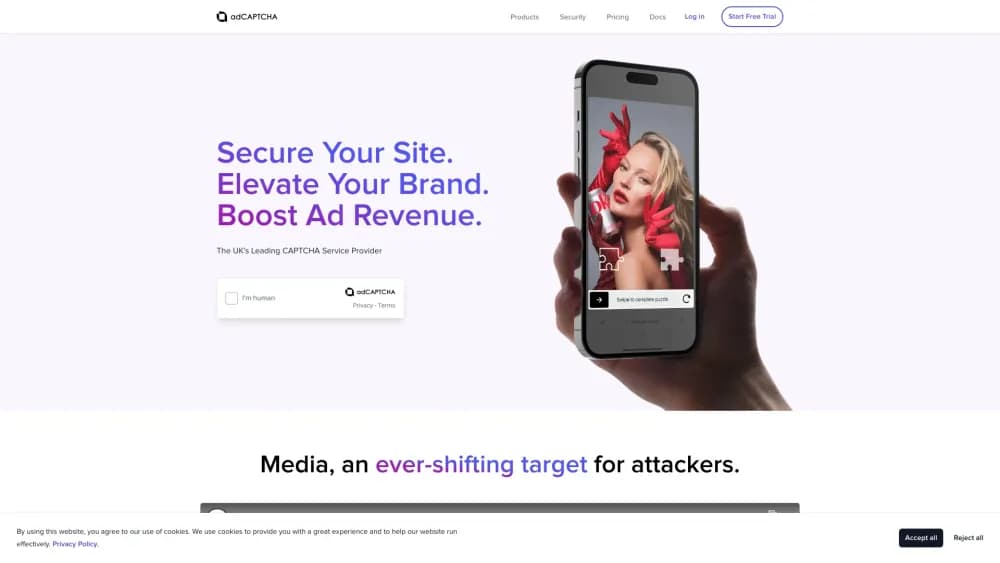
adCAPTCHA replaces puzzle tests with short video or image ads, so visitors prove they are human while your brand gets seen. It sets no cookies and collects no personal data.
About adCAPTCHA
What Is adCAPTCHA
adCAPTCHA is a media based CAPTCHA service built by adCAPTCHA Ltd, a London company founded by Alfie Scarborough. Instead of asking visitors to click traffic lights, it plays a short clip or a still image from your own media library and watches how the person responds. The check works as ad space at the same time.
The pitch is simple. Everyone hates CAPTCHA puzzles, and almost every site needs them. adCAPTCHA takes that forced pause and fills it with content you choose: a product film, a festival trailer, a track from a new album. Four layers of security sit behind the challenge, and the company says it stores no personal data and sets no cookies.
The limits matter too. A visitor who only wants to reset a password still has to watch something before getting through, and verification volume drives the bill. Sites that need a challenge with zero commercial content, or a purely invisible one, are better served elsewhere.
Getting Started
- Create an account at adcaptcha.com and confirm your email.
- Add your site in the dashboard, then upload the video or image files you want to use.
- Install the widget with the JavaScript snippet, or drop in the React, Vue, Angular, or Svelte component.
- Validate the returned token on your server with the Node.js or PHP library, then publish.
Product Information
A quick look at adCAPTCHA's pricing, supported platforms, and performance.
Best for
The users, tasks, and scenarios where this tool fits best.
Users
- Site owners who want a CAPTCHA alternative that doesn't look like a CAPTCHA
- Ecommerce teams fighting card testing and checkout bots
- Publishers and media brands
- Frontend developers on React, Vue, Angular, or Svelte
Tasks
- Replacing reCAPTCHA or hCaptcha on a signup form
- Cutting the drop-off that hard puzzles cause on login pages
- Monetizing verification traffic
Scenarios
- High volume account creation, where thousands of fake signups a day waste support time and storage.
- Limited-stock drops and ticket sales, where checkout bots clear inventory before real buyers arrive.
- Payment pages hit by card testing, where stolen card numbers get checked in small batches.
Key features
Media Based Challenges
Each challenge is a video clip or a still image you upload, in portrait or widescreen, with optional sound. Visitors answer a question about what they just saw or complete a small interaction, and the media changes as your campaigns change. The format makes the check feel like a pre-roll ad rather than a test.
Four Layers of Bot Detection
The bot protection stack combines media variation, behavioural signals, device checks, and token validation on your server. Because your media rotates, the same answer never works twice, which removes the pattern that solver farms rely on. The vendor says the stack also catches AI-driven bots that mimic human timing.
Ad Slots Worth Selling
The CAPTCHA-Media marketplace lists your verification inventory for advertisers, and the dashboard reports completed challenges so you can bill for verified human views. Publishers can also run their own promotions instead. Either way, a step users already resent starts paying something back.
Framework Components and SDKs
Official packages cover React, Vue, Angular, and Svelte on the front end, with Node.js and PHP for server side token checks. A plain JavaScript snippet handles everything else. Most teams report a working install in minutes rather than a sprint.
Audio and Accessible Challenges
Music and audio questions give visually impaired visitors a way through, and the company holds a UK patent application for the approach. That matters for sites with public sector or regulated accessibility duties, where a visual-only puzzle is a compliance risk.
Dashboard Control Over Media and Sites
One dashboard holds your media library, site keys, and campaign schedule. You can swap creative per site without touching code, pause a clip, or load a new one for a launch. Small teams can run the whole verification setup without a developer on call.
Pros and cons
Pros
- The verification step carries your own media, so a friction point becomes promotion or ad revenue.
- No cookies and no personal data collection, which simplifies GDPR and consent conversations.
- Official components for four front end frameworks plus Node.js and PHP libraries.
- Free Basic plan makes it cheap to test on a small site before committing.
- Audio challenges cover visitors who can't solve a visual puzzle.
Cons
- Visitors must watch or inspect media before they get through, which adds time on urgent tasks like a password reset.
- Pricing climbs with verification volume, so heavy traffic sites pay far more than the $29 Pro sticker.
- Brand fit is a real constraint: an ad in front of a login screen annoys some audiences, and you carry that reaction.
- Fewer third party plugins and community answers than reCAPTCHA or hCaptcha, so niche setups need custom work.
Frequently asked questions
It verifies that a visitor is human by showing a short video or image and checking the response, then issues a token your server validates. The media doubles as an ad or brand message.
Related content
Explore related tools, skills, and articles for adCAPTCHA.
adCAPTCHA Alternatives

Odyssey 3
Odyssey · OtherOdyssey-3 is Odyssey's foundation world model. It simulates physics in real time, turns a prompt into an interactive environment, and adapts to robots, cars and games.

JarvisCore
Prescott Data · Coding · Productivity · OtherJarvisCore is an open source Python runtime where AI agents work as equal peers on an agent mesh, claim tasks from a shared ledger, and reach external services through a zero-trust broker.
Clef
Cloudflare · Business · OtherClef is Cloudflare's open-source decision model for Workers AI. It returns calibrated probabilities for typed questions, not generated text, so agents can classify, route, and act fast.