

Odyssey 3
Odyssey · Other
Odyssey-3 is Odyssey's foundation world model. It simulates physics in real time, turns a prompt into an interactive environment, and adapts to robots, cars and games.
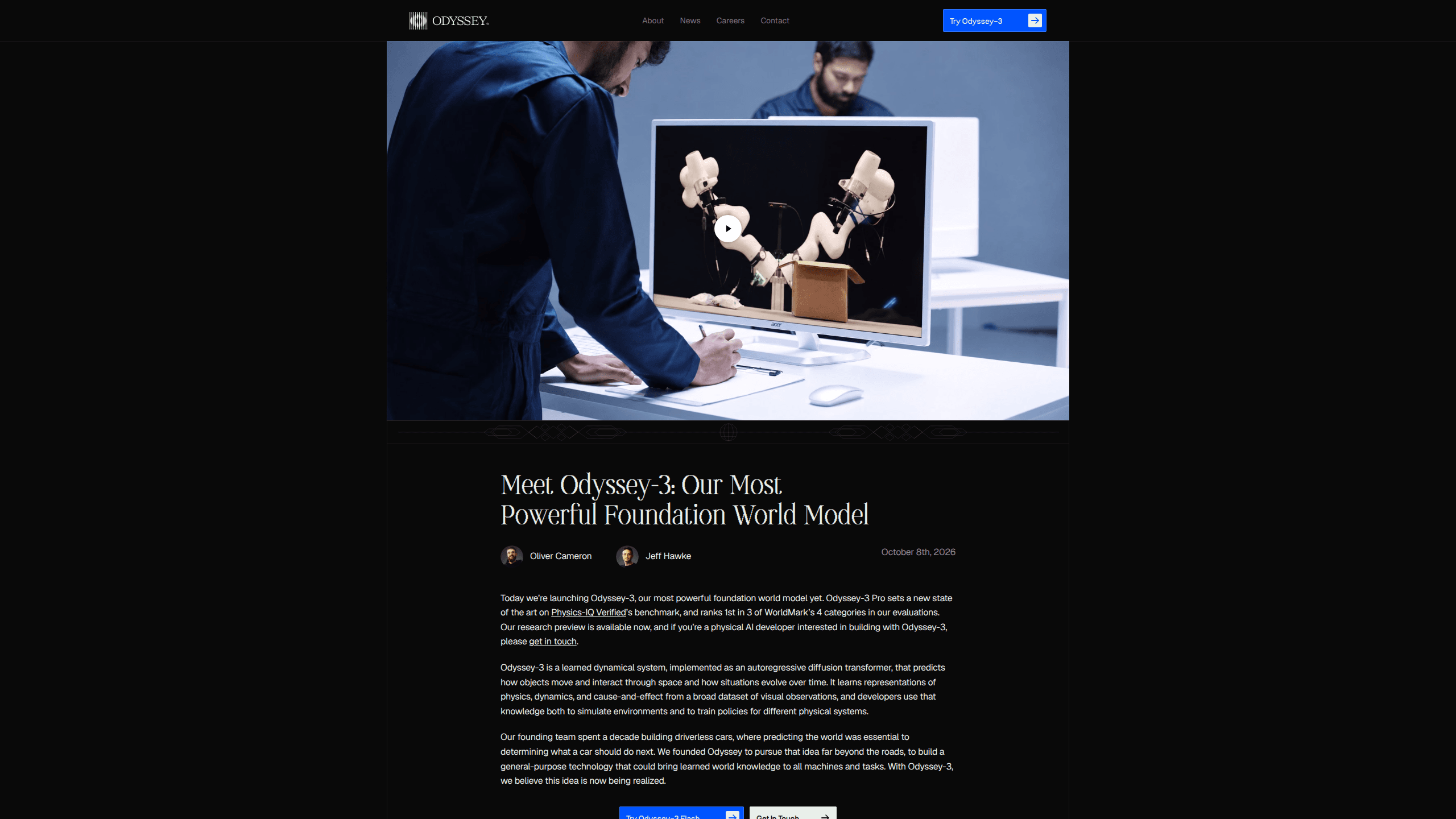
About Odyssey 3
What Is Odyssey-3
Odyssey-3 is a world model built by Odyssey, an AI lab founded in 2023 by Oliver Cameron and Jeff Hawke. A world model learns how the physical world behaves, then predicts what happens next. Odyssey-3 does that in real time: you give it a prompt, it generates an environment, and it keeps predicting how that environment changes as you move or introduce events.
The model is an autoregressive diffusion transformer. In plain terms, it generates video frames step by step, and each new frame is conditioned on the frames before it plus whatever action arrives at that moment. That's what makes the environment interactive instead of a fixed clip. Odyssey trained it on internet video with time-stamped event annotations, gameplay footage paired with keyboard and mouse input, and simulated rigid-body interactions.
Developers come to it for two jobs. One is simulation: generate a world an agent or a person can move through. The other is policy learning: attach a small action decoder or policy trained on paired observations and actions, and the same backbone can drive a robot arm, a humanoid, a car or a drone with far less task data than training from scratch needs.
The limits sit on the access side. Odyssey-3 is a research preview, not a shrink-wrapped product. There's no published price list, no public API documentation, and no self-serve way to download weights. You try Odyssey-3 Flash in the browser, and anything beyond that starts with a conversation with the company.
Getting Started
- Open experience.odyssey.systems and sign in to the research preview.
- Type a prompt that describes a place or scene, then wait for the model to generate the first frames.
- Move through the environment with first-person or third-person controls, and drag the camera independently to inspect what the model predicts.
- Introduce an event or an action mid-generation and watch how the world responds.
- For a robotics or driving project, contact Odyssey about access, then train an action decoder on paired observations and actions from your own hardware.
Product Information
A quick look at Odyssey 3's pricing, supported platforms, and performance.
Best for
The users, tasks, and scenarios where this tool fits best.
Users
- Robotics engineers
- Simulation and game teams
- AI researchers
Tasks
- Training a manipulation policy
- Testing a driving stack
- Generating multi-camera footage
- Evaluating an agent
Scenarios
- A robot arm that drops an object
- A humanoid program with a short data budget
- Pre-visualizing a game level
Key features
Real-time interaction instead of a rendered clip
You can move through a generated scene while it's still being produced, and the model updates what you see as you act. Odyssey-3 Flash is the distilled version built for that loop, using a few denoising steps per frame. The result is a real-time world model you can probe, not a video you can only watch.
Two versions with different resolutions and costs
Odyssey-3 Pro renders at 1280 by 720 and targets the highest physical accuracy. Odyssey-3 Flash runs at 832 by 480 and trades some detail for speed and a lower cost per second. Odyssey frames the pair as a tradeoff between accuracy and physics simulation cost, so you can pick per experiment.
Physics accuracy measured on a public benchmark
Odyssey-3 Pro scored 66.1 on the video-to-video track of Physics-IQ Verified, which Odyssey says is the highest reported result, and 54.7 on image-to-video. The benchmark asks models to continue videos of real experiments across fluid dynamics, optics, solid mechanics, magnetism and thermodynamics. Scores come from the vendor's own evaluation, so treat them as a starting point for your own tests.
First-person, third-person and a free camera
The preview offers both navigation modes plus independent camera movement. You can inspect the same prediction from a different angle without restarting the scene. For a robotics team, that's a quick way to check whether the model has learned a stable layout or only a convincing view from one position.
Action decoders that adapt the model to a machine
A small learned component sits on top of the frozen backbone and translates its internal representations into motor commands. Odyssey reports robot arm tasks learned from tens of hours of demonstrations, including recovery behavior such as regrasping after a miss. The same recipe produced humanoid policies for Flexion and a driving policy trained on 20 hours of data.
Environments for training and testing agents
Because the world responds to actions, an agent can pursue a goal inside it and learn from the consequences. Odyssey uses this loop in its PROWL work, where agents find failures that guide model improvements and the model supplies training experience in return. It also gives teams a place to observe risky behavior before it reaches hardware.
Pros and cons
Pros
- Real-time interaction works in a browser preview, so you can judge the model before asking for access.
- Physical accuracy leads the Physics-IQ Verified leaderboard according to Odyssey's published results.
- One backbone covers robot arms, humanoids, cars, drones and games, which cuts the data needed per new body.
- A frozen backbone plus a small action decoder keeps adaptation cheap compared with training a model from scratch.
- The research team publishes technical detail on training data and architecture, which helps you judge fit.
Cons
- No public pricing, no published API and no downloadable weights, so commercial use depends on a conversation with Odyssey.
- The free preview exposes Flash at 832 by 480, not the Pro model that holds the benchmark score.
- Benchmark numbers are vendor-run, and WorldMark results come from Odyssey's own evaluation setup.
- Real-time interaction still needs substantial GPU capacity on the serving side, so latency and cost vary by deployment.
Frequently asked questions
Odyssey-3 is a foundation world model from Odyssey. It predicts how objects move and interact, generates interactive environments from a prompt, and can be adapted to control robots, vehicles and drones.
Related content
Explore related tools, skills, and articles for Odyssey 3.
Odyssey 3 Alternatives

JarvisCore
Prescott Data · Coding · Productivity · OtherJarvisCore is an open source Python runtime where AI agents work as equal peers on an agent mesh, claim tasks from a shared ledger, and reach external services through a zero-trust broker.
Clef
Cloudflare · Business · OtherClef is Cloudflare's open-source decision model for Workers AI. It returns calibrated probabilities for typed questions, not generated text, so agents can classify, route, and act fast.

iFixAi
iFixAi · Business · OtheriFixAi is an open-source auditor for AI agents. It runs your agent through a simulation of your business, grades every reply, and returns an A to F scorecard backed by evidence.