

Adversa AI
Adversa AI Ltd. · AI Detection
Adversa AI is a runtime security platform for AI coding agents. It records what Claude Code, Copilot, Cursor, and Codex do, chains each step, and blocks the dangerous actions.
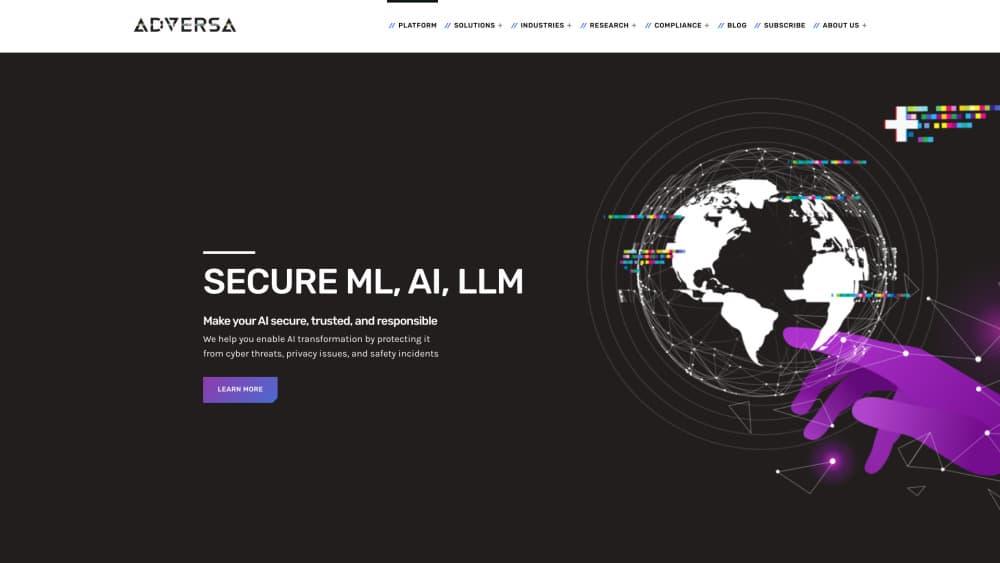
About Adversa AI
What Is Adversa AI
Adversa AI is an AI agent security platform built for one narrow problem: coding agents now read files, run shell commands, and push code, and nothing in a normal security stack sees the whole sequence. The company sells a gateway plus a light sensor that sits on developer machines, watches every model call and tool call, and stops an action chain mid-flight when it turns destructive.
The product grew out of offensive research. Adversa AI Ltd. runs an AI red teaming practice, publishes adversarial AI research, and writes the defaults of the platform from what its lab breaks. That lineage explains the pitch: most buyers have already approved three or four agent brands, and each vendor governs only its own. The company files this work under agentic development security, and the same runtime shows up in AI detection and response buying conversations when a security team wants agent activity inside its existing monitoring.
The limit is scope. It covers coding agents, not every AI system in a company. There's no public price, no self-serve signup, and no free tier, so you can't evaluate it without a sales conversation. Small teams without a security function and a real deployment of agents have little reason to look.
Getting Started
- Book a demo, then agree on a scoped observe-mode pilot with the agents and repositories you want covered.
- Deploy the gateway where your model traffic flows and install the sensor on a first group of developer machines.
- Connect the vendors' compliance APIs so agent sessions from Claude Code, Copilot, Cursor, and Codex land in one view.
- Run in observe mode for a week, read the chains the platform builds, and tune which action sequences count as dangerous.
- Switch the policies you trust to blocking, then hand the audit log to whoever owns your security review.
Product Information
A quick look at Adversa AI's pricing, supported platforms, and performance.
Best for
The users, tasks, and scenarios where this tool fits best.
Users
- Security leaders at companies that already run several coding agents
- AppSec and platform engineers
- SOC analysts
- Risk and compliance teams
Tasks
- Stopping a destructive command before it runs
- Catching credential exposure
- Blocking prompt injection and poisoned context
- Reconstructing what happened after an incident
Scenarios
- Rolling coding agents out across an engineering organization
- A regulated environment that can't send data to a vendor cloud
- A first near miss, such as an agent that read internal API secrets and tried to send them out
Key features
Four Capture Points
The platform watches model traffic, the agent harness, the developer's machine, and the vendors' own compliance APIs at the same time. Each point alone leaves a gap. Model traffic shows intent, the endpoint shows effect, and the harness shows the tooling in between, so Adversa AI maps all of them into one graph.
Agent Behavior Graph
Every reasoning step, tool call, file touch, and outbound connection becomes a node in a graph, with inputs and effects attached. Risk gets scored as the chain forms rather than per event. A single odd step stays context, which is why the vendor reports a 2,000:1 ratio of raw signals to confirmed incidents.
Chain-Level Blocking
Policies act on sequences, not just on single actions. A poisoned repo that gets installed, read, and then exfiltrated is blocked at the exfiltration step, while the same read on its own passes. Median blocking decision time is 0.2 ms in production, according to Adversa AI, which is fast enough that developers don't notice the layer.
300+ Default Policies
The rulebook ships populated and covers known coding agent attack techniques plus public incidents. MCP security rules are in that default set, since a malicious tool description is one of the cheapest ways to steer an agent. Red team findings compile into the same policy set, so a technique that worked in the lab stops working for your agents without you writing a rule. Custom policies cover the internal paths and secrets specific to your company.
Evidence and Audit Trail
Each session is recorded with the conversation, the tool calls, and the resulting actions. When an auditor asks what an agent did with customer data last month, the answer comes from a stored record instead of a rebuilt guess. Secrets are never stored, per the vendor's trust documentation.
Deployment and Certification
Cloud, on-premises, and air-gapped options cover teams that can't route traffic through a third party. SOC 2 Type I and II audits, ISO 27001 certification, and GDPR alignment handle the procurement questions that stall agent rollouts. Single sign-on and role-based access sit on top.
Pros and cons
Pros
- Covers several agent brands in one layer, which matters when developers pick their own tools and vendor controls stop at their own product.
- Judges actions in context, so legitimate agent work keeps running while genuinely destructive chains get stopped.
- Ships with a populated policy set, which shortens the gap between deployment and useful protection.
- Records what agents did in a form that survives an audit, a real advantage for regulated buyers.
- Backed by an active research team, and the public open-source SecureClaw framework gives security teams something to inspect before they buy.
Cons
- No public pricing and no free plan, so a small team can't test it without a sales cycle and a pilot.
- Value depends on real agent adoption. A company still deciding whether to allow coding agents gets little from a runtime control layer.
- It covers coding agents, not the rest of your AI estate, so model endpoints, chatbots, and internal copilots need separate coverage.
- Deployment asks for network and endpoint work up front, which is a project rather than a same-day install.
Frequently asked questions
It sits between your coding agents and everything they touch, records each action, and blocks the action chains that turn into incidents. The output is a live behavior graph plus a stored record of every session.
Related content
Explore related tools, skills, and articles for Adversa AI.
Adversa AI Alternatives
Isgen AI
Isgen · AI DetectionIsgen AI is a web-based AI detector that scores text for machine authorship and shows you which sentences and phrases push the number up. It's built for teachers, editors, students, and writers. Their question is simple: did this draft come from ChatGPT, GPT-5, Claude, Gemini, DeepSeek, or another model? You paste or upload content, run a scan, and get a Human, AI, and Mixed breakdown in seconds. There's also a companion editor that scores text while you write it.
Humanizeai Tools
Humanizeai Tools · Writing · AI DetectionHumanizeai Tools is a web-based AI humanizer that rewrites machine-generated text so it sounds like a person wrote it, which is the whole point of the category it belongs to. Paste a draft from ChatGPT, Claude, or Gemini, run it through the tool, and it swaps out the phrases and sentence patterns that AI detectors flag. If your goal is to make AI text sound human before you publish it, this is the kind of tool built for exactly that. It suits students, bloggers, and marketers who need copy that reads naturally and clears tools like GPTZero, Copyleaks, and Winston AI after a single pass.

Hidemyai
Hidemyai · Writing · AI DetectionHidemyai is an AI content humanizer. It rewrites text from ChatGPT, Jasper, and similar tools so the result reads like a person wrote it. You paste your draft, pick a document type and tone, and the service returns a version meant to bypass AI detectors such as Originality.ai, Turnitin, and ZeroGPT. It targets writers, marketers, and students who lean on AI drafts but can't ship copy that sounds robotic. The promise is simple: make AI content undetectable.