

Aeneas
Google DeepMind, with the University of Nottingham, Warwick and Oxford · Other
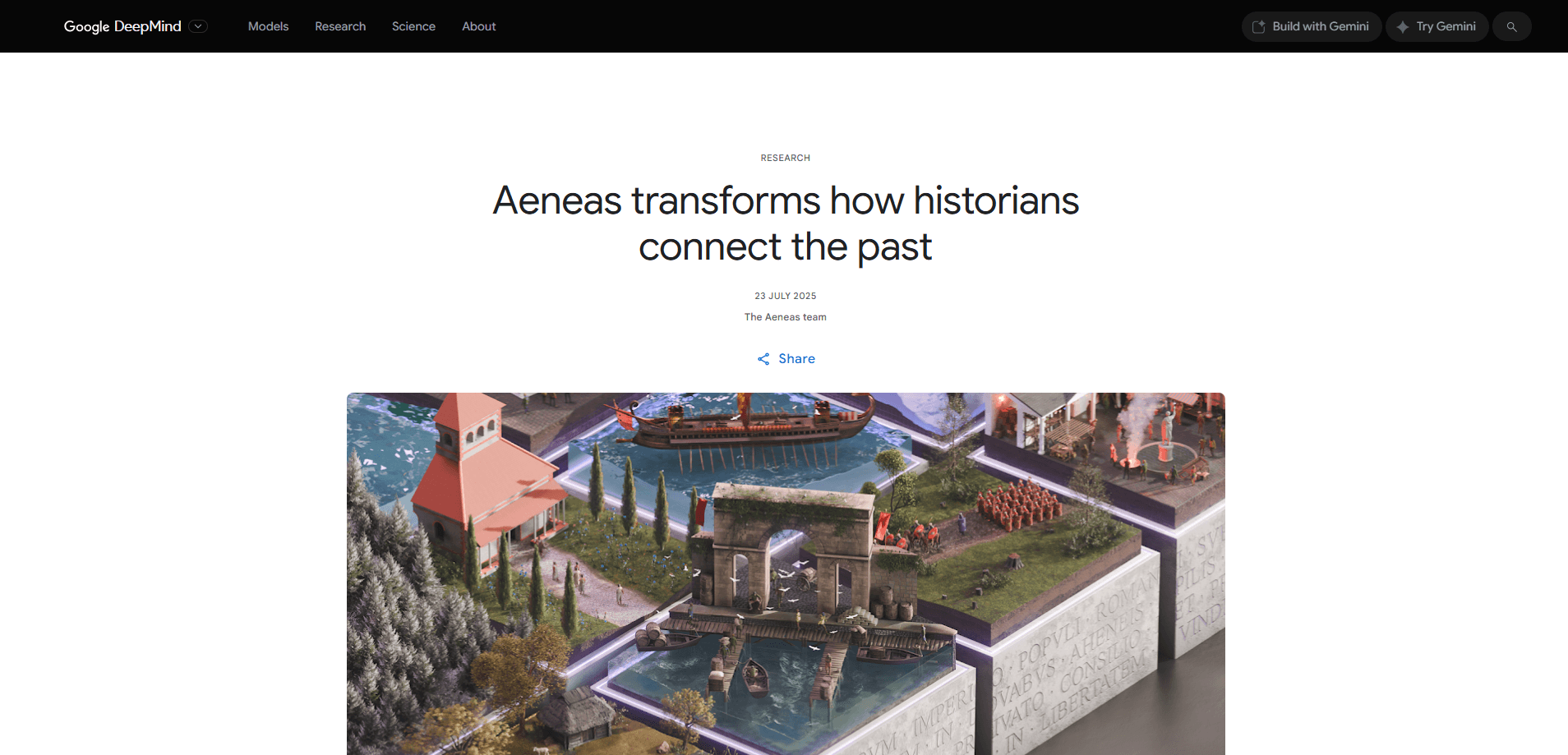
Aeneas is DeepMind's open-source AI model that restores damaged Latin inscriptions and predicts their date, geographic origin and closest textual parallels.
About Aeneas
What Is Aeneas
Aeneas is a generative neural network built by Google DeepMind with historians at the University of Nottingham, Warwick and Oxford. It reads ancient texts, mainly Latin inscriptions carved on stone, bronze and pottery, and helps scholars place them in a wider historical context. The team published the work in Nature in July 2025 and released the code and dataset as open source.
The job it does is largely a search and repair task. When an inscription turns up broken or weathered, a historian normally hunts through reference works for parallels, texts that share wording, formula or setting. That hunt can take days and depends on which libraries a scholar can reach. Aeneas automates it, turning each text into what the team calls a historical fingerprint and pulling the most relevant parallels out of a corpus of more than 176,000 Latin inscriptions. In effect, it puts a large slice of the field of epigraphy into a single model you can query.
Two limits shape how you'd use it. Aeneas is trained on Latin, so its headline numbers apply there. The team says the approach adapts to other languages, scripts and media. And it's a research tool, not a finished product. You run it through code, a demo site or a notebook, so you need some comfort with Python or a willingness to follow a setup guide.
Getting Started
- Open the interactive demo at predictingthepast.com, or visit the Google DeepMind project page for the paper and links
- Clone the predictingthepast repository on GitHub and follow the setup instructions for the model and dataset
- Feed the model a character sequence with markers for known-length gaps and unknown-length gaps, plus an inscription image if you have one
- Review the restored text, the ranked parallel inscriptions and the date and geographic predictions, then keep the ones that hold up
Product Information
A quick look at Aeneas's pricing, supported platforms, and performance.
Best for
The users, tasks, and scenarios where this tool fits best.
Users
- Classicists and ancient historians
- Archaeologists and museum staff
- Digital humanities scholars
- Students and teachers
Tasks
- Text restoration
- Geographic attribution
- Chronological attribution
- Parallel retrieval
- Corpus study
Scenarios
- A weathered altar fragment arrives with no provenance
- A museum prepares an exhibit
- A paper needs a stronger chronology
- A cross-disciplinary team studies a lesser-known script
Key features
Arbitrary-Length Text Restoration
Aeneas restores missing characters and fills gaps whose length nobody knows, a step past earlier models that could only handle gaps of set length. The team reports it recovers inscriptions with up to ten missing characters at about 73 percent accuracy. For a damaged text, that can turn an unreadable fragment into a usable source.
Parallel Text Retrieval
The model converts each inscription into a historical fingerprint and searches a corpus of more than 176,000 Latin inscriptions for the closest matches. Those parallels carry shared phrasing, function or cultural setting, well past the literal string matches older tools offered. It's the function historians lean on most, since context is what makes a fragment meaningful.
Multimodal Geographic Attribution
Aeneas is the first model of its kind to use both text and image to guess where an inscription was made. A shallow vision network reads a grayscale image alongside the text, which lifts accuracy on the geographic task in particular. The team reports it places texts in one of 62 Roman provinces at about 72 percent accuracy.
Chronological Attribution
Given a date range from a historian, Aeneas narrows the likely date to within about 13 years. That matters because radiocarbon dating doesn't work on stone or metal, so scholars often date inscriptions by style and formula alone. A tighter range makes it easier to line a text up with events and other finds.
A Large Open Latin Corpus
The model is trained on the Latin Epigraphic Dataset, which pools more than 176,000 inscriptions and some 16 million characters from sources like the Epigraphic Database Roma and the Epigraphic Database Heidelberg. DeepMind released the dataset and code, so teams can study, audit or retrain the model on their own material.
Human-AI Workflow in Real Studies
The team tested Aeneas with 23 historians on real inscriptions from the seventh century BC to the eighth century AD. Historians called the contextual suggestions useful in about 90 percent of cases and reported a 44 percent rise in confidence on key tasks. On restoration and geographic attribution, people working with the model beat either the model or the historians alone.
Pros and cons
Pros
- Open source model and dataset, so researchers can inspect, retrain and extend it
- Handles unknown-length gaps, which older restoration tools couldn't do
- Uses inscription images as well as text, the first model to do so for geographic attribution
- Backed by a peer-reviewed Nature paper and a study with working historians
- Free to use through the demo, the code or a Colab notebook
Cons
- Trained on Latin, so you get the published accuracy there and only a research claim for other scripts
- It's a research tool, not a product, so setup needs some Python and coding comfort
- It suggests parallels and dates rather than proving a reading, so a historian still has to judge the output
- No public API or pricing, since the project ships as code rather than a service
Frequently asked questions
Aeneas is an open-source AI model from Google DeepMind that helps historians work with ancient texts, mainly Latin inscriptions. It restores damaged text, suggests a date and place of origin, and finds the inscriptions that are most similar to the one you're studying. The team published it in Nature in July 2025.
Related content
Explore related tools, skills, and articles for Aeneas.
Aeneas Alternatives

Odyssey 3
Odyssey · OtherOdyssey-3 is Odyssey's foundation world model. It simulates physics in real time, turns a prompt into an interactive environment, and adapts to robots, cars and games.
JarvisCore
Prescott Data · Coding · Productivity · OtherJarvisCore is an open source Python runtime where AI agents work as equal peers on an agent mesh, claim tasks from a shared ledger, and reach external services through a zero-trust broker.
Clef
Cloudflare · Business · OtherClef is Cloudflare's open-source decision model for Workers AI. It returns calibrated probabilities for typed questions, not generated text, so agents can classify, route, and act fast.