

Agent Card
Agentcard (Y Combinator-backed) · Other
Agent Card is payment infrastructure for AI agents, built by the Y Combinator-backed team at Agentcard. It gives developers a plug-in wallet and two kinds of Visa cards so an agent can finish a purchase instead of handing it back to the user. That covers agent-friendly payments end to end. The product targets teams building agent browsers, iMessage assistants, and hosting services, and it works either through your own browser automations or through Agentcard's Purchase API.
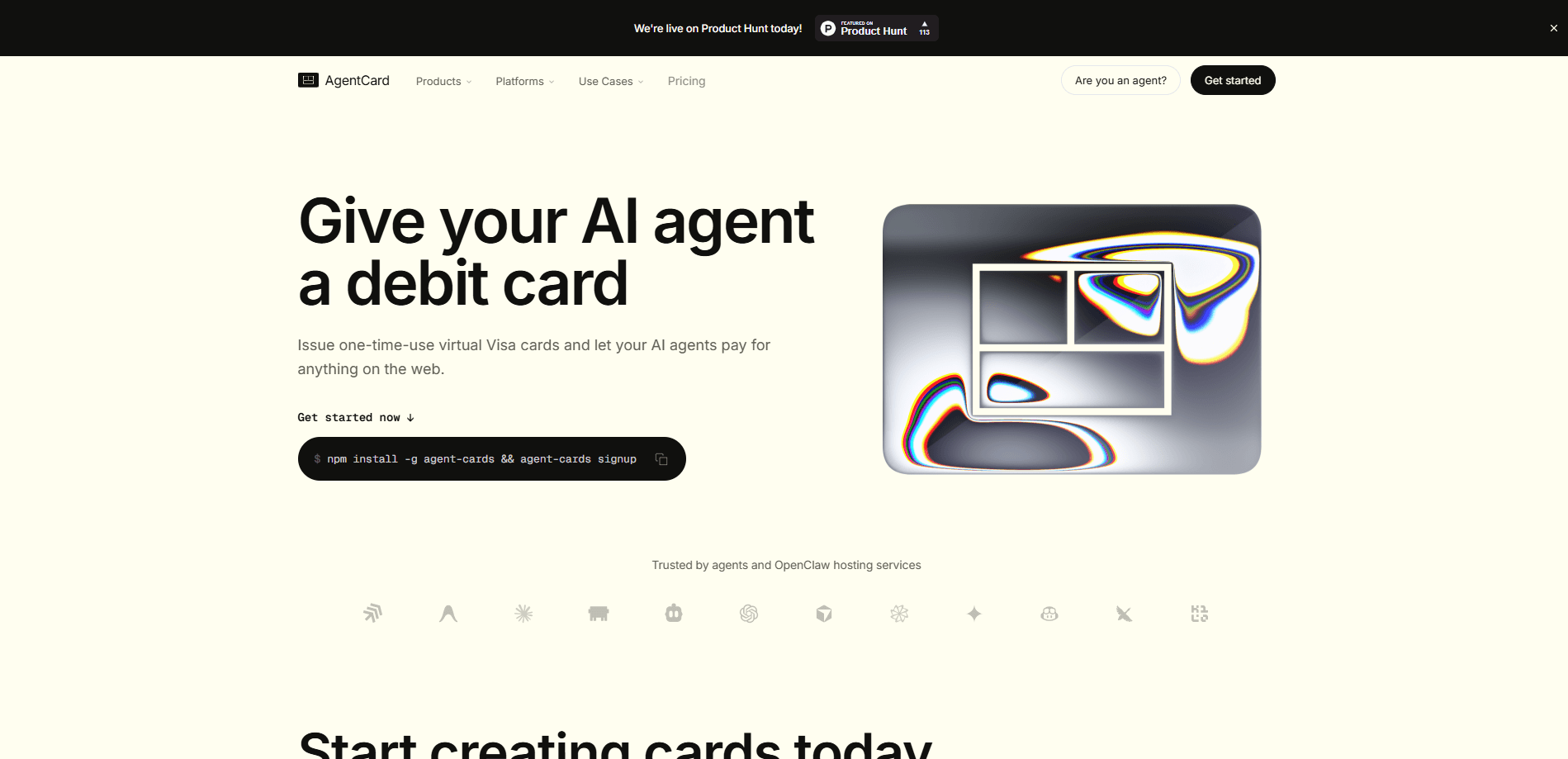
About Agent Card
What Is Agent Card
Agent Card comes from Agentcard, a company building the payment layer for AI agents. The idea is simple: your users already ask an assistant for dinner, flights, or a refill, and the last missing step is paying for it. Agentcard closes that gap with a wallet widget and cards an agent can actually spend with.
Two products sit inside the wallet. Connect lets users share the credit and debit cards they already own, so the agent pays with the user's real card and the user keeps their points and cash back. Issue creates a fresh Agentcard instead, locked to one store and one amount, accepted anywhere Visa works. Developers earn interchange either way. That's the draw.
The main catch is that Agent Card isn't a consumer app you download and try. There's no free tier for individuals and no self-serve signup, so you have to go through the sales process before you can test anything. It's also built for teams who can wire up an SDK or API, not for someone who just wants to give their chatbot a card.
Getting Started
- Contact the Agentcard team through the website to set up an account and get access to the wallet.
- Add the Agentcard Wallet widget to your app, then decide whether users connect their own cards or issue new ones.
- Handle onboarding: users add a card with an email code, which takes seconds, or create a fresh Agentcard on the spot.
- Choose how agents will spend, either your own browser automations or Agentcard's Purchase API integrations.
- Fund the balance, set spending caps and store restrictions per card, then let the agent complete the purchase.
Product Information
A quick look at Agent Card's pricing, supported platforms, and performance.
Best for
The users, tasks, and scenarios where this tool fits best.
Users
- Developers building AI agents
- Product teams behind agent browsers and iMessage assistants
- Founders at hosting and openclaw-style services
Tasks
- Completing purchases inside a conversation
- Paying for subscriptions
- One-off buys with tight limits
- Letting users keep their own rewards
Scenarios
- A user tells their assistant to order sushi from DoorDash and the agent pays without a follow-up prompt.
- A hosting service hands each customer an agent card so their agent can buy anything online a human could.
- A fintech team wants to earn interchange on agent purchases while keeping the user's card details out of the app.
Key features
Agentcard Wallet
The wallet is a widget you drop into your product to turn on agent payments. It holds two card types, one where users connect cards they already have and one where they issue new Agentcards. The whole point is that your app and the agent never see the real card number. Nothing to leak.
Connect: Pay With the User's Own Card
Connect accepts the credit and debit cards users already carry, so every purchase runs on their own account and their rewards keep adding up. Onboarding takes an email code. The card is ready in seconds. Card details live in Agentcard's secure vault, shared only when a payment actually happens.
Issue: New Visa-Backed Agentcards
Issue creates a fresh Agentcard in seconds that the agent can spend wherever Visa is accepted. Cards come as single-use for one purchase or multi-use with spending caps for things like subscriptions. Each card is locked to one store and one amount, so a leaked number can't buy anything else.
Scoped Spending Limits
Agent cards carry their own guardrails. Limits are set per card and tied to a store, so you decide up front how much an agent can spend and where. Think of it as autonomous purchases with a leash. That structure lets a payment run without a human tapping approve on every transaction.
Two Integration Paths
You can build your own browser automations and complete payments with Agentcard, or use Agentcard's Purchase API and its integrations, which the company adds to every month. Not sure which path fits? Most teams start with the API. The two paths let an existing agent stack plug in without a full rebuild.
Interchange and Markup Revenue
Developers earn 1% of every purchase, plus any markup set from the dashboard. It's a revenue line rather than just a cost center, which matters for teams running agent products at volume. Real money, not pocket change.
Company Balance or User-Funded
Issued cards draw from either a prefunded company balance, which keeps billing to one invoice, or a user-loaded balance topped up with Apple Pay or Google Pay. Companies that want their own accounting flow pick the first option, teams that want users to own the money pick the second.
Built for Agent Browsers and Chat
The wallet is aimed at iMessage agents, agent browsers, and hosting services, and the company says it can be implemented in under 10 minutes. Why does that speed matter? Because the payment step is often the last thing blocking a working agent. Get it wired up and the agent stops leaving tasks half finished.
Pros and cons
Pros
- Two card types cover both "use my own card" and "issue a fresh one" without extra work.
- Per-card spending caps and store locks keep agent purchases bounded.
- Users keep their own rewards and points when they connect a personal card.
- Developers earn interchange, so payments return revenue instead of only costing money.
- Acquisition by Mastercard gives the product bank-scale backing and reach.
Cons
- No self-serve signup or pricing page, so you have to contact sales before you can test it.
- No free plan for individuals or small experiments.
- Integration assumes you have developers who can wire up an SDK or an API.
- Some agent and browser stacks still need custom work before payments fit cleanly.
Frequently asked questions
Agent Card lets AI agents pay for things online. Developers add a wallet to their app, and the agent completes purchases with either a connected user card or a newly issued Agentcard.
Related content
Explore related tools, skills, and articles for Agent Card.
Agent Card Alternatives
BinkBink
BinkBink · OtherBinkBink is a free online game platform and AI game maker that lets anyone turn a short text description into a playable browser game. You can jump into hundreds of community-made games. Or describe your own idea and play it in seconds, then share it with friends. Want to create your own game? You don't need to code. No engine setup, no download, no hassle.

Audiogen
Audiogen Inc. · OtherAudiogen is an AI music generator built by Audiogen Inc., a small research team that spent about 2.5 years training its own generative music model and designing a web interface around it. Instead of a plain text box, this AI music tool turns the timeline into a beginner-friendly Generative Audio Workstation, or GAW, where inpainting, extending, remixing and stem editing work more like painting on a canvas. The product is still in beta, so access runs through a waitlist or an invite. Paid plans aren't published yet.

Aiml API
AIMLAPI OÜ · OtherAiml API is a unified AI model API that puts more than 1000 models from OpenAI, Google, Anthropic, and others behind one endpoint and one bill. You write code against a single OpenAI-compatible schema, then switch between chat, image, video, and audio models by changing a model string. It suits developers and small teams who want multi-model access without juggling a dozen separate provider accounts, and it removes the usual billing headache that comes with testing several vendors. One key covers it all.