

Aiml API
AIMLAPI OÜ · Other
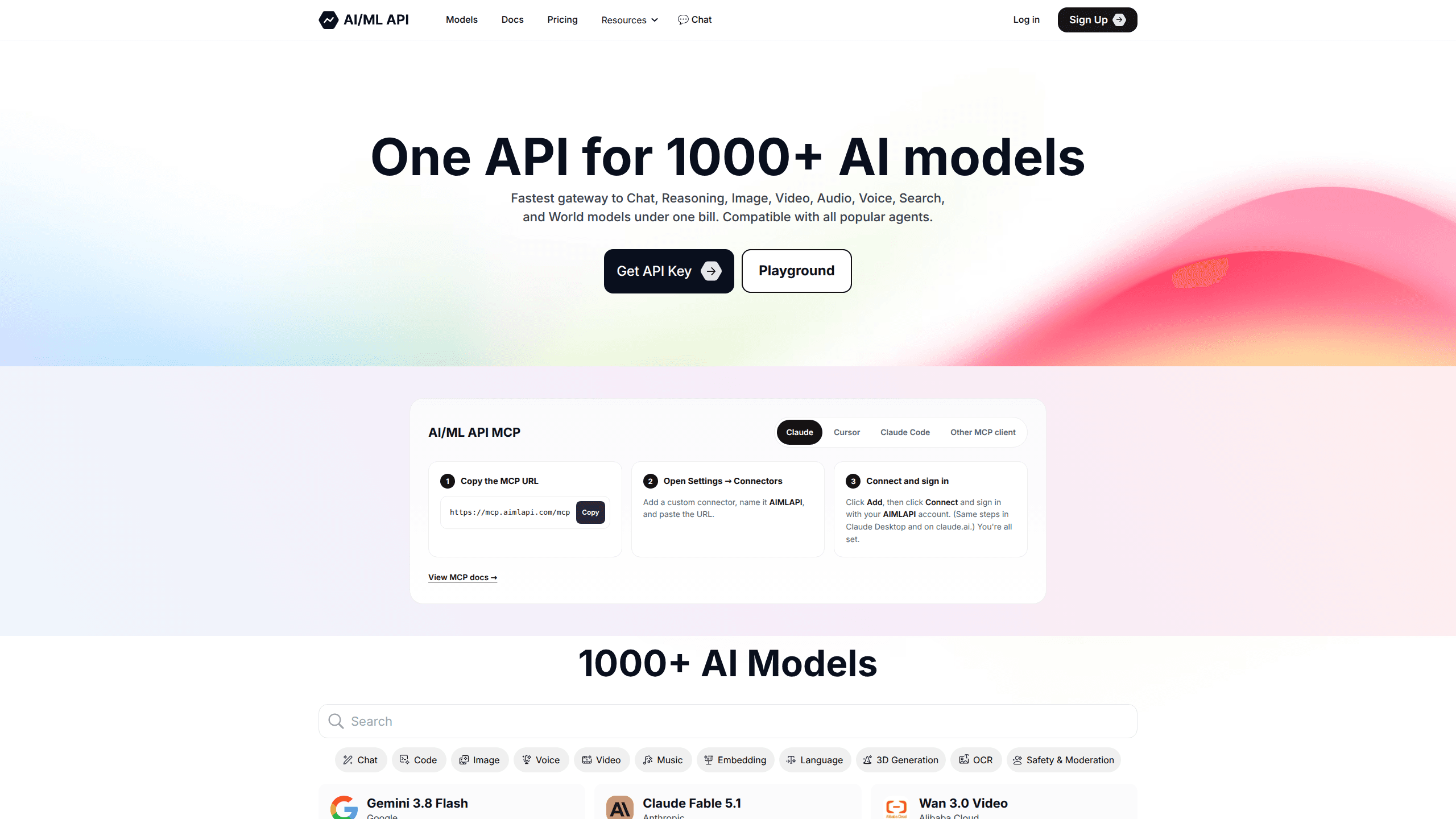
Aiml API is a unified AI model API that puts more than 1000 models from OpenAI, Google, Anthropic, and others behind one endpoint and one bill. You write code against a single OpenAI-compatible schema, then switch between chat, image, video, and audio models by changing a model string. It suits developers and small teams who want multi-model access without juggling a dozen separate provider accounts, and it removes the usual billing headache that comes with testing several vendors. One key covers it all.
About Aiml API
What Is Aiml API
Aiml API (also written AI/ML API) is an AI model marketplace and routing layer. Instead of signing up with every model vendor, you get one key and one balance that work across text, image, video, voice, music, embeddings, 3D, and OCR models. The platform tracks pricing, latency, and capabilities in one dashboard so you can compare before you commit.
The appeal is practical. Most teams testing models waste days on separate billing setups and SDK differences. As a multi-model API gateway, it keeps the base URL the same and moves only the model name. If a newer model lands, you point at it and keep your existing request shape. Simple as that. No rewrites.
The main limitation is that you're still paying per token or per generation through a reseller. You don't get fine-tuning control over the underlying weights, and quality depends on the upstream provider, so a quiet change on their side can shift your output without warning. For teams that need custom training on proprietary data, this isn't the right layer.
Getting Started
- Create an account at aimlapi.com and confirm your email.
- Open the dashboard and generate an API key from the keys page.
- Point your OpenAI client at the base URL https://api.aimlapi.com/v1 and paste in your key.
- Pick a model from the catalog, send a test request, or run it first in the AI Playground sandbox.
- Check your balance and usage in the billing view, then move the same call into production.
Product Information
A quick look at Aiml API's pricing, supported platforms, and performance.
Best for
The users, tasks, and scenarios where this tool fits best.
Users
- Developers building AI features
- Startups prototyping on a budget
- Product teams comparing models
Tasks
- Text generation and reasoning
- Image and video generation
- Speech and audio work
- Embeddings and retrieval
Scenarios
- Switching providers mid-project
- Building multi-model features
- Quick evaluation before integration
Key features
One API for 1000+ Models
The catalog spans chat, code, image, voice, video, music, embedding, language, 3D, OCR, and moderation models. Each entry lists pricing, latency, and capabilities so you can compare options in the same place. For a builder, one integration covers tasks that would otherwise need several providers. That's the whole point.
OpenAI-Compatible Endpoint
Requests follow the OpenAI schema, so existing SDKs and libraries work with a base URL change. Why does that matter? You swap the model name to move between providers, and your tooling, retries, and error handling stay the same. This keeps migration cost low when you want to try something new.
AI Playground Sandbox
The Playground lets you run models in the browser before you write any code. You can test prompts, compare outputs, and confirm a model fits your task. It's a fast way to settle on a model without burning integration time. Try before you build.
Real-Time Pricing and Latency Comparison
The dashboard surfaces AI model pricing and latency side by side across models. That lets you weigh a cheaper, slower model against a pricier, faster one with actual numbers. It matters when cost and response time both shape your product. Numbers beat guesses. Really.
MCP Server and Agent Integrations
Aiml API ships an MCP endpoint that connects to Claude Desktop, Cursor, Claude Code, and other agent tools. You authenticate with your account and let agents list models or run completions directly. It's a short path from setup to agent-driven workflows, especially if you already run an AI assistant inside your editor and want it to reach models beyond the defaults. Setup takes minutes.
Multi-Modal Coverage in One Bill
Text, image, video, audio, and embeddings all settle on the same account. You avoid scattering spend across vendors and reconciling separate invoices. Budget tracking stays in one place. That saves real time. One bill, one view.
Serverless Infrastructure and Uptime SLA
The platform runs on serverless infrastructure and advertises a 99.9% uptime SLA with 24/7 support. For production teams, that means less deployment overhead to manage yourself, and someone else owns the maintenance work that would otherwise eat into an engineering sprint. The trade-off is that you depend on their routing layer staying up.
Pros and cons
Pros
- One key and one OpenAI-compatible endpoint cover 1000+ models across many task types.
- Pricing and latency data sit next to each other, so comparing models takes minutes, not a benchmark project.
- A free tier plus pay-as-you-go pricing lowers the cost of testing an idea.
- The MCP server plugs into popular agent tools with a short setup.
- Text, image, video, and audio spend lands on a single bill.
Cons
- You pay reseller rates per request, which can cost more than going direct to a provider at high volume.
- Model quality and availability depend on the upstream vendor, so changes there affect you.
- There's no fine-tuning of underlying weights, which rules it out for teams training on proprietary data.
Frequently asked questions
Aiml API gives you one endpoint to reach over 1000 AI models for text, image, video, audio, and more. Developers use it to add AI features without managing separate accounts for each model provider.
Related content
Explore related tools, skills, and articles for Aiml API.
Aiml API Alternatives

Odyssey 3
Odyssey · OtherOdyssey-3 is Odyssey's foundation world model. It simulates physics in real time, turns a prompt into an interactive environment, and adapts to robots, cars and games.

JarvisCore
Prescott Data · Coding · Productivity · OtherJarvisCore is an open source Python runtime where AI agents work as equal peers on an agent mesh, claim tasks from a shared ledger, and reach external services through a zero-trust broker.
Clef
Cloudflare · Business · OtherClef is Cloudflare's open-source decision model for Workers AI. It returns calibrated probabilities for typed questions, not generated text, so agents can classify, route, and act fast.