

Agent Identity
Agent Identity · Coding · Business
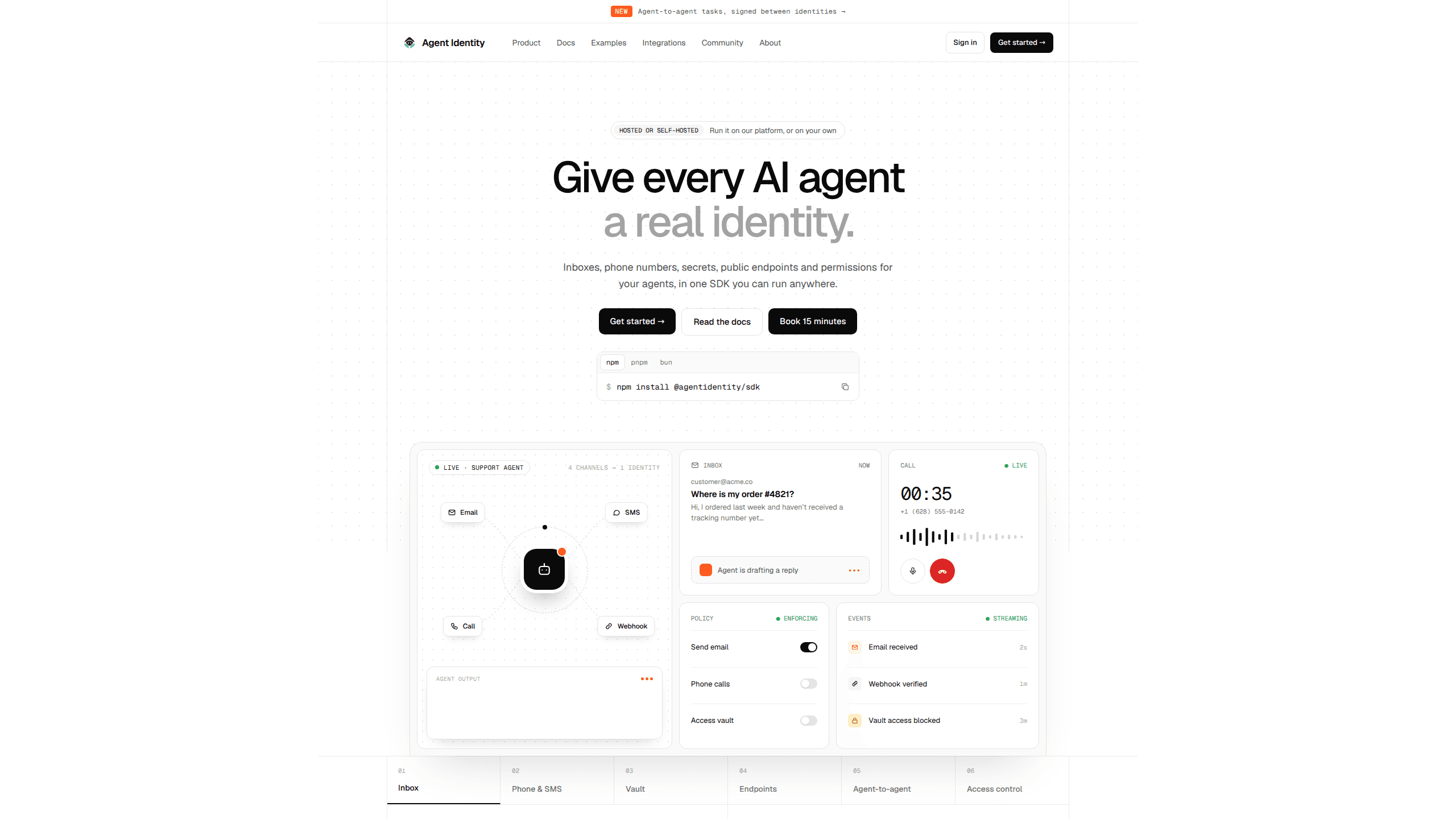
Agent Identity gives every AI agent its own email inbox, public URL, phone number and Agent2Agent endpoint, plus a scoped secrets vault, all through one TypeScript SDK.
About Agent Identity
What Is Agent Identity
Agent Identity is hosted identity infrastructure for AI agents, built by the team at agent-identity.dev. You stop running agents under your own mailbox and your own API keys. Each agent gets an identity instead: an email address, a public URL, an A2A endpoint, a set of secrets it may borrow, and a permission list that says what it can do.
The problem it solves is attribution. When a support bot replies from your inbox and a research bot calls an API with your key, a failed action looks like something you did. With a separate identity per agent, every message and every call carries a name, and revoking access means disabling one agent rather than rotating a shared key.
The setup is developer-first. You install an agent SDK, define an agent in a config file, and the platform provisions the inbox, endpoint and vault entry in the same call. Events arrive as typed callbacks, so your code reacts to a reply instead of polling a mailbox.
Three limits are worth knowing before you commit. Voice calls work in the US and Canada only, and text messages are not live yet. The first-class SDK is TypeScript, with REST and MCP for everything else. And the company says SOC 2 is in progress rather than complete, which matters if your procurement team asks for a report.
Getting Started
- Create an account at app.agent-identity.dev. You can also let the agent sign itself up: paste the signup prompt from the docs into Claude Code, Codex or Cursor, and a human confirms one verification code.
- Install the SDK with
npm install @agentidentity/sdk, then define an agent with a name, an email address and a phone flag. - Connect a domain for the inbox, and add any provider keys you want the agent to use. Keys go into the vault, not into the prompt.
- Subscribe to the events you care about, such as
email.received,call.completedora2a.message, and write the handler that replies or forwards the work. - Start the agent, then check the dashboard and audit log to see which actions ran and which ones policy blocked.
Product Information
A quick look at Agent Identity's pricing, supported platforms, and performance.
Best for
The users, tasks, and scenarios where this tool fits best.
Users
- Developers building customer-facing agents
- Small product teams without an ops engineer
- Teams running several agents in one product
Tasks
- Handling inbound support email
- Verifying agent output before it reaches a system
- Passing work between agents
Scenarios
- A solo founder wants a support agent that answers from [email protected]
- A team already using Claude Code or Cursor wants an agent with a real address
- A company preparing for an audit needs to show who did what
Key features
Per-Agent Email Inboxes
Creating an agent also creates its mailbox, and that address can send, receive and keep threads. Replies, bounces and spam complaints arrive as events rather than sitting in a folder for a cron job to find. On the Free plan you also get IMAP and SMTP access, so the same inbox works in a normal mail client during debugging.
Live Phone Calls with a Voice Agent
An AI agent phone number lets people call the agent and lets the agent call out. The built-in voice agent, Aid Voice, answers with no server of your own, or you stream the call over WebSocket and feed the caller's speech to your own model. Calls run in the US and Canada today, and the platform bills by the minute once usage charges start.
Scoped Secrets Vault
The agent secrets vault encrypts values on your machine before they leave, so the service never holds plaintext. Each secret belongs to one agent and is handed over through a lease tied to a single operation, which keeps a key out of the prompt and out of the config file. If an agent tries to read a key it does not own, policy stops the call and writes it to the log.
Signed Webhooks and Public Endpoints
Every agent gets a public URL with a signed webhook, and the SDK verifies the signature in one function call. That gives you a stable address for Stripe, GitHub or an internal service to call, without exposing your own server or writing signature code by hand. Bad signatures are rejected before your handler runs.
Agent-to-Agent Messaging over A2A
Agent-to-agent messaging uses the open A2A protocol, so an identity published by this platform can be discovered and messaged by agents built elsewhere. Each agent exposes a public agent card, and you set the reach rules: private by default, with allow lists and block lists when you want a wider network.
Policy Engine and Audit Trail
Agent access control is checked before an action runs, not after. You define what each agent may do across email, calls, vault reads and external APIs, and anything outside that list stops. The audit log then records the decision, which turns a vague question about agent behavior into a list of timestamped entries you can filter by agent.
Pros and cons
Pros
- One identity covers email, phone, webhook, A2A and secrets, so you stop stitching four vendors together for a single agent.
- The vault keeps keys out of prompts and config, and per-agent scoping limits the damage when one agent goes wrong.
- Durable events let an agent wait for a reply and resume after a restart, which removes the polling loop most email agents still carry.
- Free plan with 5 identities and no card requirement makes it cheap to test the workflow on a real domain.
- The MCP server and self-signup guide fit the tools developers already use, including Claude Code, Codex and Cursor.
Cons
- SMS and iMessage are listed as coming soon, so an agent that needs to text customers cannot use this yet.
- Phone numbers are limited to the US and Canada, which rules out local numbers for most teams outside North America.
- The TypeScript SDK is the documented path. Python developers work through REST or MCP and lose some of the typed event handling.
- Stored mail is capped at 2 to 6 GiB per mailbox depending on plan, so heavy archives need cleanup or an export step.
- SOC 2 is still in progress, and regulated buyers may have to wait for the report.
Frequently asked questions
Agent Identity is identity infrastructure for AI agents. Each agent gets an email inbox, a public URL, an A2A endpoint, a secrets vault and a permission set, managed through an agent SDK, a CLI, an MCP server and a REST API. Actions are recorded against the agent that took them.
Related content
Explore related tools, skills, and articles for Agent Identity.
Agent Identity Alternatives

Base Code
Base44 (Wix) · Coding · ProductivityBase Code is a shared cloud development environment from Base44. Teammates describe changes to an existing GitHub codebase in chat, preview them live and send them back as pull requests.

Google EmbeddingGemma 2
Google DeepMind · Writing · Image · CodingGoogle EmbeddingGemma 2 is a 740M-parameter open model that turns text, code, images, audio, and video frames into vectors in one 768-dimension space, running on phones and laptops.

GitGlow
GitGlow · Coding · ProductivityGitGlow is a local-first desktop Git client that lets independent developers review their own code and their AI agents' changes in one place before shipping.