

AgentLoop
aiedwardyi · Coding
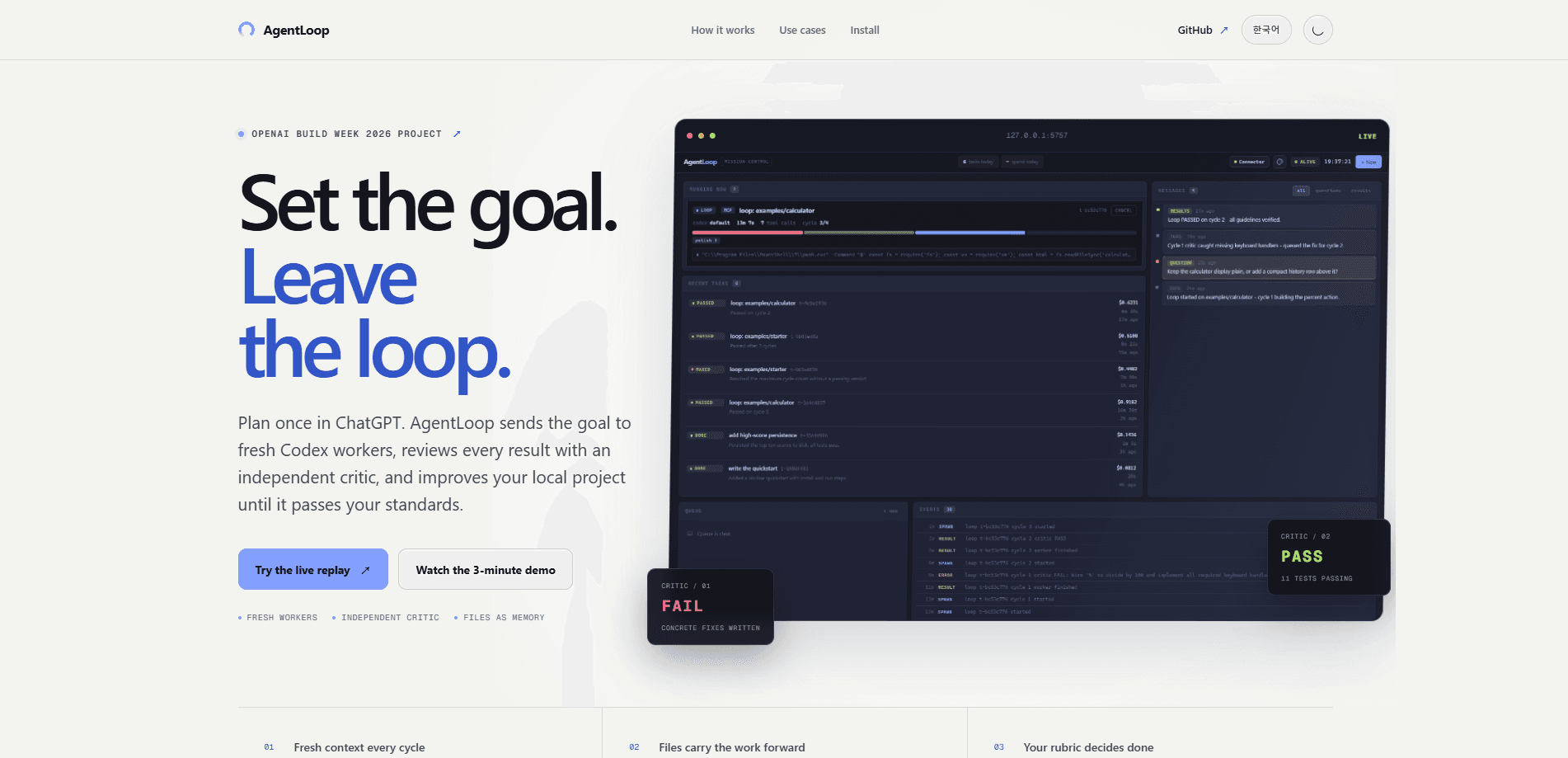
AgentLoop is a local orchestration daemon that turns a bounded coding goal into shipped work. Think of it as a local agent workflow you actually own. You plan once in ChatGPT or Claude, hand over the goal, and AgentLoop runs fresh Codex or Claude Code workers cycle by cycle while an independent critic enforces the standard you wrote in GUIDELINES.md. Your project files act as memory, so nothing gets lost between cycles, and you can watch every verdict, cost, and transcript on a live dashboard. It's built for unattended coding loops you can leave running and check later.
About AgentLoop
What Is AgentLoop
AgentLoop is a coding agent orchestrator for solo developers who run long agent tasks and can't sit and supervise every session. Instead of shuttling plans between a chat window and a terminal all day, you set the goal and the finish line once and let the loop carry the handoffs.
The core idea is simple. Each cycle starts a brand-new worker process, which removes the stale assumptions and dead context that pile up in long chats. Work moves forward through the project files themselves, not a growing conversation. Not a chat log. An independent critic then reads your rubric and the worker's output, and its verdict decides whether the loop continues, fails, or ships.
It runs where your code already lives: Node.js 18+, Git, and either Codex or Claude Code CLI. There's no hosted workspace and no npm install. That's also the main limit. AgentLoop is a command-line tool for developers comfortable with a terminal, not a click-to-start app, and it needs one of those two coding engines to do anything at all. Setup is quick if you already use those tools. If you don't, it isn't.
Getting Started
- Make sure Node.js 18+, Git, and either the Codex CLI or Claude Code CLI are installed on your machine.
- Clone the repository and move into the folder:
git clone --branch v1.2.0 --depth 1 https://github.com/aiedwardyi/AgentLoop.gitthencd AgentLoop. - Start the daemon with
node src/daemon.jsand open the local dashboard. - Write your bounded goal in
goal.mdand your definition of done inGUIDELINES.md. - Pick your engine per loop from the dashboard, then let the worker and critic cycles run until the critic returns a PASS verdict.
Product Information
A quick look at AgentLoop's pricing, supported platforms, and performance.
Best for
The users, tasks, and scenarios where this tool fits best.
Users
- Solo developers
- Indie hackers shipping features alone
- Engineers who care about process
Tasks
- Feature development
- Code migrations
- Hardening passes
- Regression coverage
- Product polish
Scenarios
- Overnight runs on a side project where you want progress by morning without monitoring every tool call.
- Multi-project days where you queue independent tasks and check the dashboard between other work.
- Teaching a junior or an AI worker your standards by making the rubric explicit and repeatable.
- Auditing an agent's reasoning after the fact, since every cycle, verdict, and transcript stays on the timeline.
Key features
Fresh Context Every Cycle
AgentLoop starts a new engine process for every worker and every critic session, so no prior chat history follows them. This avoids context rot, the buildup of stale assumptions that makes long-running chats unreliable. The durable memory is the project itself plus the concrete fixes the critic writes, which keeps tokens from being burned re-reading an ever-growing conversation.
Independent Critic With Your Rubric
You put your definition of done in GUIDELINES.md. A fresh critic reads that file every cycle alongside the worker's output and the project files. The critic's final line is a strict contract: it must land on PASS, FAIL with fix notes, or CONTINUE. FAIL becomes injected instructions for the next worker, so feedback turns into action rather than a comment you have to relay by hand. In the project's own evaluation, a fresh critic found a mixed percent-decoding defect after all nine tests had passed.
Files as Durable Memory
Progress lives in PLAN.md and STATE.md, not in a conversation. A worker reads the plan and state, makes one increment, updates state, and exits. Because the memory is in files, a loop stays bounded and easier to leave unattended. It also means you can read the same artifacts the agents work from and see exactly what changed in each step.
Live Dashboard and Observability
Every cycle, verdict, transcript, cost, and file handoff shows up on a local dashboard. You can cancel a run from there instead of hunting down a process, and you can ask ChatGPT for status through an MCP bridge. No guesswork. For anyone who's tried to debug an unattended agent run after the fact, having the timeline recorded is the difference between fixing a problem and guessing at it.
Codex and Claude Code Support
AgentLoop runs Codex CLI and Claude Code as interchangeable engines. You pick one per loop from the dashboard, or per task through the bridge. The project keeps planning separate from local execution, and the roadmap points toward two-way agent questions and research loops next.
Auto-Checkpoints in Git
For projects inside a git work tree, auto-checkpointing is on by default, so the daemon can commit progress as cycles complete. Sudden failures, like a stuck task that hits its retry cap, don't wipe out the work already done. Recovery is a git command away, not a lost afternoon. That matters on overnight runs.
Bounded Loops by Design
A loop is intentionally sequential. Independent queued tasks can run up to a concurrency limit, but one loop never spins into a parallel swarm racing across the same project. That's deliberate. Budgets are capped too. maxCycles runs from 1 to 50 and defaults to 3, and taskRetries caps consecutive failures before a task is marked blocked and skipped.
Pros and cons
Pros
- Free and MIT licensed, with the full source available on GitHub.
- Runs locally against your existing repo, so your code never leaves your machine.
- Fresh worker and critic processes each cycle cut down on the context rot that plagues long agent chats.
- The critic enforces rules you write yourself, which makes quality checks consistent and repeatable.
- A live dashboard records every verdict, cost, and transcript, so unattended runs stay auditable.
- Works with either Codex CLI or Claude Code, so it fits an engine you already use.
Cons
- Command-line setup only. There's no GUI installer, so non-developers will bounce off the required Node.js, Git, and engine CLI steps.
- You need a Codex or Claude Code subscription or API access separately. AgentLoop itself is free, but the loop can't run without one of those engines.
- The rubric does the heavy lifting. Vague acceptance criteria produce vague verdicts, so it rewards teams who already write precise specs.
- There's no hosted option. If you want a managed workspace you can open from any browser, this isn't it.
Frequently asked questions
AgentLoop is a local daemon that orchestrates coding agents. Want to stop manually relaying messages between a planner and a coding agent? That's the job it takes over. It sends a bounded goal to fresh Codex or Claude Code workers, has an independent critic review each result against your rubric, and repeats the cycle until the work passes your standards.
Related content
Explore related tools, skills, and articles for AgentLoop.
AgentLoop Alternatives
Forefront
Forefront · CodingForefront is a web platform for building with open-source AI. It lets you fine-tune leading open-source language models on your own data, evaluate how they perform, and run them through an API or export them to host yourself. Developers who want the convenience of a closed-source platform but insist on owning their models and data are the target audience here.

Startkit
StartKit.AI · CodingStartkit is a boilerplate for building AI SaaS and AI wrapper products. Think of it as an AI startup boilerplate with the boring parts already wired up: authentication, Stripe and Lemon Squeezy payments, usage limits, transactional email, and an AI API starter that talks to OpenAI, Anthropic, Groq, or Llama. You clone the repo, set your price, and start on the part of your product that people actually pay for. It's Next.js under React and Tailwind, so most of the boilerplate code already feels familiar.
Testim
Tricentis · CodingTestim is an AI-powered test automation platform for building and running end-to-end tests across web, mobile, and Salesforce applications. It leans on machine learning to keep tests stable when an interface changes, so teams spend less time fixing broken selectors. Not bad for an automated testing tool you can start using today. You create tests by recording actions in a browser, then optionally add JavaScript when you need more control. It's a solid pick for busy QA teams.