

AgentMail
AgentMail · Writing · Marketing
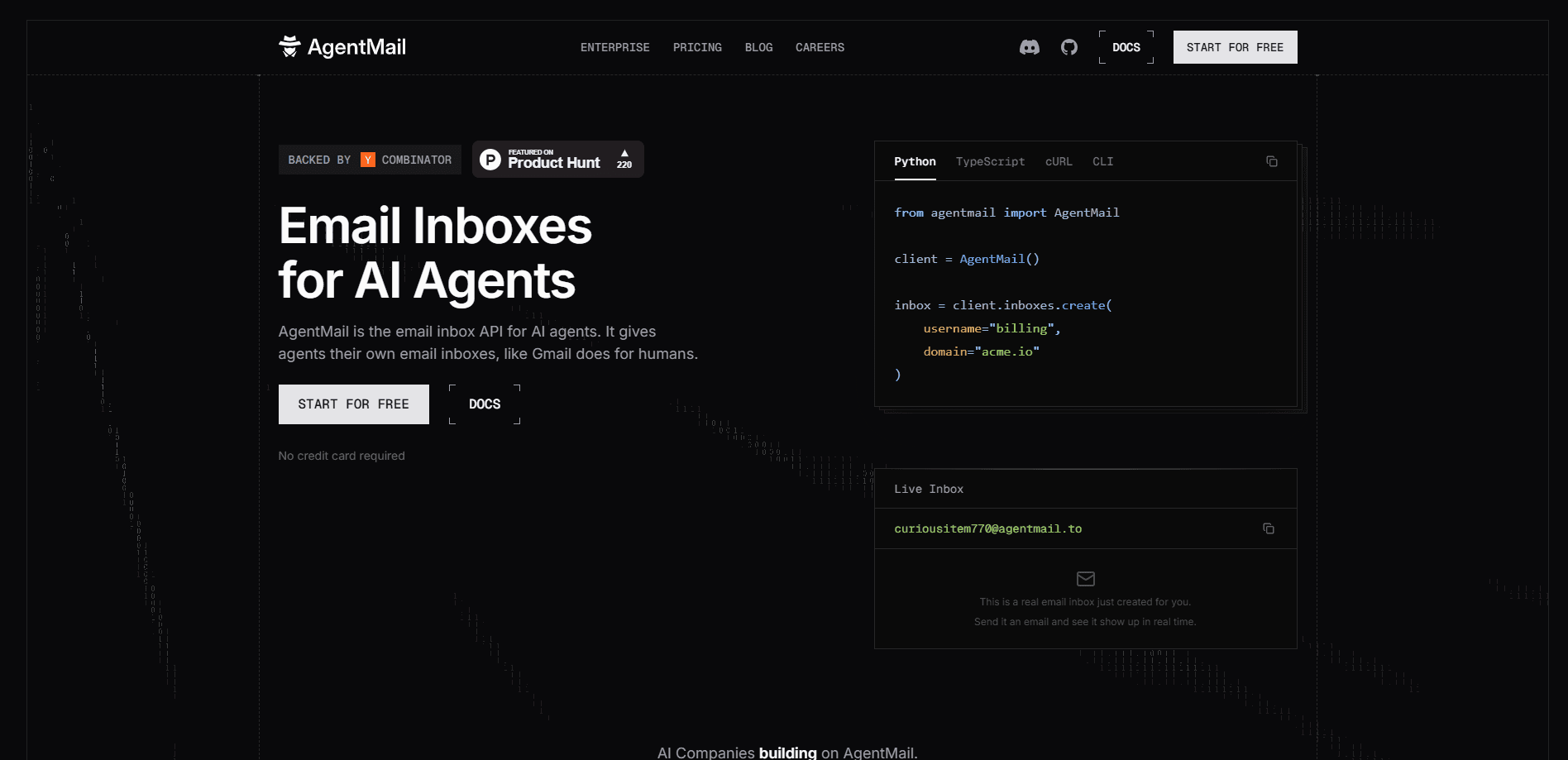
AgentMail is an API-first email platform that gives AI agents their own inboxes, so they can send, receive, and act on email without borrowing a human account. It handles inbox creation, threading, attachments, and real-time events through a REST API, with Python and TypeScript SDKs and an MCP server for tool-wired agents. Teams reach for it when their agents need a verifiable identity, like signing up for a service or replying inside an existing thread.
About AgentMail
What Is AgentMail
AgentMail is email infrastructure built specifically for AI agents, not for people. It's the email API for AI agents that want a real address of their own. Instead of forcing an agent to drive a shared Gmail login, you create an inbox programmatically and hand that address to the agent. The agent then signs up for services, receives confirmation codes, and holds multi-party conversations through the same email protocol everyone else uses.
So how does AI agent email differ from a normal mailbox? The address exists for a program, not a person.
The product targets developers who are shipping agent products and keep hitting the same wall: legacy providers price per inbox, throttle sends, and offer little API support for spinning up new addresses. AgentMail flips that model. You pay by usage, you can create many inboxes, and there are fewer hard rate limits to fight. No per-seat charge. No surprise bill.
The main catch is that this is a developer platform. If you don't write code, there's no dashboard workflow that gets you very far. Enterprise-only items like BYO cloud deployment, dedicated IPs, and SAML SSO sit behind custom pricing, so the jump from Startup to Enterprise isn't something you can self-serve. That's a real limit for smaller teams.
Getting Started
- Sign up at the AgentMail console and grab an API key from your account settings.
- Create an inbox with a single API call, either on the shared domain or on your own custom domain.
- Install the Python or TypeScript SDK, or connect the MCP server to the agent runtime you already use.
- Send your first message and wire up a webhook or WebSocket listener for incoming mail.
- Verify your sending domain with DKIM, SPF, and DMARC records when you move to production volume.
Product Information
A quick look at AgentMail's pricing, supported platforms, and performance.
Best for
The users, tasks, and scenarios where this tool fits best.
Users
- Backend developers
- AI product teams
- Startup founders on a budget
Tasks
- Handling signup and verification emails
- Running support conversations
- Building structured extraction pipelines
Scenarios
- Multi-agent workflows where bots email each other to coordinate, and you need each one to have a distinct address.
- Scheduled and triggered notifications sent from a product, where a webhook fires the moment a reply lands.
- Enterprise deployments that need SSO and EU region cloud, which the lower tiers don't offer.
Key features
Programmatic inbox creation
The core of AgentMail is creating inboxes through code rather than a signup form. The free tier allows three of them. One API call gives an agent a working address. For platform builders, multi-tenant Pods keep each customer's inboxes walled off from the rest.
Send and receive with threading
Agents can both send and receive through the same inbox, and replies stay grouped into threads. Attachments and multi-party threads work as you'd expect, which matters when an agent is negotiating with a service or a group of people over several days. Threads keep context intact.
Real-time events over webhooks and WebSockets
You don't have to poll for new mail. Incoming messages can trigger a webhook endpoint or stream over a WebSocket connection, so your agent can react the moment something arrives. No polling. This is what makes email feel less like a batch job and more like a live channel.
Python and TypeScript SDKs plus MCP server
The SDKs cut the boilerplate of hand-rolling HTTP calls. For agents built on tool-calling runtimes, the MCP server exposes email actions directly, so an agent can list, read, and send without you writing glue code for each capability.
Custom domains with DKIM, SPF, and DMARC
You can send from your own domain instead of a shared one, and the deliverability records get validated for you. DKIM, SPF, and DMARC come on every tier, which is the baseline for landing in an inbox instead of a spam folder. Custom domains start on the Developer plan. Not the free one.
Semantic search, labels, and structured extraction
Every email becomes a searchable record, and you can search across inboxes in your organization by meaning rather than exact keywords. User-defined prompts drive automatic labeling, and the platform pulls structured data out of messages, which is handy for turning an inbox into a light database.
IMAP and SMTP access
For agents or tools that speak classic email protocols, AgentMail also exposes IMAP and SMTP. That means you can plug in an existing mail client or script without rewriting it around the REST API. Handy for legacy stacks.
Pros and cons
Pros
- Pricing scales with usage rather than a per-inbox subscription, so a project running many agents doesn't explode in cost.
- Inboxes are API-first, which means no OAuth dance and no shared human credentials for the agent to inherit.
- Webhooks and WebSockets let the agent respond to mail the moment it arrives, not on a polling timer.
- The free tier is functional, with 3 inboxes and 3,000 emails a month for real prototyping.
- DKIM, SPF, and DMARC on all tiers keeps deliverability work off your plate.
Cons
- There's no no-code path, so non-developers can't get much done without help from an engineer.
- Enterprise features like dedicated IPs and SAML SSO require talking to sales, which slows procurement.
- Custom domains don't start until the $20/mo Developer tier, so the free plan is limited to the shared domain.
Frequently asked questions
It gives AI agents their own email inboxes so they can send and receive mail on their own. You create the inbox through an API, hand the address to the agent, and it can sign up for services, reply in threads, and keep a searchable record of everything.
Related content
Explore related tools, skills, and articles for AgentMail.
AgentMail Alternatives

Google EmbeddingGemma 2
Google DeepMind · Writing · Image · CodingGoogle EmbeddingGemma 2 is a 740M-parameter open model that turns text, code, images, audio, and video frames into vectors in one 768-dimension space, running on phones and laptops.

MePersona
MePersona, Inc. · Writing · Productivity · MarketingMePersona is an AI unified inbox for creators. It learns your voice, drafts replies to fan messages from 12 platforms, and sends only what you approve.

Fluence
Yay Software (Yannick Huchard) · Writing · Voice & Language · ProductivityFluence is an Android app that reads PDFs, EPUBs, Word files and web articles aloud, follows each sentence as it speaks, and answers questions about the text on the phone itself.