

Agihalo
Agihalo · Coding
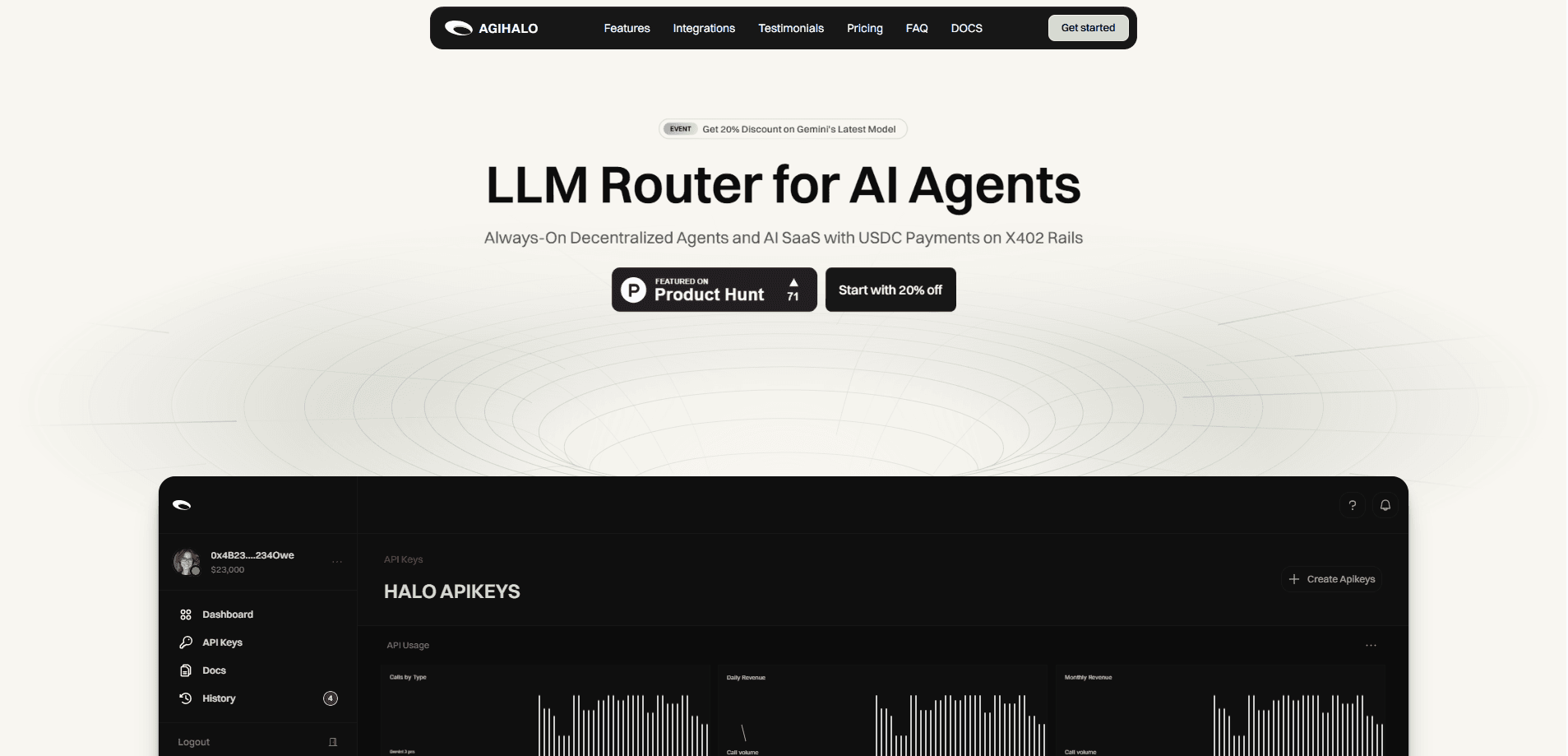
Agihalo is an LLM router and agent platform that lets developers route requests to Gemini and other supported models through a single endpoint while giving autonomous agents a way to pay for their own usage. It combines model routing, per-agent spend controls, long-term agent memory, and decentralized USDC payments on X402 rails in one service layer. That mix targets autonomous AI agents that need to run and pay for themselves. Keep your existing OpenAI-compatible code, change the base URL, and let agents manage their own model calls.
About Agihalo
What Is Agihalo
Agihalo is a routing layer that sits between your application and the model providers you already use. Instead of wiring up each vendor separately, you point your client at Agihalo's base URL and reach Gemini, GPT, and other supported models through one interface. It keeps each provider's familiar request format. So how much work is migration? Usually, it's just swapping the endpoint.
The bigger idea is autonomy. Agihalo gives AI agents a way to hold and spend their own budget. That's what AI agent payments look like here: an agent requests a call, pays in USDC over X402 rails, and retries supported routes without a human approving each transaction. For teams running many agents, that removes a lot of manual accounting.
The catch is scope. Agihalo is built for developers shipping agentic products. It isn't for casual users who just want a chatbot. It also assumes crypto payments and API keys, because USDC funding is central to how the autonomous flow works. Pricing isn't published on a public page right now, so budget planning means contacting the team directly.
Getting Started
- Create an account and open the Agihalo dashboard, then set up a project for the application or environment you're integrating.
- Generate an API key under the API Keys section and store it in your server secret manager as an environment variable.
- Point your existing OpenAI-compatible client at the Agihalo base URL and keep the rest of your request structure unchanged.
- Send your first request to confirm the route works, then fund the project with USDC to enable agent-driven payments.
- Issue separate keys for each agent and set spend limits so you can track and cap costs per agent.
Product Information
A quick look at Agihalo's pricing, supported platforms, and performance.
Best for
The users, tasks, and scenarios where this tool fits best.
Users
- Backend and AI developers
- AI SaaS builders
- Web3-oriented teams
Tasks
- Routing model calls across providers
- Metering agent spend
- Building autonomous workflows
Scenarios
- Running 24/7 agents on a fixed budget
- Migrating an existing LLM integration
- Auditing cost by project
Key features
Unified LLM Router
Agihalo routes requests to supported models, including Gemini and GPT options, through a single endpoint. It speaks the Gemini API and OpenAI formats, so you keep the provider's native request structure. The main change is the base URL. That means less integration work when you add a new model or switch providers.
USDC Payments on X402 Rails
Agents can pay for their own model usage in USDC over X402, the payment protocol behind Agihalo's autonomous flow. An agent requests a call, pays, and retries supported routes on its own. For teams that want agents operating without constant human oversight, this is the core of the product.
Per-Agent API Keys and Spend Controls
You can issue unlimited API keys and assign limits to each one, which keeps costs tied to a specific agent rather than a shared pool. Real-time usage tracking then shows call volume and cost by type. Handy when one agent misbehaves. You can find it fast instead of guessing.
Agent Memory
Agihalo includes long-term memory that's scoped per project, so agents can carry context across sessions. Because memory is isolated by project, the same account can run unrelated products without their data bleeding together. No cross-contamination.
Base URL Migration
The migration path is deliberately small. Point an existing OpenAI client at the Agihalo base URL and keep the rest of your request structure. Teams usually don't have to touch application logic. That shortens the switch from a multi-week project to an afternoon.
Usage Dashboard
The dashboard tracks API call volume by type, daily and monthly revenue figures, and cost breakdowns. It gives you a live view of which agents and models are driving spend. That matters once several agents run at once. Without it, costs blur together.
Autonomous Refueling
Agihalo lets agents manage and top up their own LLM credits through its sub-LLM system. The point is continuity. Agents keep running around the clock without a person watching the balance. It's the difference between a demo and something you leave running overnight.
Pros and cons
Pros
- Routing Gemini and GPT through one endpoint cuts integration work when you use multiple providers.
- Per-agent API keys with limits make agent-level cost tracking practical, not guesswork.
- USDC payments on X402 support agents that pay for their own calls without manual approval.
- The base URL swap keeps migration light for apps already on OpenAI-compatible SDKs.
- Project-scoped memory and authentication keep separate products from mixing data.
Cons
- Pricing isn't published on a public page, so you can't estimate costs before contacting the team.
- USDC and X402 payments mean you need crypto familiarity, which rules out teams that want plain card billing.
- It's a developer platform with no consumer app, so non-technical users have no path in.
Frequently asked questions
Agihalo is used to route LLM requests to models like Gemini and GPT through one endpoint and to let AI agents pay for their own usage. Developers use it to add model routing, spend controls, and autonomous payments without rebuilding their integration.
Related content
Explore related tools, skills, and articles for Agihalo.
Agihalo Alternatives
Forefront
Forefront · CodingForefront is a web platform for building with open-source AI. It lets you fine-tune leading open-source language models on your own data, evaluate how they perform, and run them through an API or export them to host yourself. Developers who want the convenience of a closed-source platform but insist on owning their models and data are the target audience here.

Startkit
StartKit.AI · CodingStartkit is a boilerplate for building AI SaaS and AI wrapper products. Think of it as an AI startup boilerplate with the boring parts already wired up: authentication, Stripe and Lemon Squeezy payments, usage limits, transactional email, and an AI API starter that talks to OpenAI, Anthropic, Groq, or Llama. You clone the repo, set your price, and start on the part of your product that people actually pay for. It's Next.js under React and Tailwind, so most of the boilerplate code already feels familiar.
Testim
Tricentis · CodingTestim is an AI-powered test automation platform for building and running end-to-end tests across web, mobile, and Salesforce applications. It leans on machine learning to keep tests stable when an interface changes, so teams spend less time fixing broken selectors. Not bad for an automated testing tool you can start using today. You create tests by recording actions in a browser, then optionally add JavaScript when you need more control. It's a solid pick for busy QA teams.