

AI for Good Foundation
AI for Good Foundation · Other
AI for Good Foundation is a Berkeley nonprofit that builds free AI tools for humanitarian work, including Ukraine aid matching and an assistant for refugees.
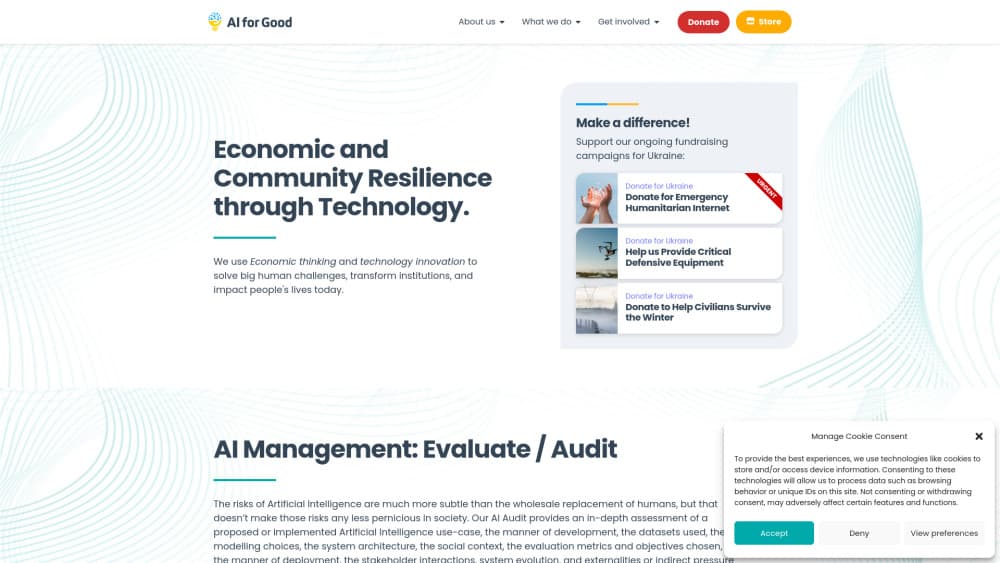
About AI for Good Foundation
What Is AI for Good Foundation
AI for Good Foundation is a 501(c)(3) public charity founded in 2015 by machine learning and social science researchers in the US and Europe. It works out of Berkeley, California, with an international network of staff, partners and volunteers. The stated goal is to point technology at the UN Sustainable Development Goals instead of at commercial products.
The foundation builds and runs its own software. LifeForce, also called MySyla, matches civilians in Ukraine with food, shelter and medical care across 37,000+ service locations. Eureka is a multilingual assistant that walks refugees through the paperwork of settling into a new country. Witness Ukraine records civilian testimony, and Economists for Ukraine organizes academic and policy work around reconstruction. An SDG data catalog and an AI for SDGs library cover the research side.
Nothing on the platform carries a subscription. Donations and grants pay for the work, and the tools stay free for the people who need them. That makes it a nonprofit AI foundation in the literal sense, with no seat licenses and no upsell path.
The limits are real. You can't sign up from anywhere in the world and get a general-purpose product. There's no public API and no self-serve dashboard. Each tool lives inside a specific program, usually with a local partner or government agency running it on the ground.
Getting Started
- Open ai4good.org and pick the program that fits: LifeForce for aid in Ukraine, Eureka for refugee integration, Witness Ukraine for testimony, or the library for research.
- If you're directly affected by displacement or conflict, reach the service through the local team or partner organization named on the program page.
- If you're a researcher or nonprofit, browse the SDG data catalog and the AI for SDGs library to see which datasets and prior work are already public.
- If you want to help, use the get involved pages to donate, volunteer or open a partnership conversation.
- Expect a human reply instead of an automated onboarding flow. Deployments get coordinated by staff, not by a signup form.
Product Information
A quick look at AI for Good Foundation's pricing, supported platforms, and performance.
Best for
The users, tasks, and scenarios where this tool fits best.
Users
- Nonprofit and NGO teams
- Researchers studying AI and sustainable development
- Displaced people and their caseworkers
- Funders and policy teams
Tasks
- Matching aid requests to nearby supply
- Navigating residency and benefits paperwork
- Recording civilian testimony
- Finding development datasets
Scenarios
- Humanitarian response inside Ukraine
- Early research on humanitarian AI
- A pilot with an established partner
Key features
LifeForce Aid Matching
LifeForce, branded MySyla in some materials, is a matching platform for civilians in Ukraine. It covers 37,000+ service locations and gives people real-time information on food, shelter, medicine and healthcare. The value sits in coordination: requests and supply get connected in one place instead of scattered across Telegram channels that became unsafe during the war.
Eureka Refugee Assistant
Eureka is a multilingual assistant built for refugees moving through integration in Europe. It asks a short set of questions, then produces a personalized set of steps and reminders for residency, benefits and local services. The design keeps user data on the phone, which matters for people who have reason to distrust databases.
Witness Ukraine
Witness Ukraine is a war journal platform for civilians to record and share testimony safely. Regional governments across Ukraine recognize it, which gives the collected accounts a path toward legal and historical use. It is a documentation tool first, not a social network.
SDG Data Catalog
The catalog collects development datasets from sources such as the Global Health Data Exchange, Global Forest Watch, NOAA and the Ocean Tracking Network. Each entry explains what the data covers, so a researcher can judge fit before downloading. It saves the tedious part of a project: finding out which portals are maintained and which are stale.
AI for SDGs Library
The library maps opportunities across the 17 goals, tracks AI and machine learning initiatives, and lists open resources. It works as a briefing for someone entering the field. You can see where work already exists before pitching a duplicate project.
Deploy, Educate, Govern
The foundation splits its work three ways. Deploy means building and scaling the tools above. Educate means working with students, economists, technologists and policymakers. Govern means drafting technology policy with governments. Economists for Ukraine sits in that last bucket, linking sanctions research and academic support to reconstruction planning.
Pros and cons
Pros
- Free for end users, with funding coming from donations and grants rather than licenses.
- Field presence backs the software. LifeForce runs with 40+ full-time staff inside Ukraine, so problems get handled locally.
- Privacy is designed in where it counts. Eureka keeps personal data on the user's device.
- Public research material is genuinely open, including the SDG data catalog and the AI for SDGs library.
- Software work is paired with policy and economics, which helps when a deployment needs government buy-in.
Cons
- No public API and no developer documentation, so a team that wants to build on the tools has no technical entry point.
- Coverage is program-specific. Eureka and LifeForce serve particular regions, and there's no global product to fall back on.
- No published pricing or service terms, which makes procurement slow for institutions that need a contract and a support SLA.
- Most access runs through partner organizations, so individuals can't always self-serve.
Frequently asked questions
Yes. The tools are free for the people who use them, and the organization is funded by donations and grants. There's no paid tier and no subscription.
Related content
Explore related tools, skills, and articles for AI for Good Foundation.
AI for Good Foundation Alternatives

Odyssey 3
Odyssey · OtherOdyssey-3 is Odyssey's foundation world model. It simulates physics in real time, turns a prompt into an interactive environment, and adapts to robots, cars and games.

JarvisCore
Prescott Data · Coding · Productivity · OtherJarvisCore is an open source Python runtime where AI agents work as equal peers on an agent mesh, claim tasks from a shared ledger, and reach external services through a zero-trust broker.
Clef
Cloudflare · Business · OtherClef is Cloudflare's open-source decision model for Workers AI. It returns calibrated probabilities for typed questions, not generated text, so agents can classify, route, and act fast.