

Aidaptive
Jarvis ML Inc. (Aidaptive) · Marketing · Business
Aidaptive is a predictive AI platform for vacation rental managers and hotels. It personalizes property search, recommendations, guest audiences, and pricing so more bookings land on your own site.
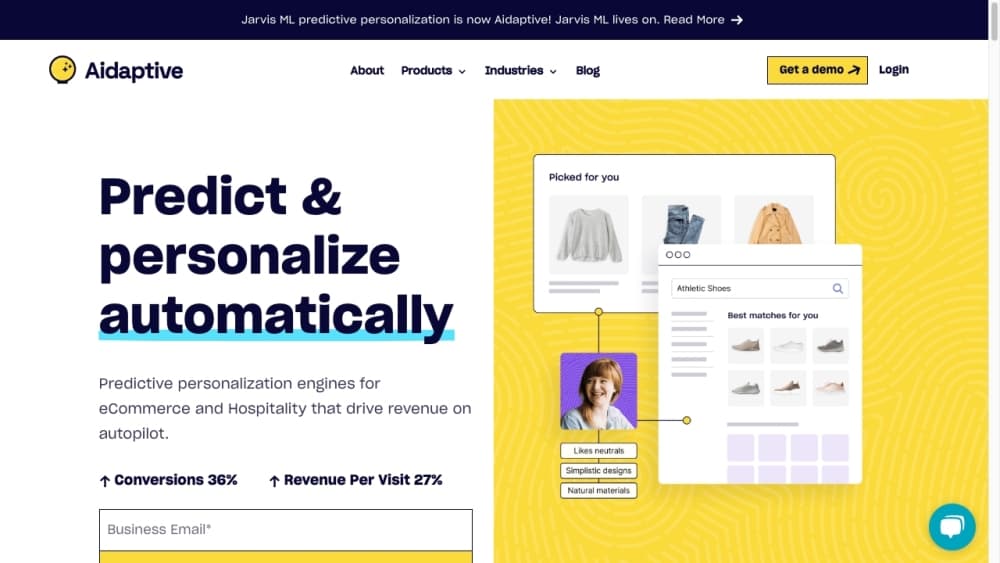
About Aidaptive
What Is Aidaptive
Aidaptive is a machine learning platform built for the booking journey. It reads behavioral, contextual, and catalog data, then ranks homes, segments guests, and adjusts rates for each visitor. The company sells to vacation rental managers (VRMs) and hotel groups, not to individual travelers.
The product line started as a personalization engine and now covers six modules: recommendations, search, audiences, pricing, agentic ads management, and a guest-facing agent called Ask Aidaptive. All of them run on the same ranking core, so predictive personalization stays consistent when a guest searches on your site and later opens an email. Deployment takes 16 to 24 hours according to the vendor, mostly because the work is connecting your property management system and booking engine rather than writing code.
Two limits matter before you book a demo. There's no self-serve signup and no published price, so access runs through a sales conversation and a contract. And the platform is narrow by design. A SaaS company or a general online store gets little from it, since the models are trained on travel inventory and booking windows.
Aidaptive is the commercial brand of Jarvis ML Inc., founded in Cupertino in 2021 by Rakesh Yadav, who spent 14 years on machine learning for Google Ads and Google Payments. The company raised a $16 million seed round in April 2022 led by Dell Technologies Capital and SHAKTI, then launched the Aidaptive brand in November 2022. It reports more than 100 VRM customers covering over 30,000 homes.
Getting Started
- Request a demo from the Aidaptive site. A solutions contact reviews your portfolio size, booking stack, and the channels you want to personalize.
- Connect your data sources. The team wires up your property management system, booking engine, and email or CRM tools. Streamline VRS, Guesty, Escapia, Track, and Barefoot are among the listed integrations.
- Agree on the modules you need. Most operators start with recommendations and search, then add audiences, pricing, or the agentic tools once traffic data builds up.
- Go live and review results. The vendor quotes a 16 to 24 hour deployment, after which ranking and personalization apply to live sessions and campaign segments update on their own.
Product Information
A quick look at Aidaptive's pricing, supported platforms, and performance.
Best for
The users, tasks, and scenarios where this tool fits best.
Users
- Vacation rental managers with 100 or more homes
- Marketing and revenue leads at hotel groups
- Independent property managers fighting OTA dependence
Tasks
- Ranking listings for first-time visitors
- Building campaign segments without manual tagging
- Setting rates around margin instead of occupancy alone
- Cutting paid search waste
Scenarios
- Peak season with tight inventory
- A new portfolio coming off a PMS migration
- Guests who browse on mobile and book later by email
Key features
Predictive Recommendations
The recommendation engine models each guest against similar and unusual customer groups, then surfaces properties that fit the current session. It uses page views, filters, device, location, traffic source, and abandoned paths, not just past bookings. For a manager, that means a family browsing four-bedroom beach homes gets comparable units in the same building instead of whatever sits at the top of the default sort.
Predictive Search
Search results reorder as a guest types or applies filters. The engine reads the intent behind a query rather than matching keywords, so "house with a pool near the beach" returns homes that fit the description even when the listing title says something else. Results also adapt for anonymous visitors by borrowing patterns from guests with similar behavior. Conversion improves because the guest finds a plausible match in fewer clicks.
Predictive Audiences
Aidaptive builds guest segments from behavior, geography, device, booking window, and family size with no manual tagging. Segments refresh in real time as people browse, book, or abandon a cart, and they export to a CRM, email platform, or ad network. Reactivation, upsell, and abandonment campaigns each get a matching audience instead of one broad list reused everywhere.
Predictive Pricing
Pricing here is margin-aware. The model weighs occupancy against profitability, so it doesn't chase fill rate at any cost and doesn't stop at rate parity with competitors. Managers set the boundaries, and the engine proposes rates per date and segment. That makes it closer to margin-aware dynamic pricing than to a rule based rate manager, and it suits operators who already know their cost per booking.
Agentic Ads Management
The ads agent reads live occupancy, demand signals, and competitor rates, then moves budget toward nights that genuinely need help. It pulls spend back when a date is close to selling out, which addresses the classic problem of paying for bookings you would have won anyway. The vendor says the module was built by engineers who worked on Google Ads machine learning.
Ask Aidaptive
Ask Aidaptive is a set of agents connected to your PMS and OTA channels. They draft guest replies in your brand voice, handle booking conflicts across channels, monitor reviews, and answer pricing questions using the same data as the pricing engine. It runs continuously, which matters for inquiries that arrive outside office hours. A human still needs to set the escalation rules and approve sensitive replies.
Pros and cons
Pros
- One ranking core behind search, recommendations, audiences, and pricing, so personalization stays consistent across the site and email.
- Handles anonymous traffic by matching sessions to similar guest groups, which is where most first-time visitors start.
- Deployment is quoted at 16 to 24 hours with managed integrations, so a small marketing team doesn't need engineers on the project.
- The agentic layer covers ads and guest communication, two jobs that usually sit in separate tools and separate budgets.
- Vendor-reported results include a 235 percent lift in direct booking revenue, and named customers such as Exceptional Stays and JZ Vacation Rentals are willing to talk about the work.
Cons
- No public pricing and no self-serve trial. You can't test the ranking quality before a sales call, and budget approval depends on a custom quote.
- Built for travel inventory. Hotels and vacation rentals fit, while other ecommerce categories fall outside the model's training.
- Results depend on clean PMS and booking data. Duplicate listings or missing rate plans weaken recommendations and pricing signals.
- The performance numbers come from the vendor and customer testimonials, not from an independent audit, so treat the 235 percent figure as a marketing claim.
Frequently asked questions
It personalizes the booking journey for hospitality operators. The platform ranks properties in search and recommendation slots, groups guests into campaign segments, suggests rates, and runs ad and guest communication agents. Everything feeds off one model of guest intent.
Related content
Explore related tools, skills, and articles for Aidaptive.
Aidaptive Alternatives

ngram 2.0
ngram · Video · Marketingngram 2.0 is an AI video generator for teams. It turns a prompt, a screen recording, or a product URL into a narrated explainer, product demo, or AI avatar video, and every scene stays editable.

shippedit.me
Krawlup · Marketing · Businessshippedit.me now redirects to Krawlup, a web platform that audits SEO, AEO and page speed every week, then hands the fixes to AI coding agents over MCP.

MePersona
MePersona, Inc. · Writing · Productivity · MarketingMePersona is an AI unified inbox for creators. It learns your voice, drafts replies to fan messages from 12 platforms, and sends only what you approve.