

Aidy
Aidy · AI Assistant
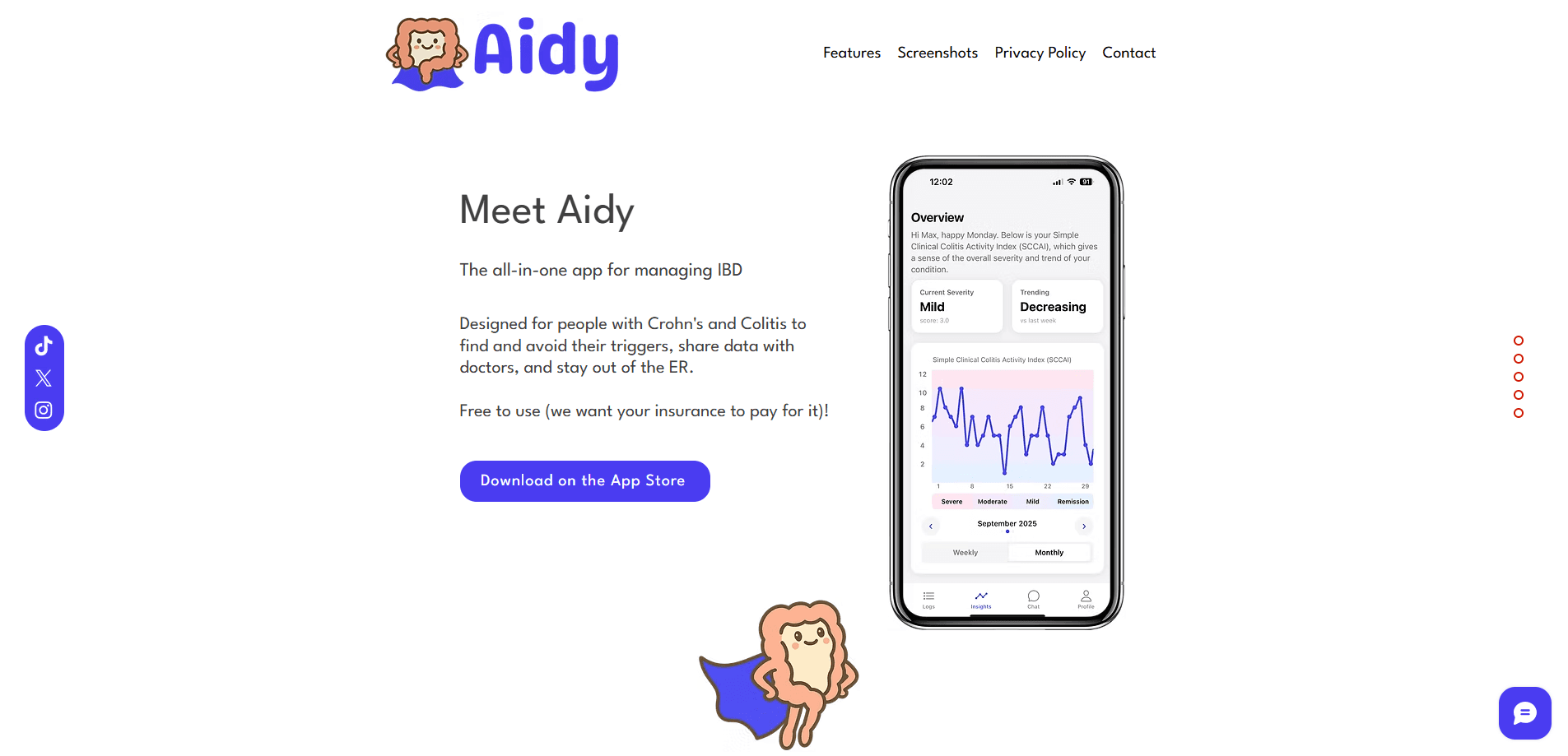
Aidy is a free mobile health app built for people living with Inflammatory Bowel Disease, mainly Crohn's disease and ulcerative colitis. It runs through text messages or an iPhone app, and its job is simple: help you log how you feel each day, then show you patterns you'd never notice on your own. If you've ever walked into a GI appointment with no idea what to say about the last three months, Aidy is aimed squarely at you. That's the short version.
About Aidy
What Is Aidy
Aidy is a daily support tool for IBD patients. Instead of a pile of spreadsheets and half-remembered flare-ups, you get short check-ins that capture symptoms, stool habits, and how you're actually feeling. The app then turns that log into something useful: which foods, stress levels, or missed doses tend to line up with your bad days. Do you really know your own triggers? Most people don't.
The core problem it solves is memory. Most people with Crohn's or UC can't accurately describe a flare that started six weeks ago, and doctors make decisions on incomplete pictures. Sound familiar? Aidy also bundles a learning center with plain-language articles on medications, flares, and nutrition, plus a medication access section that checks typical insurance requirements and points you toward manufacturer savings programs. No sign-up needed for that part.
The biggest limitation is scope. Right now Aidy covers only Crohn's disease and ulcerative colitis, so it won't help you with IBS or other gut conditions. It's also a support tool, not a treatment. The company states plainly that it doesn't replace medical advice, so think of it as a better set of notes to bring to your doctor, not a substitute for one.
Getting Started
- Text the Aidy number shown on the website, or download the Aidy app from the App Store if you'd rather use your phone.
- Answer the short intake questions about your condition so Aidy knows if you're managing Crohn's or UC.
- Do a daily check-in when it prompts you. It takes a minute and mostly means tapping a few symptom ratings.
- Read back through your log and the learning center articles once a couple of weeks of entries pile up.
- Share your symptom history with your care team at your next appointment, either by showing your phone or exporting the summary.
Product Information
A quick look at Aidy's pricing, supported platforms, and performance.
Best for
The users, tasks, and scenarios where this tool fits best.
Users
- People newly diagnosed with Crohn's or ulcerative colitis who need help understanding their own patterns
- Long-term IBD patients whose symptoms shift over time and who want a record to compare against
- Anyone who struggles to remember details at GI appointments and wants data to back up how they feel
Tasks
- Logging daily symptoms, stool frequency, and pain levels without opening a complicated tracker
- Spotting trigger foods, stress patterns, or adherence gaps that line up with flares
- Preparing a clear symptom summary to hand to a gastroenterologist
Scenarios
- Flare-up periods when symptoms change fast and you need to track what's moving
- The weeks before a specialist appointment, when an accurate history matters most
- Starting a new medication and wanting hard evidence on whether it's working
Key features
Daily Symptom Check-Ins
Aidy prompts you with a short check-in each day and turns your answers into a running record. Symptom tracking for IBD lives or dies on consistency, so the design favors small and frequent over big and rare. You log stool habits, pain, and energy in under a minute, and the app keeps it organized so you never have to reconstruct a bad week from memory.
Pattern and Trigger Identification
Over time, your daily log becomes a data set, and Aidy uses it to surface links between what you do and how you feel. If your symptoms spike on days you skip a meal or sleep badly, that connection shows up. That's the whole idea behind IBD trigger tracking: find the suspects, then test them. It's a starting point, not an answer. It won't diagnose anything, but it gives you and your doctor something concrete to investigate.
Learning Center
The app ships with clear, practical articles on Crohn's, UC, medications, flares, and nutrition, written for patients rather than clinicians. You can browse by topic or jump straight to the condition you're managing. It's the kind of background reading that makes a diagnosis feel less like a black box.
Medication Access Support
A dedicated section checks typical insurance requirements and connects you with official savings, enrollment, nursing, training, and delivery programs from drug manufacturers. You don't need to sign up to use it, which is a refreshing change from tools that gate every feature behind an account.
Care Team Communication
Aidy helps you bring your data into the exam room. Instead of describing a flare in vague terms, you can show your symptom history and let the pattern do the talking. For patients who freeze up during short appointments, that shift alone changes the conversation. It's a small thing. It matters anyway.
Text-First, App-Optional Access
You can use Aidy entirely through SMS, with no app store download required, or install the iOS app if you prefer a visual interface. The text route keeps the barrier low for older patients or anyone who doesn't want another icon on their home screen.
Pros and cons
Pros
- Completely free, with no paid subscription tier, funded instead by health plans, employers, and research partnerships
- Low friction to start, since texting the service takes seconds and needs nothing installed
- Combines tracking, an IBD learning library, and medication access help in one place
- Encourages better doctor conversations by turning fuzzy memories into a documented history
- Explicit privacy stance: data is encrypted, not sold, and no ads run in the app
Cons
- Only supports Crohn's disease and ulcerative colitis, so patients with IBS or other gut conditions are out of luck for now
- iOS and SMS only, meaning Android users have to rely on the text experience rather than a native app
- Pattern insights depend on how faithfully you log, so gaps in check-ins weaken the whole picture
- It's educational support, not a medical device, so it won't replace real clinical guidance or monitoring
Frequently asked questions
Yes. Aidy has no paid user subscriptions. The company generates revenue by working with health plans, employers, and researchers, and it states this directly on its site. You won't hit a paywall for core tracking features.
Related content
Explore related tools, skills, and articles for Aidy.
Aidy Alternatives

Iplan AI
Iplan AI · Productivity · AI AssistantIplan AI is an AI travel planner that turns a few trip details into a full day-by-day itinerary in seconds. You answer questions about your destination, interests, budget, and travel companions, and the tool builds a plan you can edit, share, and carry with you on any device. It targets travelers who want a solid draft without spending hours in spreadsheets and browser tabs. Think of it as an itinerary generator that does the tedious part for you.

Screenhelp
Screenhelp · Productivity · AI AssistantScreenhelp is an AI screen assistant that turns a single keyboard shortcut into real-time help. You press Ctrl+Shift+Space, it captures what's on your screen, and it streams an answer into a private panel in about two seconds. Think of it as an AI screenshot helper you trigger on demand. It runs on Mac, Windows, and the web, starts free with 30 answers a month, and stays invisible during screen sharing on Zoom, Teams, and Google Meet.

Rainbow
Rainbow · AI AssistantRainbow is an AI weather forecast app built around short-term precipitation nowcasting. Its engine pushes min-by-min rain and snow predictions up to four hours ahead, blending live satellite and radar feeds into hyperlocal forecasts. The app adds live rain radar, a seven-day outlook, precipitation alerts, home-screen widgets, and a hurricane tracker, and it runs on both Android and iOS with a free tier plus paid upgrades.