

Airtop
Airtop · Coding
Airtop is a cloud browser platform that lets AI agents and automation tools drive a real browser through a natural-language API. It works with sites that have no API.
About Airtop
What Is Airtop
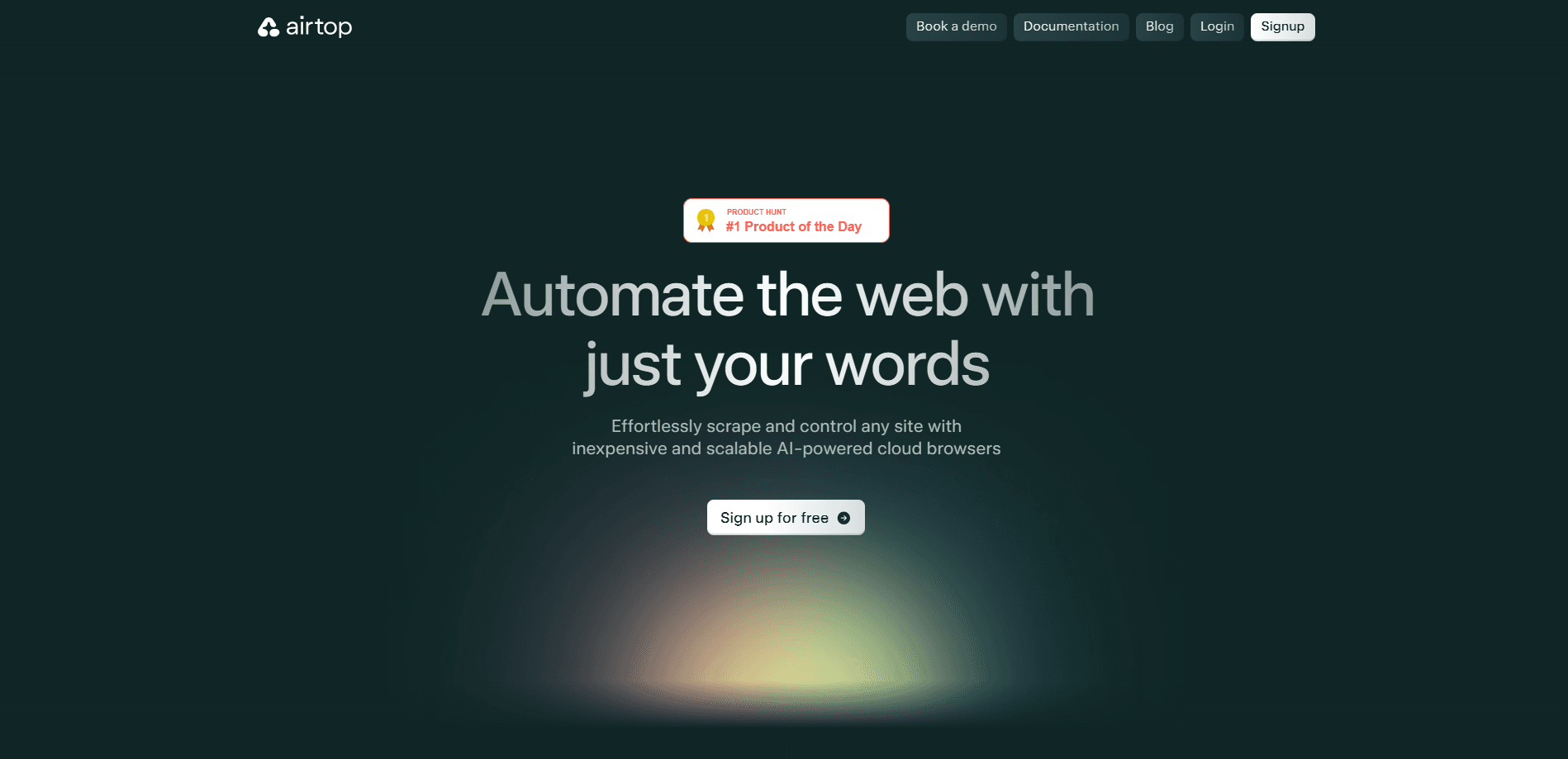
Airtop is a cloud browser platform. You, your AI agent, or your scripts control a real web browser running in the cloud, and you tell it what to do in plain English through an API.
Most automation starts with a service's API. When that API doesn't exist or doesn't cover what you need, teams fall back on browser scripts. Airtop targets that second path and removes most of the pain: it manages the browser fleet, handles logins, proxies, and CAPTCHAs, and lets an LLM read and act on pages instead of brittle CSS selectors.
The catch is scope. Airtop is built for developers and technical teams who can write code and wire up an API key. It bills in credits, so heavy browser or AI use costs more than a flat subscription suggests. Anyone who just wants a no-code scraper for a single site will find it heavier than needed.
Getting Started
- Sign up at the Airtop portal and grab an API key.
- Install the Node.js or Python SDK, then create a cloud browser session with one line of code.
- Drive the page with the AI API: send a prompt like "extract the title, price, and link of every result" and get structured JSON back.
- Add a live view or a saved profile when the target site sits behind a login, so your agent can browse on the user's behalf.
- Deploy the workflow as an automation and run it on a schedule, a trigger, or a webhook.
Product Information
A quick look at Airtop's pricing, supported platforms, and performance.
Best for
The users, tasks, and scenarios where this tool fits best.
Users
- Developers and automation engineers
- Growth and revenue-ops teams
- Data and research teams
Tasks
- Scraping data behind a login
- Filling forms at scale
- Monitoring pages for changes
Scenarios
- Invoice reconciliation
- Early-stage market research
- Recurring lead generation
Key features
Natural-Language Browser Control
Instead of writing selectors, you send a prompt and Airtop figures out what to click, type, or read. Its API handles paginated extraction, so you can ask for "up to 1,000 results across all pages" and get JSON back. This keeps automations working even when a site changes its layout.
Agent Builder Compiles Workflows
Agent Builder takes a plain-English description of a workflow and compiles it into reusable, deterministic code. Airtop says these compiled agents run up to 100 times more efficiently than agents that reason through every step at runtime. Same input, same output, every run.
Authenticated Sessions and Profiles
Airtop can show users a live browser view so they log in themselves. Once a login happens, you save the profile with its cookies and restore it later. Airtop states it never stores passwords and keeps the whole profile encrypted.
Built-In Proxies and CAPTCHA Handling
A residential proxy network covers more than 100 million IPs across 100+ countries, and you can bring your own proxy vendor instead. The platform also handles CAPTCHA solving, which is one of the main reasons large scraping jobs fail.
Playwright, Puppeteer, and Selenium Support
When you want lower-level control, the cloud session exposes a Chrome DevTools Protocol endpoint. You connect Puppeteer, Playwright, or Selenium over CDP and keep writing the kind of script you already know.
Pre-Built Integrations and a Secure Vault
Connectors cover HubSpot, Google Ads, Google Sheets, Gmail, Slack, Airtable, and more. For systems without a connector, you store API keys, OAuth tokens, and passwords in the Airtop vault so agents can use them without exposing them in code.
Enterprise Security and Observability
Airtop is SOC 2 Type II certified and HIPAA compliant, and it says customer data is never used for model training. Real-time logs show every action, result, and request, which matters when an automation touches financial or customer records.
Pros and cons
Pros
- Reaches websites that have no API, including portals and legacy tools behind a login.
- Natural-language API cuts out fragile selector maintenance and lets non-specialists describe tasks.
- Agent Builder compiles workflows into code, which Airtop says cuts runtime cost sharply versus LLM-per-step agents.
- Security posture is strong for a browser automation tool, with SOC 2 Type II, HIPAA, encryption, and no training on customer data.
- Ready-made integrations and a step-by-step startup flow shorten the time to a first working agent.
Cons
- Credit-based billing makes total cost hard to predict, especially with heavy AI or proxy use.
- The free plan caps you at 3 simultaneous sessions and 1 deployed agent, so real testing needs a paid tier.
- Building anything beyond a basic prompt requires coding skills and comfort with an API.
- Vault, proxy, and profile features add a learning curve before automation runs reliably in production.
Frequently asked questions
Airtop runs web browsers in the cloud and lets an API or an AI agent control them. You can scrape pages, fill forms, log into accounts, and monitor sites, all without managing your own browser infrastructure.
Related content
Explore related tools, skills, and articles for Airtop.
Airtop Alternatives

Base Code
Base44 (Wix) · Coding · ProductivityBase Code is a shared cloud development environment from Base44. Teammates describe changes to an existing GitHub codebase in chat, preview them live and send them back as pull requests.

Google EmbeddingGemma 2
Google DeepMind · Writing · Image · CodingGoogle EmbeddingGemma 2 is a 740M-parameter open model that turns text, code, images, audio, and video frames into vectors in one 768-dimension space, running on phones and laptops.

GitGlow
GitGlow · Coding · ProductivityGitGlow is a local-first desktop Git client that lets independent developers review their own code and their AI agents' changes in one place before shipping.