

Aisera
Aisera (part of Automation Anywhere) · Coding · Marketing
Aisera is an enterprise AI agent platform for IT, HR and customer service. Its agents answer questions, run routine tasks and close tickets through 400+ system connectors.
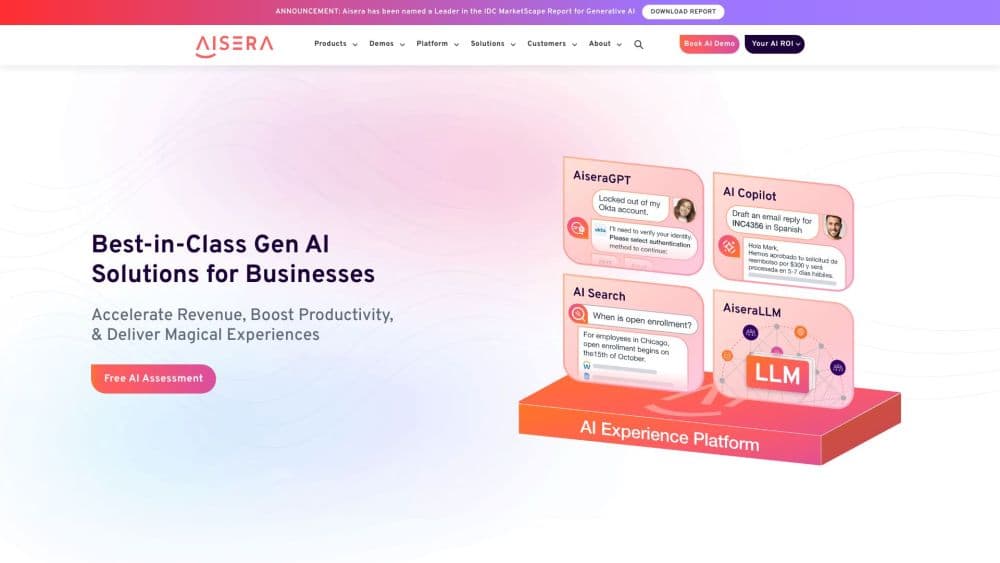
About Aisera
What Is Aisera
Aisera is a platform for building and running enterprise AI agents that handle employee and customer requests. It sits on top of the systems a company already uses, such as ServiceNow, Jira, Workday, Okta and Microsoft Teams, then answers questions in plain language and takes the next step when an answer isn't enough. Someone asking about a locked account gets a reset link and a confirmation, not a tutorial.
The pitch is simple. Most support volume is repeatable work: password resets, software access, benefits questions, order status. Aisera turns those into conversations that finish on their own, and hands the leftovers to a human with context attached.
There are caveats. Aisera is sold to companies, not individuals. There's no self-serve signup, no published price list and no free tier, so you can't test it on a Sunday afternoon without talking to sales. Results also depend on how clean your knowledge base and ticketing data are. Point an agent at messy documentation and it will sound confident and be wrong.
The company is now part of Automation Anywhere, which completed the acquisition and folded the product into its agentic automation lineup. Existing deployments keep running under the Aisera brand.
Getting Started
- Book a demo and scope the domains you want covered first, usually IT service desk, then HR or finance.
- Connect the systems of record: ticketing, knowledge, identity and the chat channels your staff already use.
- Pick prebuilt agents or build your own in Agent Composer, then set guardrails on what each agent may read and do.
- Run a pilot with one department, watch resolution rates in the analytics view, and widen the rollout once the numbers hold.
Product Information
A quick look at Aisera's pricing, supported platforms, and performance.
Best for
The users, tasks, and scenarios where this tool fits best.
Users
- IT service desk teams
- HR shared services
- Customer support organizations
Tasks
- Password and MFA resets
- Access requests
- Policy and knowledge questions
- Ticket triage and routing
Scenarios
- A service desk drowning in level-one volume
- Support across several channels
- Growth without proportional hiring
Key features
Aisera Assistant
This is the employee-facing companion. It answers questions and then executes the follow-up action across departments, so a single conversation can start with a payroll question and end with a completed form. It works inside the chat tools people already have open.
Agent Composer
Agent Composer lets teams describe a new agent in natural language instead of code. You define what it handles, which systems it can touch and what it should refuse, then test it before release. It's the fastest path for a department with a niche process that no prebuilt agent covers.
Aisera Unify
Aisera Unify is the integration layer, built on open standards including A2A, MCP and AGNTCY. It lets you plug in third-party agents and tools alongside Aisera's own, which matters if you've already bought agents elsewhere and don't want a second silo. The point is orchestration, not lock-in.
Agent Assist
Agent Assist works on the human side of the desk. It drafts replies, surfaces the next best action and summarizes long threads so a rep doesn't reread forty messages. New hires tend to feel the difference first, since the suggested answer carries the institutional knowledge they haven't learned yet.
Prebuilt Agents and Connectors
The library ships with more than 400 connectors for ticketing, knowledge and identity systems, plus a large set of pretrained workflows for common tasks. Aisera's own materials cite 1,200+ workflows, and the count is the reason a deployment can go live in weeks rather than quarters. ITSM automation is the deepest area, followed by HR and customer service.
Governance and Analytics
TRAPS is Aisera's governance framework: trusted, responsible, auditable, private and secure. In practice that means permission scoping, audit trails and observability through OpenTelemetry, which your security team will ask about before anything goes live. The analytics view tracks containment, resolution and handoff rates per agent.
Pros and cons
Pros
- Wide connector coverage means most enterprises find their ticketing, identity and knowledge systems already supported.
- Open standards in Aisera Unify make it easier to mix in agents from other vendors instead of replacing everything.
- Agent Composer lowers the build barrier, so a process owner can ship an agent without filing a ticket with engineering.
- Channel coverage is broad: Teams, Slack, web, email, voice and mobile all reach the same agent.
- Governance tooling is concrete rather than a slide, with audit trails and per-agent permission scopes.
Cons
- No public pricing and no free trial. You can't compare Aisera pricing against alternatives without a sales conversation, which slows down evaluation.
- It's an enterprise purchase. Small teams will find the setup effort and contract size hard to justify.
- Answer quality tracks your knowledge base. Stale documents produce confident wrong answers, and cleaning them is your project, not Aisera's.
- The product line is broad and the naming takes time to learn: Assistant, Agent Assist, Unify, Composer, TRAPS and GenIQ all sit in one platform.
Frequently asked questions
It runs AI agents that answer employee and customer questions and then carry out the related task, such as resetting a password or opening an access request. The agents connect to your existing systems rather than replacing them.
Related content
Explore related tools, skills, and articles for Aisera.
Aisera Alternatives

Base Code
Base44 (Wix) · Coding · ProductivityBase Code is a shared cloud development environment from Base44. Teammates describe changes to an existing GitHub codebase in chat, preview them live and send them back as pull requests.

Google EmbeddingGemma 2
Google DeepMind · Writing · Image · CodingGoogle EmbeddingGemma 2 is a 740M-parameter open model that turns text, code, images, audio, and video frames into vectors in one 768-dimension space, running on phones and laptops.

GitGlow
GitGlow · Coding · ProductivityGitGlow is a local-first desktop Git client that lets independent developers review their own code and their AI agents' changes in one place before shipping.