

AISight
The Archon · Coding · Marketing
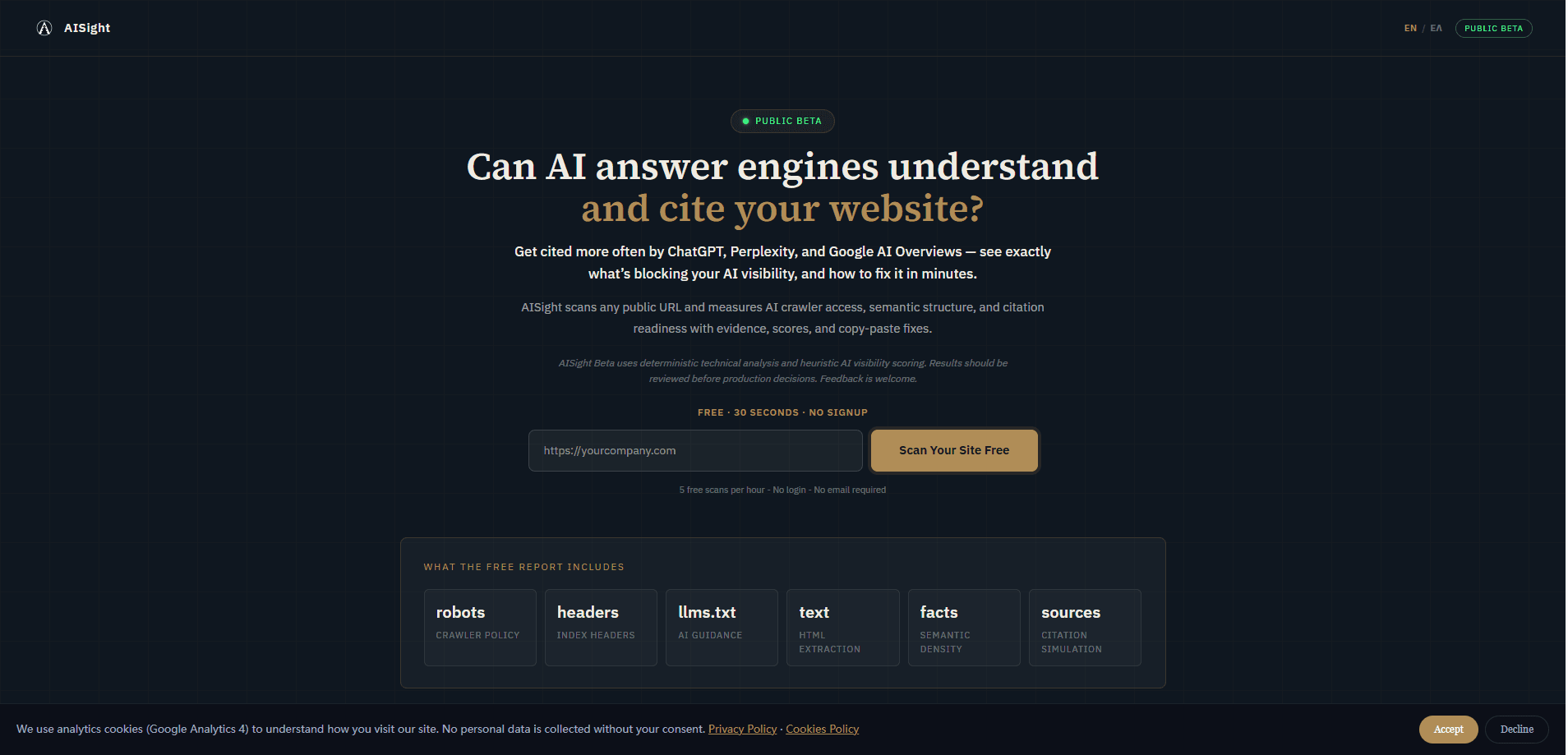
AISight is a free AI visibility audit tool that scans any public URL and reports whether AI answer engines can find, parse, and cite it. You paste a link, wait about 30 seconds, and get back a visibility score, a prioritized list of what's broken, and copy-paste fixes. It checks the signals that matter to ChatGPT, Perplexity, Google AI Overviews, and Bing Copilot: crawler access, semantic structure, and citation readiness. There's no signup, no email, and no login, so you can run several scans an hour without an account.
About AISight
What Is AISight
AISight is an AI visibility and citation readiness tool built by The Archon. It answers a question traditional SEO tools mostly ignore: when someone asks an AI assistant about your topic, can that assistant actually read your page and quote it as a source? If you want to get cited by ChatGPT, Perplexity, or Google AI Overviews, that question is the whole game. Think of AISight as a specialized AI SEO tool rather than another rank tracker.
The way AI systems work is different from search engines. They reason, summarize, and cite rather than rank. That means a page can rank well on Google and still be invisible to ChatGPT, because the crawler never got access, the headings were a mess, or there were no clear factual statements to extract. AISight scans for those gaps and scores them.
The tool runs on deterministic technical analysis plus heuristic scoring, and the site is upfront that this is an Early Access release. You should treat the results as a strong starting point rather than gospel before making production decisions. The main limits: it checks one URL at a time, it measures technical readiness rather than guaranteeing citations, and there's no account system, so scans aren't saved anywhere for you.
Getting Started
- Go to the AISight site in any browser. No login or email is required.
- Paste a public URL into the scan field, for example your homepage or a key landing page.
- Let the scan run. It pulls the HTML, reads index headers, parses robots.txt, checks for an llms.txt file, and maps the H1 to H4 heading hierarchy.
- Wait for the visibility score and the prioritized issue list, which ranks problems by expected impact.
- Apply the copy-paste fixes to your site, then rescan to confirm the score moved.
Product Information
A quick look at AISight's pricing, supported platforms, and performance.
Best for
The users, tasks, and scenarios where this tool fits best.
Users
- SEO managers and content leads who own organic traffic and want a second lens now that answer engines sit alongside Google
- Web developers and technical SEOs who need a concrete checklist of crawl and markup fixes rather than vague advice
- Marketing and PR teams at small brands whose competitors show up in AI answers while they don't
Tasks
- Auditing a single landing page for AI crawler access before a campaign launch
- Finding missing or blocked signals, like a robots.txt rule that shuts out ChatGPT's crawler
- Checking whether a page has the clean headings and structured data an AI system needs to parse it correctly
- Getting copy-paste fixes for citation readiness so a page's facts are easy to quote
Scenarios
- A content refresh where rankings are fine but AI referrals are flat, and you need to know why
- A pre-launch check on a new site before you spend on promotion
- A quick competitor comparison, running the same scan on a rival URL to see what they do better
Key features
AI Visibility Score
Every scan distills the raw technical findings into a single evidence-based score. Instead of a wall of raw audit output, you get one number that tells you roughly where a page stands for AI visibility. The score is meant to be directional, so use it to track progress across rescans rather than to compare unrelated pages.
Crawler Access Checks
This is where a lot of pages quietly fail. AISight checks whether AI and search crawlers can technically reach the page at all. It reads index headers, parses robots.txt, and looks for a source-guidance file such as llms.txt. A single bad Disallow rule aimed at AI bots can keep your best content out of every answer engine, and this check surfaces it fast.
Semantic Structure Analysis
Once a crawler reaches a page, the content still has to be organized well enough to parse. AISight extracts the H1 to H4 heading hierarchy, looks at entities, and reviews structured data. If your meaning is buried in design or split across vague headings, an AI system guesses, and guessing leads to misattributed facts.
Citation Readiness Scoring
Citation readiness measures how easily an answer engine can pull and quote your own factual statements. Pages full of marketing language give an AI nothing to cite, while pages with clear, self-contained claims are easier to attribute. This feature tells you whether a page is quotable or just readable.
Evidence and Prioritized Fixes
The report doesn't stop at what's wrong. It ranks issues by expected impact and pairs each one with copy-paste implementation guidance. You get three things from a scan: what's measurably broken, how much fixing it's expected to help, and what to tackle first. That ordering matters when you can only touch a handful of pages this week.
Runs Without an Account
There's no login, no email, and no signup wall. You get five free scans per hour, which is plenty for spot-checking a few pages in a sitting. The trade-off is that nothing is saved across sessions, so note your scores yourself if you want a history.
Pros and cons
Pros
- Free to use with no signup or email, so you can test it on your own pages in under a minute
- Covers the specific signals answer engines care about, like crawler access and llms.txt, rather than recycling generic SEO advice
- Copy-paste fixes and impact ranking make the output easy to act on instead of just diagnostic
- Handles robots.txt, index headers, heading structure, structured data, and citation readiness in one pass
Cons
- It's an Early Access release with heuristic scoring, so results should be reviewed before you act on them at scale
- Scans run one URL at a time, which gets tedious if you manage a large site
- Nothing is stored without an account, so you lose your scan history when you close the tab
- A good score signals readiness, not a guarantee that ChatGPT or Perplexity will actually cite you
Frequently asked questions
It audits a public URL for AI visibility, checking whether AI crawlers can access the page and whether its structure and facts are easy for an answer engine to parse and cite. You get a score, a ranked issue list, and fixes.
Related content
Explore related tools, skills, and articles for AISight.
AISight Alternatives
Forefront
Forefront · CodingForefront is a web platform for building with open-source AI. It lets you fine-tune leading open-source language models on your own data, evaluate how they perform, and run them through an API or export them to host yourself. Developers who want the convenience of a closed-source platform but insist on owning their models and data are the target audience here.

Startkit
StartKit.AI · CodingStartkit is a boilerplate for building AI SaaS and AI wrapper products. Think of it as an AI startup boilerplate with the boring parts already wired up: authentication, Stripe and Lemon Squeezy payments, usage limits, transactional email, and an AI API starter that talks to OpenAI, Anthropic, Groq, or Llama. You clone the repo, set your price, and start on the part of your product that people actually pay for. It's Next.js under React and Tailwind, so most of the boilerplate code already feels familiar.
Testim
Tricentis · CodingTestim is an AI-powered test automation platform for building and running end-to-end tests across web, mobile, and Salesforce applications. It leans on machine learning to keep tests stable when an interface changes, so teams spend less time fixing broken selectors. Not bad for an automated testing tool you can start using today. You create tests by recording actions in a browser, then optionally add JavaScript when you need more control. It's a solid pick for busy QA teams.