

Akkio
Akkio · Coding · Marketing
Akkio is an AI analytics platform built for media agencies and data providers, combining no-code modeling, Chat with Data, and campaign workflow automation in one connected environment.
About Akkio
What Is Akkio
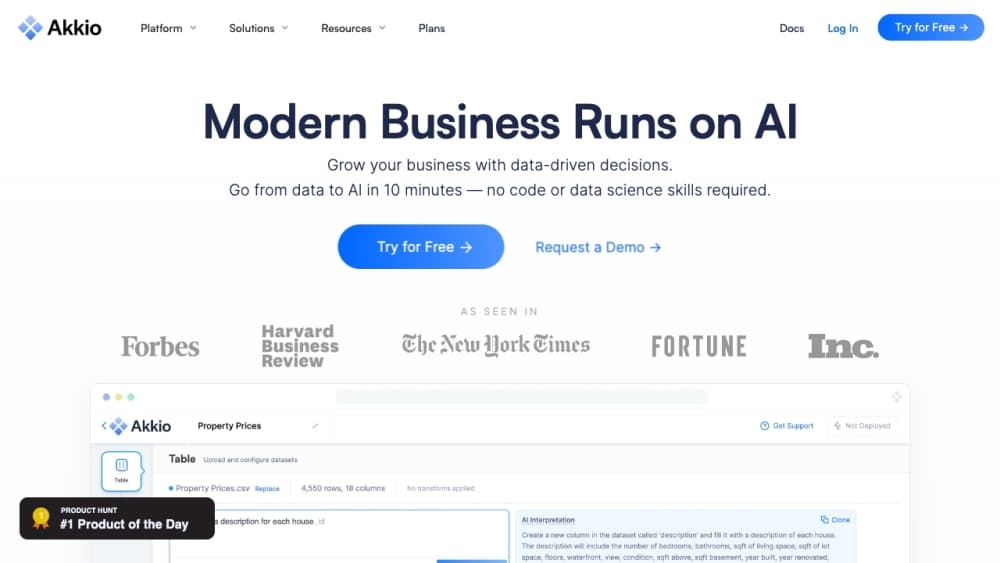
Akkio is an AI analytics platform that helps media agencies and data providers put all their data and knowledge to work across campaign workflows. For any media agency AI stack, it acts as the layer where data work runs. Instead of scattering analysis across spreadsheets, dashboards, and disconnected scripts, teams run their data work inside one platform where every tool draws on the same context.
The core problem it addresses is fragmentation. Strategists, data scientists, engineers, and client leads often work from different copies of the same information, and that friction shows up as slow turnaround and missed opportunities. Akkio connects those roles so predictions, reports, and audience insights move together through the campaign lifecycle.
Akkio runs on infrastructure that can sit inside your own cloud environment and operate on top of data you already hold, which keeps security in your control. The tradeoff is fit: the platform is aimed at agencies and data providers with real campaign operations, not at individuals looking for a lightweight personal analytics tool. Pricing reflects that focus, and there is no low-cost public tier to try first without a sales conversation.
Getting Started
- Request a demo through the Akkio site and walk your use case through with the team.
- Connect your data sources and confirm how Akkio will deploy inside your environment.
- Clean and transform a first dataset, then build a no-code model or an audience segment on top of it.
- Use Chat with Data and reporting tools to explore results and generate client-ready output.
- Deploy predictions through a web application or API so the rest of your team can act on them.
Product Information
A quick look at Akkio's pricing, supported platforms, and performance.
Best for
The users, tasks, and scenarios where this tool fits best.
Users
- Media agencies
- Data providers
- Marketing analysts
Tasks
- Building lookalike audience segments
- Lead scoring and forecasting
- Cleaning and transforming client data
Scenarios
- Running recurring client reporting
- White labeling analytics as a service
- Evaluating campaign performance mid-flight
Key features
Chat with Data
Chat with Data lets you ask questions about your datasets in plain language and get answers back without writing queries. It works alongside visualizations and live dashboards, so you move from a question to a chart without switching tools. The feature is the main entry point for team members who are not data specialists.
No-Code Modeling
Akkio builds and deploys machine learning models without code, covering common predictive analytics work. You point it at a dataset, pick a target, and it produces a predictive model you can use for lead scoring, forecasting, or sentiment analysis. Models deploy through a web application or an API, which keeps the handoff to engineering light.
AI-Native Context
Every tool inside Akkio draws on your data and business knowledge, so outputs arrive already relevant to the task at hand. That shared context is what separates the platform from a stack of standalone analytics apps that each need their own setup. It also means less time restating the same client background in every workflow.
Governance and Access Controls
Role-based access controls enforce permissions across teams, and global observability explains every AI action the platform takes. For agencies handling sensitive client data, that visibility matters when someone asks how a number was produced. It supports the security posture Akkio markets to regulated industries.
Extensible Architecture
Akkio integrates with existing tech stacks and is built to adapt as those stacks change. The platform can embed within your cloud environment and run on top of data you already hold. That flexibility suits agencies that have invested in their own data infrastructure and do not want to move everything to a new silo.
White-Label Deployment
Agencies can white label Akkio to launch a new service offering under their own brand. Customers get chat with data, generated insights, data visualizations, and live dashboards without knowing which engine runs underneath. It turns internal analytics capability into a product line.
Data Transformation and Reporting
The platform transforms and cleans data, discovers insights, and produces customer reports once data connects. Reporting is tied directly to the same connected data that feeds models, so a client deck and a forecasting model never disagree about the underlying numbers.
Pros and cons
Pros
- Combines no-code modeling, Chat with Data, and reporting in one platform, which cuts tool switching for analysts.
- Deploys inside your own cloud and on top of your existing data, keeping security under your control.
- White-label options let agencies resell analytics as a branded service.
- Role-based controls and global observability give teams a clear record of how AI outputs were generated.
- Predictions can be pushed out through a web app or API, so results reach non-technical teams.
Cons
- Pricing is custom and enterprise-oriented, so there is no public low-cost tier or self-serve free plan to test first.
- Without a free tier, small teams or solo users cannot evaluate the platform before committing to a sales process.
- The platform assumes real campaign operations and existing data infrastructure, so value depends on having that in place.
Frequently asked questions
Akkio is used to automate campaign workflows and analytics for media agencies and data providers. Teams use it to clean data, build no-code predictive models, explore datasets through Chat with Data, and generate client reports and dashboards from one connected platform.
Related content
Explore related tools, skills, and articles for Akkio.
Akkio Alternatives

Base Code
Base44 (Wix) · Coding · ProductivityBase Code is a shared cloud development environment from Base44. Teammates describe changes to an existing GitHub codebase in chat, preview them live and send them back as pull requests.

Google EmbeddingGemma 2
Google DeepMind · Writing · Image · CodingGoogle EmbeddingGemma 2 is a 740M-parameter open model that turns text, code, images, audio, and video frames into vectors in one 768-dimension space, running on phones and laptops.

GitGlow
GitGlow · Coding · ProductivityGitGlow is a local-first desktop Git client that lets independent developers review their own code and their AI agents' changes in one place before shipping.