

ALEPH ALPHA - AI for Enterprises and Governments
Aleph Alpha GmbH · Other
Aleph Alpha is a German AI company behind the open-weight Kolibri model and a sovereign AI platform built for governments, defense and regulated industries in Europe.
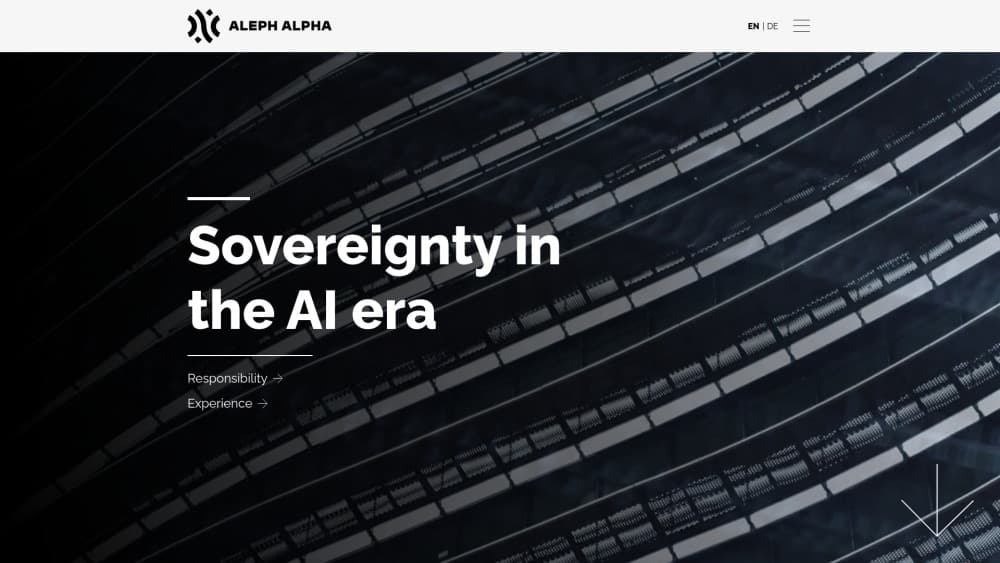
About ALEPH ALPHA - AI for Enterprises and Governments
What Is Aleph Alpha
Aleph Alpha is a Heidelberg company founded in 2019 that sells specialized language models and the software around them. The pitch is control: the models run on hardware the customer owns or leases, the platform can sit in a sovereign cloud or a sealed network, and every answer is supposed to point back to a source document.
The company stopped chasing general-purpose frontier benchmarks a while back. Its current bet is narrower and more practical. A ministry, a bank or a machine builder does not need the best chatbot on the market, it needs a system that keeps case files inside its own walls, answers in German, and shows its work when an auditor asks.
That focus comes with real limits. Kolibri, the current model, handles German and English only. There's no self-serve checkout, no published price list, and no free consumer tier, so you talk to sales before you can test anything serious. Self-hosting also means buying GPUs, because the weights need roughly 78 GB of memory before you serve a single request.
Getting Started
- Book a call with the sales team and describe the workload, since pricing and scope are quoted per project.
- Decide where the system lives: sovereign SaaS, your own cloud tenant, on-premises, or an air-gapped network with no outside connection.
- Connect the document sources the assistant should read, then set access rules so answers follow existing permissions.
- Pick the model mode for each task, with reasoning turned up for analysis and turned down for fast lookups.
- Run a pilot with one team, compare answers against the source passages, then widen access once the output holds up.
Product Information
A quick look at ALEPH ALPHA - AI for Enterprises and Governments's pricing, supported platforms, and performance.
Best for
The users, tasks, and scenarios where this tool fits best.
Users
- Public sector IT teams
- Compliance-heavy enterprises
- Industrial engineering groups
Tasks
- German document Q&A
- Requirements analysis for tenders
- Agentic back-office work
- Search across messy archives
Scenarios
- An air-gapped deployment
- A nationwide assistant rollout
- A low-risk first test
Key features
A 78B model that runs like a small one
Kolibri carries 78 billion parameters in total but activates about 3 billion per token through a mixture-of-experts design. In plain terms, you get a large model's output range while paying for far less compute per answer. Aleph Alpha claims it sits on the efficiency frontier for its class, and independent testing on your own tasks is the only way to confirm that for your workload.
German built in, not bolted on
Roughly 23% of pre-training text is German, and the tokenizer was rebuilt so German words consume fewer tokens than they would in an English-first model. The practical effect shows up on long compound nouns and legal phrasing, where translated models tend to lose precision or inflate token counts. German reasoning was a training target, not a side effect.
Answers that cite, and sometimes refuse
Document AI parses files, tables, charts and bad scans, then keeps retrieval tied to access controls. Answers quote the passage they came from. When the evidence isn't in the corpus, the model is trained to abstain and tell the user so. For anyone who has watched a chatbot invent a clause in a contract, that behavior matters more than a benchmark point.
Reasoning you can dial up or down
Kolibri ships with a controllable reasoning mode. Turn it up for multi-step analysis of a permit application, turn it down for a lookup that should take a second. Tool calling is native, so the model hands off to internal systems rather than describing what a human should do next.
Deployment on infrastructure you control
The platform runs as sovereign SaaS, in a hybrid setup or fully self-managed, including air-gapped networks. Identity management, tenant separation and an admin console are part of the stack rather than add-ons. In the strictest mode this is an on-premises LLM deployment, with weights, prompts and logs staying on your own network. Aleph Alpha says a full round trip from zero to a running app, hardware included, takes about 45 minutes on supported setups.
Agents with gates and an audit trail
Agent orchestration composes agents from reusable skills, and the runtime enforces approval on steps with real consequences. Every action is logged and traceable to a user. Governance here is a platform setting, which is a different proposition from writing a separate compliance file for every new use case.
Pros and cons
Pros
- German-language quality that general models rarely match, backed by a tokenizer and training mix designed for it.
- Answers carry source passages, and the model abstains when documents don't support a claim.
- Open weights under Apache 2.0 let you test the model on your own hardware before any purchase conversation.
- Deployment covers air-gapped and on-premises setups, which few enterprise AI platforms offer at all.
- One million token context window handles long specifications and full case files in a single pass.
Cons
- Only German and English are supported, so multinational teams need a second vendor for other markets.
- No public pricing and no self-serve tier, which makes budgeting slow and rules out small teams.
- Self-hosting needs at least two A100 or H100 class GPUs at 80 GB each, a real hardware commitment.
- Custom solutions and forward-deployed engineering are quoted separately, so total cost climbs past the platform fee.
Frequently asked questions
It sells three things: Kolibri as a model, the Adaptive Platform that serves and governs it, and packaged workspace solutions for public administration and industrial engineering. Most contracts combine all three, with services layered on top.
Related content
Explore related tools, skills, and articles for ALEPH ALPHA - AI for Enterprises and Governments.
ALEPH ALPHA - AI for Enterprises and Governments Alternatives
BinkBink
BinkBink · OtherBinkBink is a free online game platform and AI game maker that lets anyone turn a short text description into a playable browser game. You can jump into hundreds of community-made games. Or describe your own idea and play it in seconds, then share it with friends. Want to create your own game? You don't need to code. No engine setup, no download, no hassle.

Audiogen
Audiogen Inc. · OtherAudiogen is an AI music generator built by Audiogen Inc., a small research team that spent about 2.5 years training its own generative music model and designing a web interface around it. Instead of a plain text box, this AI music tool turns the timeline into a beginner-friendly Generative Audio Workstation, or GAW, where inpainting, extending, remixing and stem editing work more like painting on a canvas. The product is still in beta, so access runs through a waitlist or an invite. Paid plans aren't published yet.

Aiml API
AIMLAPI OÜ · OtherAiml API is a unified AI model API that puts more than 1000 models from OpenAI, Google, Anthropic, and others behind one endpoint and one bill. You write code against a single OpenAI-compatible schema, then switch between chat, image, video, and audio models by changing a model string. It suits developers and small teams who want multi-model access without juggling a dozen separate provider accounts, and it removes the usual billing headache that comes with testing several vendors. One key covers it all.