

Doctor Droid
DrDroid · Coding
Doctor Droid is an AI SRE agent that connects to your observability stack and runs investigations on production alerts, returning root causes and next steps.
About Doctor Droid
What Is Doctor Droid
Doctor Droid is a platform built for on-call automation on teams that get paged when production breaks. It sits on top of the tools you already use, like Datadog, Grafana, Kubernetes, and GitHub, and builds an observability knowledge graph of your services, owners, dependencies, and past incidents. When an alert fires, an investigation agent called DroidAgent pulls context from those connected systems, correlates the evidence, and reports a likely root cause.
The pitch is narrow on purpose. Doctor Droid doesn't try to replace your monitoring dashboards or your on-call rotation. It handles the first ten minutes after a page, when someone has to open five tabs and piece together what changed. Adopt.ai's CTO reported that this context gathering was the slowest part of the process for a new person on the system.
The main limits show up in setup and scope. Everything depends on read-only integrations, so if a tool isn't supported you don't get its data in the graph. The self-hosted plans that let you connect GitHub, databases, and production systems start at $2,999 per month, which puts them out of reach for small teams. Investigations also run on credits, so heavy incident weeks can burn through the plan faster than expected.
Getting Started
- Sign up for DrDroid Cloud, which includes the LLM and needs nothing to host
- Connect integrations through OAuth, giving read-only access to cloud, code, and telemetry
- Route alerts to DrDroid through Slack, webhooks, or the MCP server
- Run your first investigation from the dashboard or from Slack and review the suggested root cause
Product Information
A quick look at Doctor Droid's pricing, supported platforms, and performance.
Best for
The users, tasks, and scenarios where this tool fits best.
Users
- On-call SRE engineers
- Small platform teams
- Engineering leaders
Tasks
- Triage an alert at 3am
- Root cause analysis
- Cutting alert noise
- Post-incident review
Scenarios
- A service on fire during a canary deploy
- Reducing infrastructure cost
- Long infrastructure migrations
- Connecting production systems safely
Key features
Context Engine and Observability Knowledge Graph
Doctor Droid starts by mapping your stack. It connects to cloud, code, and observability tools, crawls the telemetry, and builds one graph that links a repo to a service, a dashboard, and a set of Kubernetes pods. The graph keeps updating in the background, so every new alert, deploy, and incident adds context rather than starting from zero.
Alert Investigation
DroidAgent takes an alert and works through it end to end. It gathers evidence from metrics, logs, deploys, and runbooks, correlates the pieces, and returns a concrete diagnosis or a short list of checks. You can trigger it from an alert, a Slack message, or your own automation, and the answer comes back where the work already happens.
Auto-Remediation with Human Approval
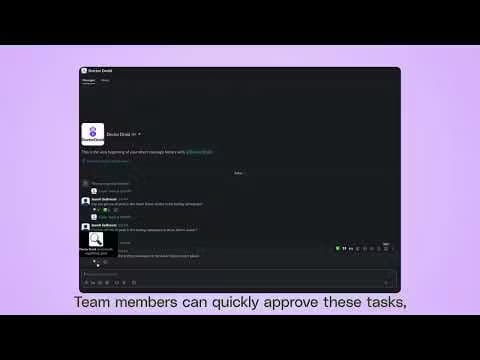
For repeat problems, Doctor Droid can run runbook-based fixes, but it asks for approval before acting. It also learns from what worked: the second time the same failure appears, it replays the path that resolved it and skips the dead ends. The effect is a lower MTTR over time without anyone writing a new runbook.
Cross-Tool Correlation
The knowledge graph traces blast radius the moment an alert fires. A GitHub repo maps to a Datadog service, a Grafana dashboard, K8s pods, and AWS resources automatically, so you see which systems are affected instead of guessing. This is where the tool separates itself from a single dashboard.
80+ Integrations
Doctor Droid connects to roughly 80 tools across cloud, code, observability, incident response, and ticketing. The list covers AWS, GCP, Azure, Kubernetes, GitHub, Datadog, Grafana, PagerDuty, Sentry, Jira, and Slack. Access is read-only, which keeps the security review manageable.
Self-Hosted Deployment
Business and Enterprise plans run entirely inside your VPC or on-prem, with no data leaving your network. Deployment goes through Helm or Docker Compose and supports air-gapped setups. This matters most for teams that need to connect GitHub, databases, and production systems without exposing them.
Pros and cons
Pros
- Pulls context from many tools into one graph, which shortens the gap between a page and a likely cause
- Learns from each incident, so recurring failures get resolved faster the second time
- Read-only integrations make the security review simpler than tools that write back to your systems
- SOC 2 Type II certified with SSO, SAML, and self-hosted options for teams that need them
- Ships a Mac App and an MCP server, so Claude and Cursor users can query org context directly
Cons
- No free tier and no permanent free plan, so evaluating it at any real scale costs money
- Self-hosted deployment, the only way to connect sensitive systems, starts at $2,999 per month
- Credit-based pricing means a heavy incident week can push past the included investigations
- Value depends on how many of your tools are supported, so a specialized stack may see a thinner graph
Frequently asked questions
It investigates production alerts for you. When an alert fires, its agent pulls context from your connected tools, correlates the evidence, and returns a likely root cause plus suggested next steps.
Related content
Explore related tools, skills, and articles for Doctor Droid.
Doctor Droid Alternatives

Base Code
Base44 (Wix) · Coding · ProductivityBase Code is a shared cloud development environment from Base44. Teammates describe changes to an existing GitHub codebase in chat, preview them live and send them back as pull requests.

Google EmbeddingGemma 2
Google DeepMind · Writing · Image · CodingGoogle EmbeddingGemma 2 is a 740M-parameter open model that turns text, code, images, audio, and video frames into vectors in one 768-dimension space, running on phones and laptops.

GitGlow
GitGlow · Coding · ProductivityGitGlow is a local-first desktop Git client that lets independent developers review their own code and their AI agents' changes in one place before shipping.