

Alfa
Alfa · Writing
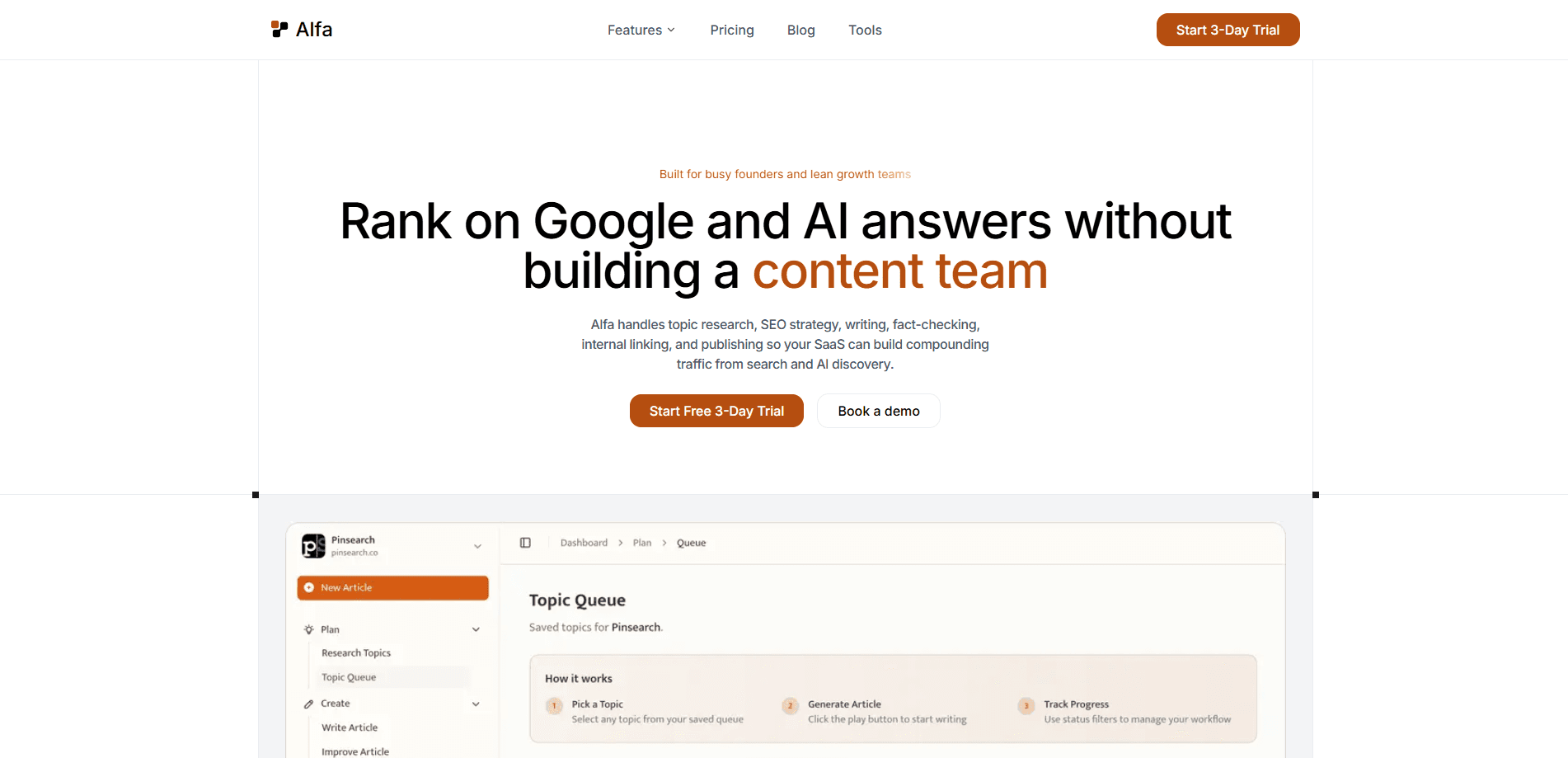
Alfa, from writealfa.com, is an AI SEO content engine for SaaS companies that want steady search traffic without hiring a content team. It handles topic research, article writing, fact-checking, internal linking, and publishing in one pipeline. You feed it your site and brand details, and it produces source-backed drafts aimed at Google rankings and citations in AI answers. If your team loses days to a single blog post, Alfa compresses that work into an automated flow you review and ship. Sound useful?
About Alfa
What Is Alfa
Alfa is a web-based content engine built for lean SaaS teams. Instead of writing one post at a time, it runs a chain of AI agents that plan topics, draft articles, verify claims, and push finished pieces to your CMS. This is what people mean by an agentic content engine: a set of agents that hand work to each other until the article is done. The pitch is simple: you build the product, Alfa builds the traffic.
The problem it targets is real. Most small SaaS teams know they need content marketing, but briefs, keyword spreadsheets, and freelancer back-and-forth eat the week. Alfa tries to own that whole loop, from picking buyer-intent topics to publishing directly into WordPress, Webflow, Ghost, or HubSpot. That's a lot of manual work off your plate.
So it's not just another AI article writer that spits out a draft and leaves. The catch is that it isn't a plug-and-play free tool either. It's a paid product aimed at teams serious about consistent output, and its quality still depends on how well you train it on your brand voice. You review before publishing, so it's not fully hands-off.
Who's it really for? Small teams with more ambition than headcount. If you can spare a few minutes to review each draft, you get a full content pipeline for less than the cost of a freelance post.
Getting Started
- Sign up for the 3-day free trial with your email address.
- Connect your site and add a brand profile so Alfa can learn your tone, positioning, and audience.
- Let the planner map a month of buyer-intent topics across comparisons, alternatives, reviews, and guides.
- Review the generated outline and draft, then check the fact-checker's verification notes on key claims.
- Connect your CMS and either auto-publish or approve each article before it goes live.
Product Information
A quick look at Alfa's pricing, supported platforms, and performance.
Best for
The users, tasks, and scenarios where this tool fits best.
Users
- Lean SaaS founders
- Solo marketers
- Small growth teams
Tasks
- Planning buyer-intent topics
- Drafting source-backed articles
- Fact-checking claims
- Publishing to a CMS
Scenarios
- Building topical authority from scratch
- Replacing a stalled blog
- Testing content-led growth
Key features
Topic Planning Across Buying Stages
Alfa maps topics across awareness, consideration, and decision searches. It leans on comparison, alternative, and review angles, which are the queries buyers actually type when they're close to choosing a tool. You end up with a plan instead of a random list of keywords. That's the difference between guessing and knowing what to write next.
Source-Backed Article Writing
Before writing, the engine studies live SERPs and competitor pages. Drafts come with claims checked against your brand dossier and public sources, and it reports a verification score so you can see what was removed. That's the main difference from a blank-page AI writer. It researches first, then writes.
Brand Voice Matching
You train Alfa on your tone, positioning, and audience, and it reuses that profile across every article. The goal is output that sounds like your team, not a generic template. It won't nail your voice on day one, but it improves as the profile gets refined.
Internal Linking
The engine suggests and inserts internal links as it builds each post. For a growing site, that's the boring work that quietly matters, because it helps both readers and crawlers find related pages and strengthens topical authority. Skip it, and orphan pages pile up fast.
Publish-Ready Output
Finished drafts go straight to your CMS or export into your existing workflow. Supported platforms include WordPress, Webflow, Next.js, Ghost, Framer, and HubSpot. You can auto-publish for speed or hold each article for review before it goes live. For teams juggling several brands and a packed publishing calendar, pushing clean drafts into the tools you already use removes the most tedious step in the content process, which is the manual formatting and copy-paste that nobody wants to do. No more export-import dance.
Fact-Checking Layer
A dedicated agent checks key claims before publication. In its own example, it removed 3 of 49 claims and reported a 94% verification score. This matters if you care about accuracy and want fewer corrections after something is already indexed. Accuracy still matters.
Pros and cons
Pros
- Runs the whole content loop, from topic research to publishing, in one product.
- Fact-checks claims and shows a verification score instead of writing blindly.
- Publishes to major CMS platforms, so no manual copy-paste.
- The 3-day trial plans a full month of content before you pay.
Cons
- No permanent free plan, so testing past 3 days means paying $49/mo.
- Quality depends on how much you invest in the brand voice profile early on.
- Support for API access isn't documented on the site, which limits custom integrations for developers.
Frequently asked questions
It's an AI content engine for SaaS teams. It plans topics, writes source-backed articles, fact-checks claims, adds internal links, and publishes to your CMS. Think of it as a content pipeline rather than a single writing tool. One subscription covers the whole job.
Related content
Explore related tools, skills, and articles for Alfa.
Alfa Alternatives

Google EmbeddingGemma 2
Google DeepMind · Writing · Image · CodingGoogle EmbeddingGemma 2 is a 740M-parameter open model that turns text, code, images, audio, and video frames into vectors in one 768-dimension space, running on phones and laptops.

MePersona
MePersona, Inc. · Writing · Productivity · MarketingMePersona is an AI unified inbox for creators. It learns your voice, drafts replies to fan messages from 12 platforms, and sends only what you approve.

Fluence
Yay Software (Yannick Huchard) · Writing · Voice & Language · ProductivityFluence is an Android app that reads PDFs, EPUBs, Word files and web articles aloud, follows each sentence as it speaks, and answers questions about the text on the phone itself.