

Algebras AI
Algebras AI · Writing
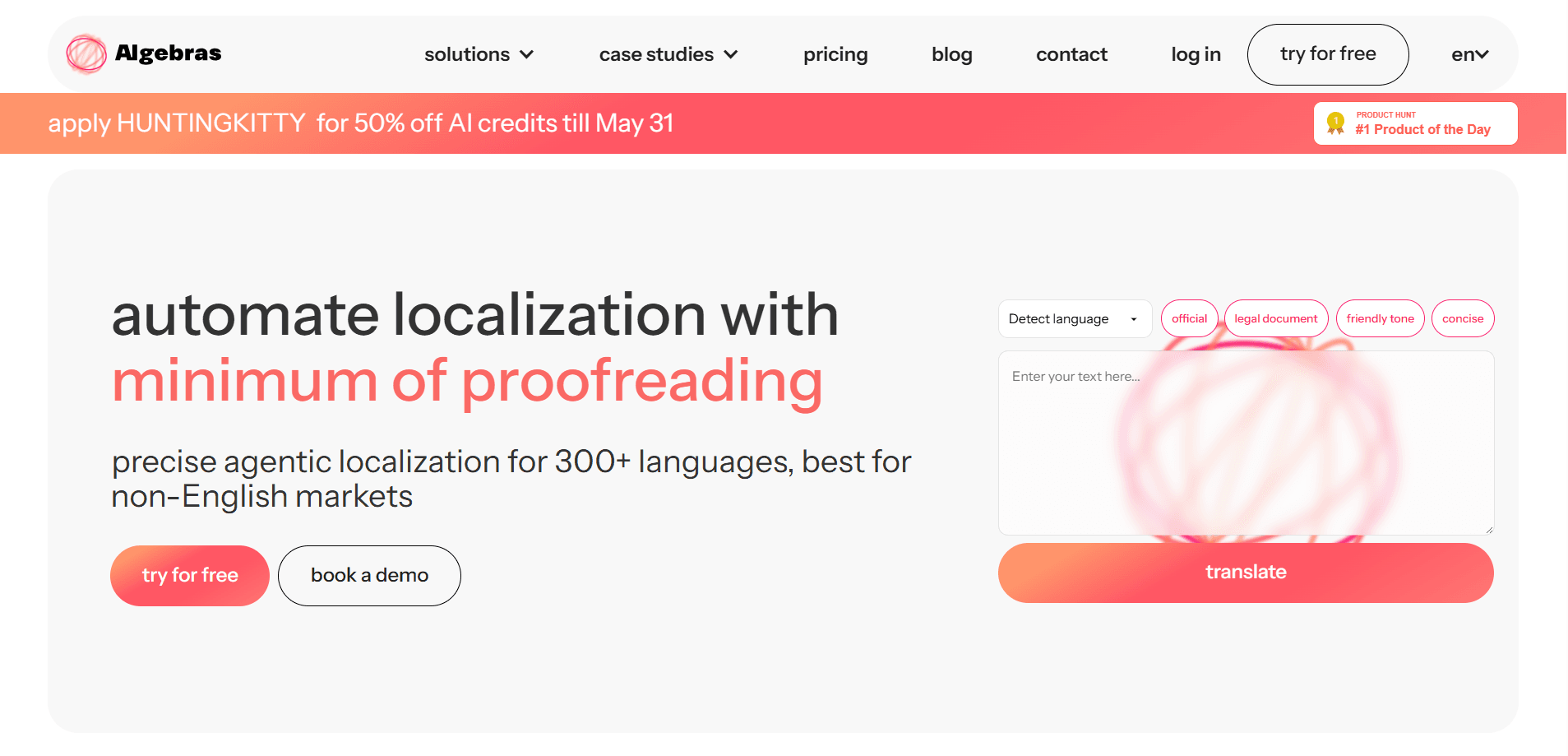
Algebras AI is an AI localization platform that translates UI text, documents, and video into 300+ languages, then flags translation errors before release to cut proofreading.
About Algebras AI
What Is Algebras AI
Algebras AI is a localization platform built for publishers, game studios, and content teams that need to ship products in many languages at once. Instead of routing every language through English, its models translate directly between the source and target language, then run an automated quality check that catches errors before a release goes out.
As an AI translation tool, the pitch is speed and cost. Algebras says its zero-shot translation models remove the English step in the middle, which the company credits for up to 90% lower localization cost and localization cycles shortened to a matter of days. The QA layer is what separates it from a plain translation API: it looks for fluency and cultural problems, not just word matches.
The limits are worth knowing. Text quality holds up better than most machine translation for complex languages like Japanese, Korean, and Chinese, but the platform still leans on AI for media and benefits from glossary setup. Video translation is billed separately from text, and the free tier caps usage, so heavy localization work moves to a paid plan fast.
Getting Started
- Sign up on the Algebras AI platform and pick the languages you need.
- Upload text, documents, or video, or connect the workflow through the localization CLI and API.
- Build a glossary so brand terms and product names stay consistent across every language.
- Let the QA system scan the output for fluency and cultural issues, then review its flags.
- Export the approved translations back into your app, site, or content pipeline.
Product Information
A quick look at Algebras AI's pricing, supported platforms, and performance.
Best for
The users, tasks, and scenarios where this tool fits best.
Users
- Game studios localizing in-game text, dialogue, and voiceovers for global players, when a glossary is set up first.
- Localization and content teams that ship UI, blogs, and marketing copy into many languages and want to skip a large proofreading pass.
- Studios that need game localization across in-game text, dialogue, and voice without a human proofreader for every build.
- Product teams behind mobile apps and websites that need to enter new markets quickly and can work from a shared vocabulary list.
Tasks
- Translating UI text and documents into 300+ languages with little or no manual proofreading.
- Dubbing and subtitling video and audio content such as ads, podcasts, and online courses.
- Checking translation quality with the Fluency Benchmark before a release goes live.
Scenarios
- Launching a product into Asian and MENA markets, where direct translation without an English stopover matters most.
- Localizing a back catalog of video ads and course material that was never translated before.
- Keeping an app's monthly string updates consistent across dozens of languages without a full review cycle each time.
Key features
Agentic translation
Algebras AI runs translation as an automated agent rather than a one-shot text swap. It reads context, applies placeholders and hints, and builds a working vocabulary on its own, which is how the platform targets near-zero proofreading for supported languages.
Voice and video localization
Video dubbing and audio translation cover media that used to be out of reach for machine tools. It handles offline audio at high quality, real-time audio translation, and video lip-sync, so dubbed content lines up with the original on screen instead of drifting out of sync.
Localization CLI
A command-line tool lets developers wire automatic software localization straight into websites and applications. That means multilingual support can be added to a build pipeline instead of a separate manual upload, which cuts the handoff between engineering and localization.
Fluency Benchmark
The Fluency Benchmark scores translation quality against real data, using industry metrics like Fluency, COMET, BLEU, and MQM. It gives teams a way to judge output before publishing instead of trusting the model blindly.
Automatic glossary and vocabulary
Algebras AI generates and applies glossaries so key terms translate the same way across every region. For brands, that consistency is what keeps a product name or tagline from shifting meaning as content scales.
Built-in QA and corrections
A multi-language QA pass looks for fluency and cultural mistakes before release. Catching these early is the point: it reduces the odds of a broken string or a tone-deaf phrase reaching users and drawing negative reviews.
Pros and cons
Pros
- Direct translation between source and target languages skips the usual English middle step.
- Text covers 300+ languages, with video dubbing support across more than 100.
- Automated QA flags fluency and cultural errors before a release ships.
- Free tier and a $15/month Standard plan make it cheap to test on real projects.
Cons
- Quality still depends on setup: a weak glossary leads to inconsistent terms across languages.
- Video translation is billed on its own, so mixed text and video work costs more than the plan price suggests.
- The free tier is small, so most teams hit paid tiers quickly once volume grows.
- Strongest for teams with a localization workflow already in place; casual users face a learning curve.
Frequently asked questions
Algebras AI translates UI text, documents, and video into more than 300 languages and runs an automated QA check that flags errors before release. It's aimed at teams that localize products for many markets at once.
Related content
Explore related tools, skills, and articles for Algebras AI.
Algebras AI Alternatives

Claude for Google Workspace
Anthropic · Writing · Productivity · BusinessClaude for Google Workspace puts Claude in a sidebar inside Google Docs, Sheets, and Slides, where it reads the file you have open and edits it in place.

Claude Haiku 5.5
Anthropic · Writing · Coding · ChatbotClaude Haiku 5.5 is Anthropic's fastest and cheapest small model, built for high volume tasks at $0.10 per million input tokens with a 1M token context window.
NoteWorthy
Suman Hansada · Writing · Productivity · AI AssistantNoteWorthy is a notes app for iPhone, iPad and Mac that writes titles, tidies formatting, summarizes long notes and files each one with on-device AI. No account, no upload, no network requests.