

Allen Institute of Artificial Intelligence
Allen Institute for Artificial Intelligence (Ai2) · Business · Other
Allen Institute of Artificial Intelligence (Ai2) is a Seattle nonprofit founded in 2014 by Paul Allen. It builds open source AI models like Olmo and Molmo, plus free research tools for science.
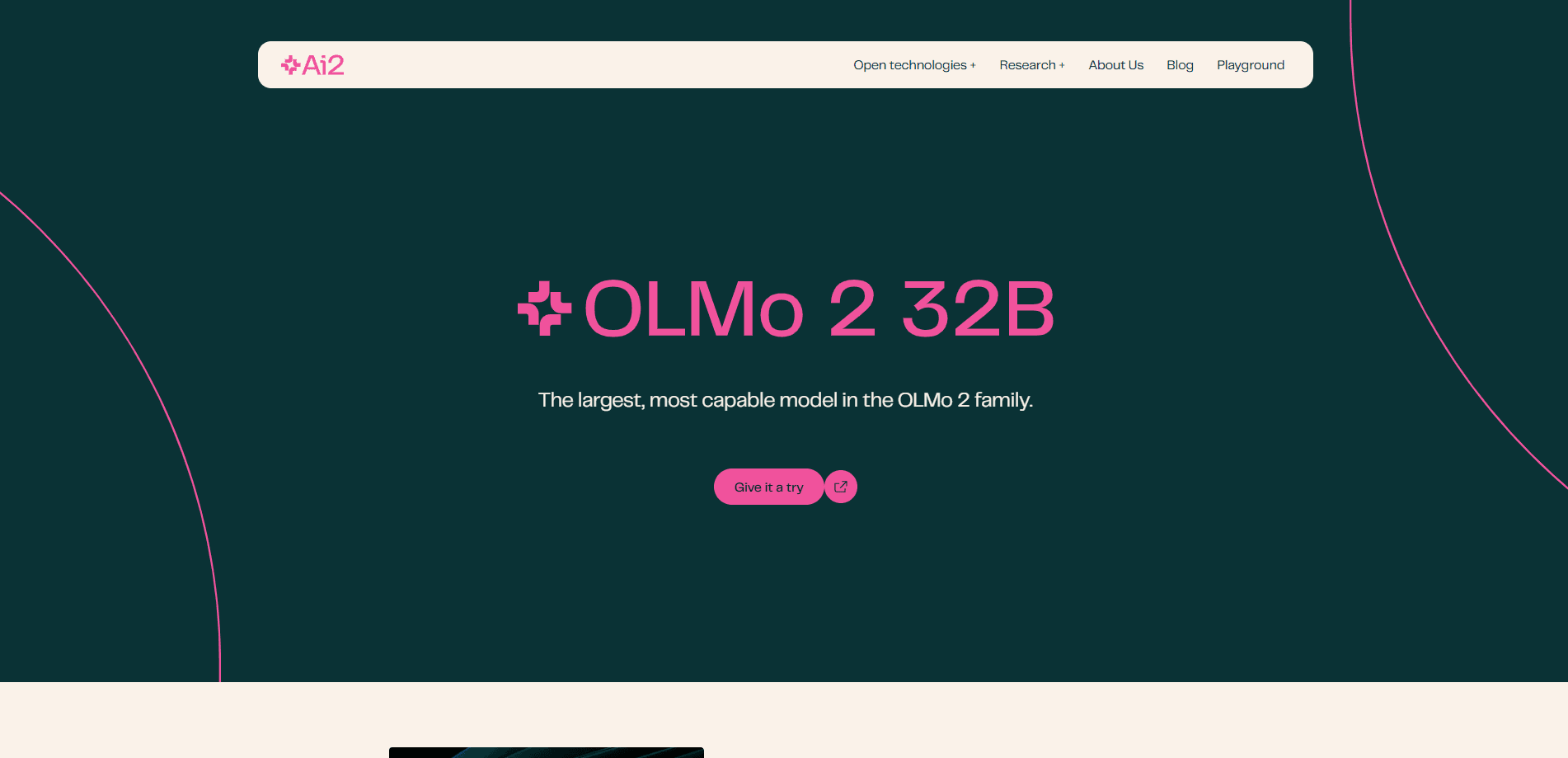
About Allen Institute of Artificial Intelligence
What Is Allen Institute of Artificial Intelligence
The Allen Institute of Artificial Intelligence, commonly called Ai2, is a nonprofit research institute based in Seattle. Paul Allen, the Microsoft co-founder and philanthropist, started it in 2014 to pursue AI research that addresses major scientific and societal problems. The institute does not sell a product. Instead, it publishes models, datasets, training code, and evaluation tools that anyone can download and inspect.
What sets Ai2 apart is how far its openness goes. Many labs release only model weights, keeping training data and code private. Ai2 releases the whole pipeline for its Olmo family, which it calls the model flow: pretraining data, midtraining data, checkpoints, code, and evaluation suites. Researchers can trace a model's behavior back to the data that produced it.
The main limits are practical. Ai2 is a research organization, not a consumer software company, so there is no polished subscription app with customer support. Its flagship models are smaller than the largest closed systems, and some tools exist mainly for scientists and developers rather than casual users.
Getting Started
- Go to allenai.org and browse the Open models section to pick a family such as Olmo, Molmo, or Tulu.
- Try a model in the Ai2 Playground, a free web demo, without installing anything.
- Download weights, datasets, and code from Hugging Face or GitHub if you want to run or fine-tune a model yourself.
- Use the API through Ai2's inference partners if you need programmatic access for an application.
- Read the technical reports and papers to understand benchmarks, training stages, and known limits.
Product Information
A quick look at Allen Institute of Artificial Intelligence's pricing, supported platforms, and performance.
Best for
The users, tasks, and scenarios where this tool fits best.
Users
- AI researchers
- Developers building open products
- Students and educators
Tasks
- Studying language model training
- Running or fine-tuning an open LLM
- Tracing model outputs to data
- Literature and citation research
Scenarios
- A lab wants to reproduce a published result
- A startup needs a base model it can legally modify
- A journalist or fact-checker needs a free paper search tool
Key features
Fully Open Olmo Model Flow
Ai2 releases the entire lifecycle of its Olmo language models, not just the final weights. That includes pretraining data, midtraining data, intermediate checkpoints, training code, and evaluation suites. The current Olmo 3 family spans 7B and 32B parameters in Base, Instruct, and Think variants, with a 32B Think model designed for step by step reasoning.
Multimodal Molmo Models
Molmo is Ai2's family of open multimodal models that handle images and video. Molmo 2 comes in 4B, 8B, and a fully open 7B variant that pairs vision with the Olmo language backbone. The models support captioning, pointing, counting, video understanding, and tracking, and Ai2 publishes the training data behind them.
Ai2 Playground
The Playground is a free web interface for trying Ai2 models without writing code or setting up hardware. You can chat with an Olmo model, test reasoning prompts, and compare behavior across variants. It lowers the entry barrier for people who want to evaluate a model before committing to a download.
Semantic Scholar
Semantic Scholar is a free academic search engine built by Ai2 that covers papers across scientific fields. It summarizes key points, surfaces citations, and helps researchers find related work quickly. It is open to anyone and needs no account to search.
Asta Scientific Agent Tools
Asta is a set of agent tools aimed at scientific discovery, co-designed with domain scientists. It includes AstaBench, a benchmark set for evaluating AI agents on research tasks, and leaderboards that compare systems. It targets researchers who want measurable, reproducible results.
OlmoEarth and AI for the Planet
OlmoEarth brings AI to environmental work such as conservation and climate modeling. The platform turns Earth observation data into decision ready insights and is built for organizations without in house AI expertise. Related projects include EarthRanger for protected area management and Skylight for illegal fishing detection.
Pros and cons
Pros
- Publishes full training data, code, and checkpoints for its flagship models, a level of openness few labs match.
- Models ship under permissive licenses, so commercial fine-tuning and redistribution are generally allowed.
- Backed by a nonprofit with a clear research mission, not a commercial vendor pushing subscriptions.
- Free and accessible tools like the Playground and Semantic Scholar lower the barrier to entry.
- Regular model updates, including the Olmo 3.1 refresh in December 2025, keep the stack current.
Cons
- Model sizes top out well below the largest closed systems, so raw capability on hard tasks can lag.
- There is no consumer package with dedicated support, so users rely on documentation and community forums.
- Getting the most from the models requires machine learning skills and often local hardware.
- Documentation is written for researchers, which can be heavy going for beginners.
Frequently asked questions
It is a nonprofit AI research institute in Seattle, founded in 2014 by Paul Allen. It develops open models, datasets, and research tools and publishes them for public use.
Related content
Explore related tools, skills, and articles for Allen Institute of Artificial Intelligence.
Allen Institute of Artificial Intelligence Alternatives
Knocket
Knocket (Tencent RTC team) · Productivity · Business · ChatbotKnocket is a free live chat and contact page tool that lets visitors message you from your website, app, or a shareable link, with every reply handled from Telegram or one inbox.

shippedit.me
Krawlup · Marketing · Businessshippedit.me now redirects to Krawlup, a web platform that audits SEO, AEO and page speed every week, then hands the fixes to AI coding agents over MCP.

Ayven
Alknoma · Productivity · BusinessAyven is an AI control centre by Alknoma that turns a plain-language goal into a dated plan, hands the work to your people and AI agents, and asks for your approval only when the call is yours.