

AlphaGenome Atlas
Google DeepMind · Other
AlphaGenome Atlas is a free genomics AI database from Google DeepMind that predicts how every possible single-letter change in human DNA affects molecular biology. It precomputes roughly 9 billion single-nucleotide variant (SNV) predictions with the AlphaGenome model, packages them into a 1-petabyte dataset, and exposes the results through a no-code web portal, an API, and a Google Antigravity skill. It's built for researchers who need to rank genetic variants without running experiments by hand.
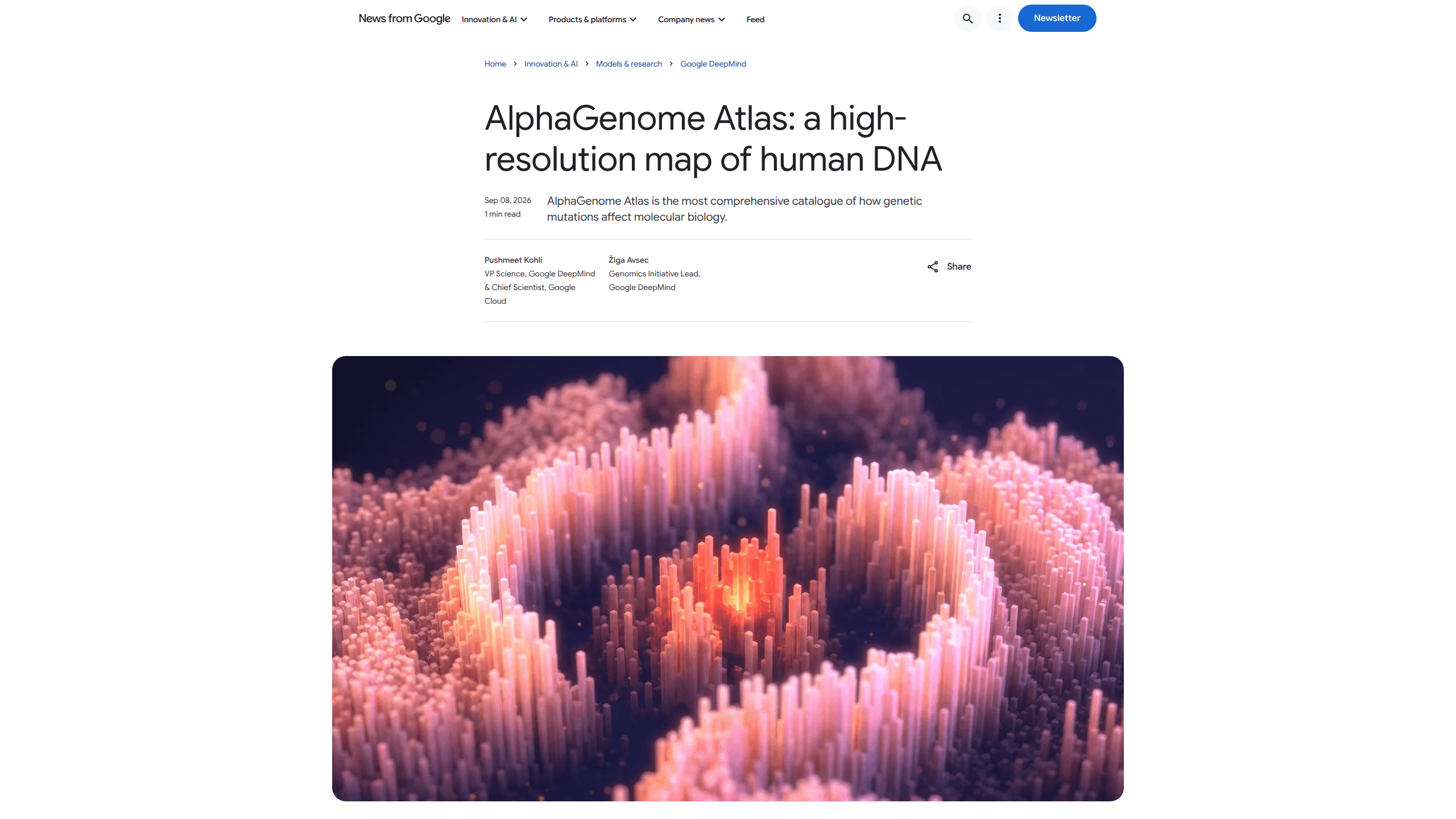
About AlphaGenome Atlas
What Is AlphaGenome Atlas
AlphaGenome Atlas is a research platform that delivers DNA variant predictions for every single-letter change in the human genome. It maps the molecular effects of each one. Instead of testing mutations one at a time in a lab, DeepMind used its AlphaGenome AI model to pre-calculate the regulatory impact of all 9 billion possible single nucleotide variants. The result is a searchable catalogue that tells scientists which changes are likely to matter.
The core problem it addresses is interpretation. Only about 2% of the genome codes for proteins, and scientists understand that slice fairly well. The other 98% is where most genetic risk hides, and it's hard to read. The Atlas makes that non-coding region legible by scoring variants on their predicted impact rather than leaving researchers to sift through raw signal.
The main limit is scope and access. AlphaGenome Atlas focuses on predictions, not confirmed lab results, so every value is a model's best estimate. That's not a replacement for lab work. Free access is aimed at academic research, and the heaviest workflows still lean on the API or the underlying AlphaGenome model. If you need validated biology, the Atlas points you where to look, it doesn't replace the bench work.
Getting Started
- Open the AlphaGenome Atlas web portal at alphagenome.google/atlas, no coding required.
- Search for a gene, region, or specific variant you want to investigate.
- Read the AlphaGenome Variant Impact (AVI) score to gauge how disruptive a variant is predicted to be.
- Filter and rank variants by effect to shortlist the ones worth following up.
- Export or cross-reference candidates, then move to deeper analysis through the AlphaGenome API if you need programmatic access.
Product Information
A quick look at AlphaGenome Atlas's pricing, supported platforms, and performance.
Best for
The users, tasks, and scenarios where this tool fits best.
Users
- Genomics researchers
- Clinical researchers and biologists
- Rare disease teams
Tasks
- Prioritizing variants for rare disease studies
- Finding rare non-coding variants behind complex traits
- Rapid variant triage across the whole genome
Scenarios
- You have a long list of candidate variants from a sequencing run and need a fast way to rank them.
- You work on a complex trait and the statistical noise makes rare non-coding signals hard to spot.
- You're planning the next stage of a study and want a broad map to decide where to run experiments.
Key features
Genome-Wide Variant Predictions
AlphaGenome Atlas holds predictions for roughly 9 billion single-nucleotide variants, covering every single-letter change possible in the human genome. That scope is what separates it from querying a model on demand: the heavy computation is already done, so you get an answer instantly instead of waiting on a fresh inference run. You search, you get a score. No waiting.
AlphaGenome Variant Impact (AVI) Score
The AVI score turns a pile of model outputs into a single, comparable number. It combines predictions from both AlphaGenome (which reads non-coding effects) and AlphaMissense (which covers protein-altering changes), so coding and non-coding variants land on the same scale. For teams triaging thousands of candidates, that one number is the difference between a usable shortlist and a spreadsheet nobody can sort. That's the whole point.
Coding and Non-Coding Coverage
Most genetic tools focus on the protein-coding 2% of the genome because that part is easier to interpret. AlphaGenome Atlas also scores the other 98%, the non-coding regions that regulate how genes get switched on and off. If your variants fall outside known genes, this is exactly the territory that tends to go unexplored. Most tools skip it.
No-Code Web Portal
The Atlas ships as an intuitive website portal that requires zero coding skills. It works as a genetic research tool right in the browser. Clinical researchers and biologists can search, filter, and read results directly in the browser. That matters because a lot of the people who need these insights aren't software engineers, and forcing them into a scripting environment would exclude most of the audience.
Multi-Surface Access
The same predictions are reachable through the AlphaGenome API, the web portal, and a skill inside Google Antigravity. Researchers who want to automate workflows can pull results programmatically, while those who prefer point-and-click never touch code. One dataset, several entry points, depending on how you work. Pick the one that fits.
1-Petabyte Precomputed Dataset
Behind the portal sits a 1-petabyte dataset, more than 30 times larger than the AlphaFold Database. The size is a direct consequence of precomputing every variant rather than computing on demand. For users, the practical payoff is speed and predictability: no waiting on server-side runs, no version drift between queries. Simple as that.
Research-Grade Application
The Atlas isn't a demo. External collaborators have already applied it to unsolved rare disease cases and large cohort studies, including work on data from more than 54,000 UK Biobank participants. Seeing real research outcomes attached to a tool helps you judge whether it fits your own workflow before committing time to it. Does that matter for your project? It usually does.
Pros and cons
Pros
- Covers the full genome, not just the protein-coding 2%, so non-coding variants actually get scored.
- The AVI score makes variant ranking fast and comparable across coding and non-coding changes.
- Free academic access through a browser portal means no setup or coding barrier to entry.
- Available via API and Google Antigravity, so it slots into automated pipelines as well as manual research.
Cons
- Everything is a prediction, so results still need experimental validation before you can treat them as confirmed.
- Free access is framed around academic research, which means commercial or clinical deployment may need a different arrangement.
- A dataset this large rewards users who already know what they're looking for; there's a learning curve in interpreting scores correctly.
Frequently asked questions
It's used to predict how single-letter changes in human DNA affect molecular biology. Researchers query it to rank variants, spot promising non-coding candidates, and decide where to focus lab work, especially in rare disease and complex trait studies.
Related content
Explore related tools, skills, and articles for AlphaGenome Atlas.
AlphaGenome Atlas Alternatives

Odyssey 3
Odyssey · OtherOdyssey-3 is Odyssey's foundation world model. It simulates physics in real time, turns a prompt into an interactive environment, and adapts to robots, cars and games.

JarvisCore
Prescott Data · Coding · Productivity · OtherJarvisCore is an open source Python runtime where AI agents work as equal peers on an agent mesh, claim tasks from a shared ledger, and reach external services through a zero-trust broker.
Clef
Cloudflare · Business · OtherClef is Cloudflare's open-source decision model for Workers AI. It returns calibrated probabilities for typed questions, not generated text, so agents can classify, route, and act fast.