

Amami
Amami · Coding · Marketing
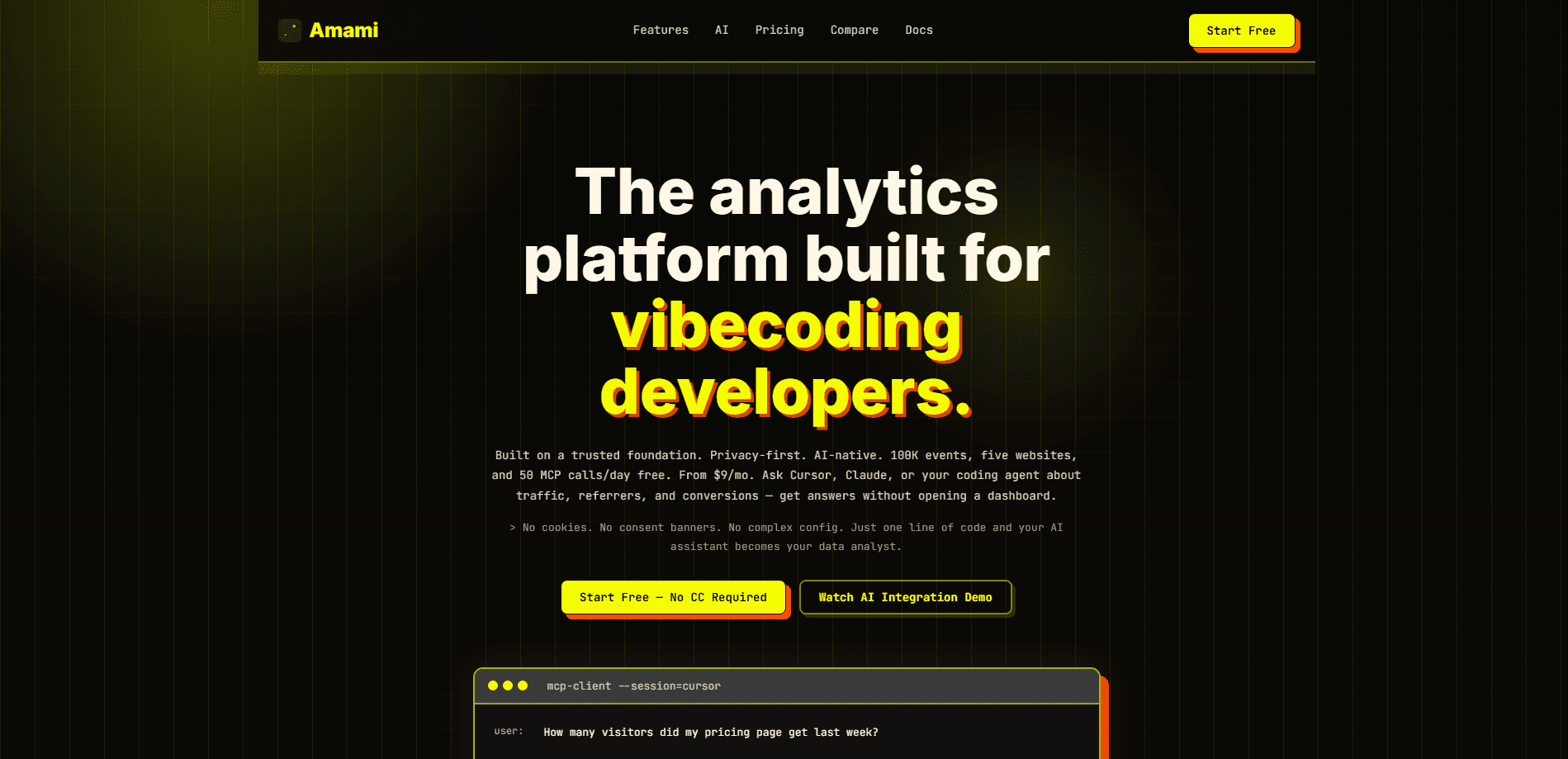
Amami is a privacy-first, AI-native web analytics platform built for developers who'd rather ask their editor a question than open a dashboard. Its tracking script is tiny, cookie-free, and GDPR-ready, and it connects to tools like Cursor, Claude, and Codex through MCP, so traffic, referrers, and conversions come back as answers inside the chat. Think of it as a lightweight Google Analytics alternative that lives inside your AI workflow. Free covers 100K monthly events across five websites, with paid plans from $9/mo. Why would you want that? Because opening another reporting tab to answer one question gets old fast.
About Amami
What Is Amami
Amami is a web analytics platform that treats privacy and AI workflow as the point, not an afterthought. You install a lightweight script, it counts visitors and events without cookies, and then you query the results through an MCP client instead of clicking around a report UI. The pitch is simple: your analytics should live where you already work.
The appeal is strongest for solo builders and small teams shipping fast. Standing up Google Analytics, waiting for data, then learning a dashboard before you can answer "did that launch work?" is a lot of overhead for a side project. Amami cuts that down to a script tag plus a prompt. That's it.
The tradeoff worth knowing up front is that the product is new and some features are labeled as published targets rather than live capabilities. Scheduled reports, webhooks, and white-label controls are examples. If you need a deeply mature platform with years of edge-case coverage, that matters. If you want privacy and AI access without ceremony, it fits well.
Getting Started
- Install Node.js 20 or newer on your machine, plus npm or another Node package runner.
- Copy Amami's one-prompt setup text into an MCP-capable client such as Codex, Claude, Cursor, Windsurf, Cline, Continue, Zed, VS Code, or OpenCode.
- Complete browser authorization to log in or register, keeping your credentials out of the chat.
- Connect a website by asking the client to call
get_tracking_script, orcreate_websiteif it doesn't exist yet, then add the returned script to your shared layout. - Verify the deployed page sends a pageview, then ask a specific analytics question for the last 7 days.
Product Information
A quick look at Amami's pricing, supported platforms, and performance.
Best for
The users, tasks, and scenarios where this tool fits best.
Users
- Indie developers and solo builders
- Teams working inside AI editors
- Privacy-conscious site owners
Tasks
- Checking what drove traffic this week
- Diagnosing a specific page
- Spotting channel performance
Scenarios
- Launch-day monitoring
- Early product research
- Agent-assisted reporting
Key features
MCP Access from Your AI Editor
Amami's standout feature is that analytics run through the Model Context Protocol. Supported clients such as Codex, Claude, Cursor, and Windsurf can discover authorized websites, pull stats, and analyze trends through conversation. You ask a plain question, and the assistant queries pageviews, referrers, and sessions on your behalf. No dashboard required. Setup is a single prompt that loads the maintained installation guide.
Cookie-Free, GDPR-Ready Tracking
The tracking script is cookie-free and stays under 2KB, which keeps page weight low and sidesteps the usual cookie-consent tangle. Amami markets this as cookie-free analytics and a GDPR-ready analytics setup, and the pitch holds up. Because no cookie identifiers are set, the privacy story is easier to explain to visitors. That doesn't make you automatically compliant, but it removes a common source of banner overhead.
Read-Only by Default with Opt-In Writes
MCP access starts read-only, so an assistant can read your numbers but can't create websites or change tracking without permission. Write tools require an explicit opt-in. Browser authorization keeps login and registration credentials out of the chat entirely, which is a sensible default when you're handing an AI agent access to your data. Good call.
Core Analytics and Real-Time Dashboard
You still get the fundamentals: visitors, pageviews, bounce rate, and session time for any date range, plus a real-time dashboard. Trends break down by minute, hour, day, or month. Performance rankings cover pages, referrers, countries, devices, events, and UTM campaigns. Nothing exotic here. It's the baseline you'd expect, done cleanly.
Goals, Funnels, and Session Replays
Beyond raw traffic, Amami tracks goals and multi-step conversion paths so you can see where people drop off. Session replays are included on every tier, from 50 per month on Free up to unlimited on the Team plan. When a number looks off, that's your next move. Watch a real session and see what actually happened.
API and MCP Limits That Scale with Plan
Every cloud plan includes both API and MCP access, and the differences come down to usage, speed, retention, and advanced capabilities. Free targets 50 MCP calls per day and 10 API requests per minute. Starter raises that to 500 and 60. Pro and above target unlimited MCP calls. Automating heavily? Pick your tier accordingly.
Capacity and Retention Tiers
Free gives you 100K events per month and 7-day retention. Starter jumps to 500K events and 6 months. Pro goes to 1M events and 24 months. Team reaches 5M events with unlimited retention, and Enterprise starts at 20M+ events with custom everything. The retention jump alone is reason to move up once you need historical comparisons.
Published Targets and Roadmap Visibility
Amami labels not-yet-shipped features as published targets rather than pretending they exist. CSV export, JSON export, webhooks, Slack alerts, AI anomaly detection, and SSO/SAML carry that label. Honest, yes. But it also means you should check the pricing page before relying on any specific capability.
Pros and cons
Pros
- Cookie-free, sub-2KB tracking script keeps pages light and simplifies consent requirements.
- MCP support lets Cursor, Claude, and Codex users query analytics without opening a dashboard.
- Read-only MCP default with opt-in writes keeps an AI agent from changing tracking on its own.
- Generous free tier: 100K events across five websites with no credit card.
- Clear labeling of published targets, so you know what's live versus planned.
Cons
- Some advertised features like scheduled reports and webhooks are targets, not current capabilities.
- The product is young, so edge cases and integrations may lag behind established analytics tools.
- Heavier automation needs a paid tier, since free MCP calls are capped at 50 per day.
- Short 7-day retention on Free limits historical trend analysis.
Frequently asked questions
Amami is a privacy-first web analytics platform for tracking visitors, pageviews, referrers, and conversions without cookies. Its main difference is MCP access, which lets you query your data from AI tools like Cursor, Claude, or Codex instead of a traditional dashboard.
Related content
Explore related tools, skills, and articles for Amami.
Amami Alternatives
Forefront
Forefront · CodingForefront is a web platform for building with open-source AI. It lets you fine-tune leading open-source language models on your own data, evaluate how they perform, and run them through an API or export them to host yourself. Developers who want the convenience of a closed-source platform but insist on owning their models and data are the target audience here.

Startkit
StartKit.AI · CodingStartkit is a boilerplate for building AI SaaS and AI wrapper products. Think of it as an AI startup boilerplate with the boring parts already wired up: authentication, Stripe and Lemon Squeezy payments, usage limits, transactional email, and an AI API starter that talks to OpenAI, Anthropic, Groq, or Llama. You clone the repo, set your price, and start on the part of your product that people actually pay for. It's Next.js under React and Tailwind, so most of the boilerplate code already feels familiar.
Testim
Tricentis · CodingTestim is an AI-powered test automation platform for building and running end-to-end tests across web, mobile, and Salesforce applications. It leans on machine learning to keep tests stable when an interface changes, so teams spend less time fixing broken selectors. Not bad for an automated testing tool you can start using today. You create tests by recording actions in a browser, then optionally add JavaScript when you need more control. It's a solid pick for busy QA teams.