

Amarsia
Amarsia · Coding
Amarsia is a platform for building and running agentic AI assistants, then exposing them as APIs your product can call. You define what an assistant does, wire in the actions and models it needs, and launch it on Amarsia's hosted infrastructure instead of assembling that stack yourself. It targets startups, small teams, and product groups that want AI features live without hiring a dedicated ML operations crew. The selling point is speed. One company claims a weekend build beats months of in-house work.
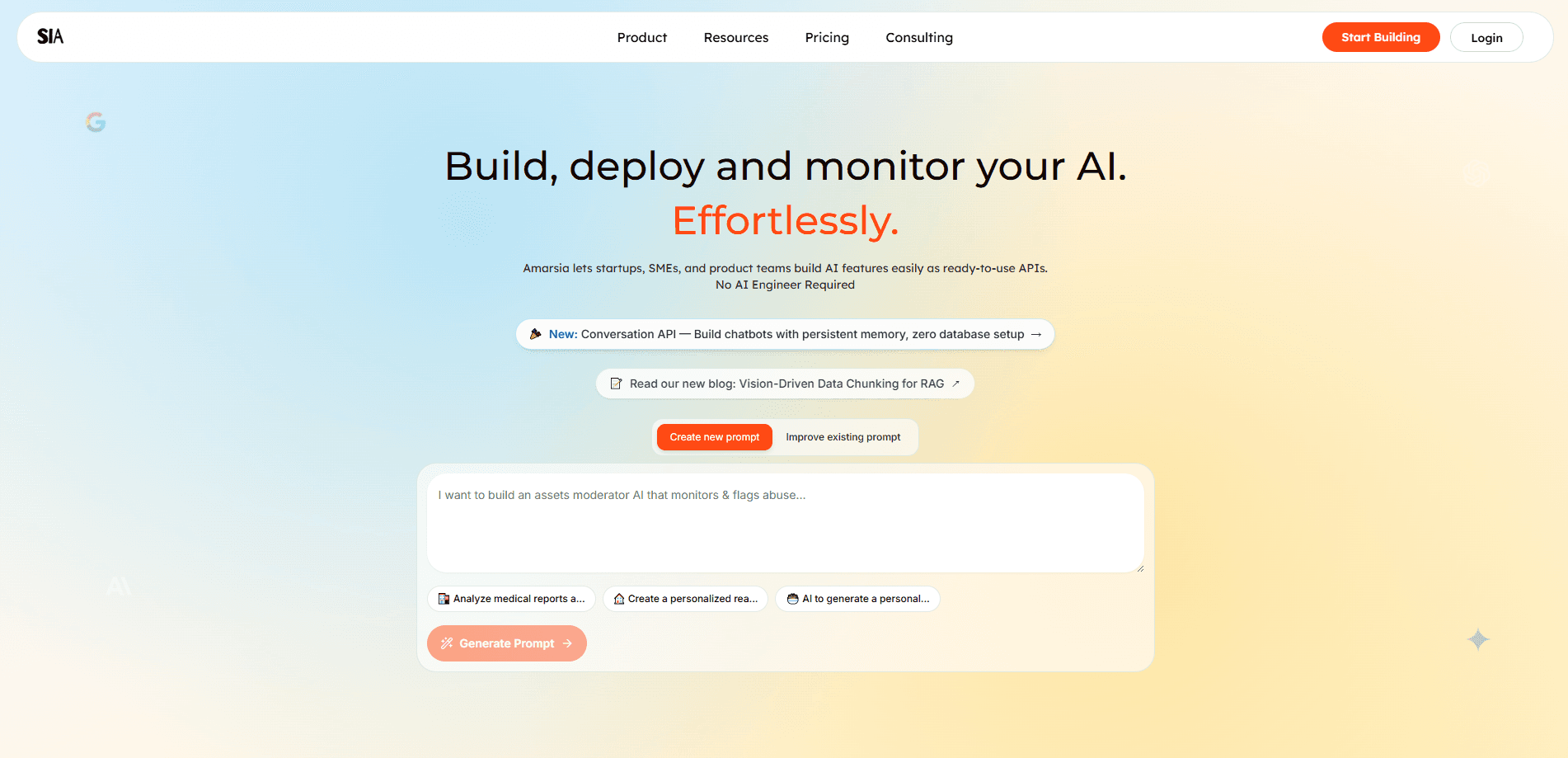
About Amarsia
What Is Amarsia
Amarsia is a managed environment for agentic AI work. An agentic assistant here means a system that doesn't just answer prompts, it takes sequences of actions and runs them toward a goal. Amarsia gives you the pieces to define those assistants, connect the actions they're allowed to perform, and put them into production behind an API endpoint. Think of it as a no-code AI assistant builder plus the runtime to host what you build.
The problem it solves is setup cost. Standing up reliable AI agents means handling hosting, model routing, retries, keys, and monitoring, and most product teams would rather spend that effort on the feature itself. Amarsia bundles that plumbing so you can focus on behavior. It also lets you cap spending with run and action limits, which matters when usage is unpredictable. Teams that call it a prompt engineering platform aren't wrong, since defining behavior is the main work you do here.
There are real constraints to weigh. The platform is built for teams shipping customer-facing features, not for researchers who need to train their own models. Lower tiers leave the knowledge base out, so retrieval-heavy agents need a paid plan. And since everything runs in Amarsia's cloud, you can't self-host on a hobby budget. Only Enterprise gets dedicated or off-cloud deployment.
So who is it actually for? Teams that want to ship an AI feature and would rather buy the infrastructure than build it.
Getting Started
- Sign up and pick the Demo plan, which is free forever and includes one agentic assistant and 1,000 runs a month.
- Open the assistant editor and describe what the assistant should do, then break that goal into the actions it needs to call.
- Connect a model. You can use Amarsia's credit-based routing across providers, or bring your own key on paid plans.
- Test the assistant in the sandbox, checking how it behaves across the common inputs you expect in production.
- Publish it and call the generated API endpoint from your app, watching your run and action usage as traffic grows.
Product Information
A quick look at Amarsia's pricing, supported platforms, and performance.
Best for
The users, tasks, and scenarios where this tool fits best.
Users
- Startup founders shipping an AI feature fast
- Product teams without ML engineers
- Developers who want their own models
Tasks
- Turning a prompt workflow into a callable API
- Running multi-step agentic tasks
- Testing AI behavior before launch
- Managing model spend across providers
Scenarios
- Launching an internal support assistant that reads a knowledge base and answers staff questions, which requires the Production or Enterprise tier since lower plans exclude the knowledge base.
- Adding an AI step to an existing app without hiring ops staff, using Amarsia's hosted runtime and API endpoint.
- Piloting several agentic assistants at once in production, where the pooled runs and multiple assistant slots of the Production plan fit better than the single-assistant tiers.
- Meeting data residency needs for a regulated rollout, since Enterprise offers US, EU, or Asia Pacific hosting.
Key features
No-Code Agentic Assistant Builder
The core of the product is an editor where you define what an assistant does without writing the orchestration code yourself. You describe the goal and the steps, and Amarsia handles how those steps run. For teams without deep AI engineering, that removes the hardest part of getting an agent off the ground. It's the practical way to build AI agents when nobody on the team has shipped one before.
Actions That Extend What Assistants Can Do
Actions are the capabilities an assistant can call on, and each plan sets a limit ranging from 5 on the free tier to 100 per assistant on Production. This is what separates an agentic assistant from a chatbot, since it lets the assistant do work rather than only produce text. The plan limits mean a simple assistant stays cheap while one that touches many systems costs more. Pick your actions carefully.
Model Routing With Bring Your Own Key
Amarsia routes across providers like Anthropic and OpenAI, and its model pricing page groups them into tiers with different credit costs per run, with lighter models running roughly four times cheaper than standard ones. Paid plans also let you use your own API keys, so you can keep existing provider relationships. For teams that treat provider choice as a requirement, this turns Amarsia into a BYOK AI platform rather than a walled garden. The trade-off is that key management and any provider rate limits become your concern again.
Evaluations and Test Cases
Paid plans include evaluations and test cases, which let you check how an assistant performs on the inputs you expect before you expose it to real users. This is the difference between shipping a demo and a feature you can stand behind. It isn't available on the free tier. So anyone serious about reliability will need at least the $49 plan.
Run and Action Limits With Overage Pricing
Each tier bundles a monthly run allowance, from 1,000 on Demo up to 20,000 pooled runs on Production, with overage charged per run per assistant. That structure keeps a runaway assistant from producing a surprise bill, because you see usage against a known ceiling. Enterprise moves to custom committed-use pricing when the standard caps no longer fit.
Hosted Runs With a 99.9% Uptime SLA
Amarsia runs the assistants for you and advertises a 99.9% uptime SLA across production workflows. Hosting, retries, and scaling are handled on its side, so your team doesn't maintain inference servers. The catch is you're tied to their environment. Without in-house hosting, your uptime is only as good as theirs.
Security and Compliance Controls
Data is encrypted with AES-256 at rest and TLS in transit, with audit logs and granular permissions. Enterprise adds customer-managed keys and regional data residency. User and model-generated data is deleted on a rolling basis, about four weeks after the last activity in a run. Teams in regulated fields get the compliance paperwork. The full control set is Enterprise-only.
Pros and cons
Pros
- Managed hosting and API endpoints remove the infrastructure work of running AI agents yourself.
- Free Demo plan with 1,000 runs a month lets you test the platform before paying anything.
- Bring-your-own-key support on paid plans keeps you in control of model provider and cost.
- Evaluations and test cases on paid tiers make it easier to validate behavior before launch.
- Clear run and action limits, plus overage pricing, keep spending predictable.
Cons
- The knowledge base is excluded from Demo, Sandbox, and Production, so retrieval-heavy agents push you toward Enterprise, which is quote-only pricing.
- Only one agentic assistant is included below the $399 Production plan, which gets tight if you're piloting several.
- Everything runs in Amarsia's cloud, so you can't self-host outside the Enterprise tier.
- Model pricing is credit-based, which can be harder to forecast than flat provider billing.
Frequently asked questions
It's a platform for building agentic AI assistants and running them for you, so your app can call them through an API. You define the assistant and its actions, and Amarsia handles hosting, model routing, and limits.
Related content
Explore related tools, skills, and articles for Amarsia.
Amarsia Alternatives
Forefront
Forefront · CodingForefront is a web platform for building with open-source AI. It lets you fine-tune leading open-source language models on your own data, evaluate how they perform, and run them through an API or export them to host yourself. Developers who want the convenience of a closed-source platform but insist on owning their models and data are the target audience here.

Startkit
StartKit.AI · CodingStartkit is a boilerplate for building AI SaaS and AI wrapper products. Think of it as an AI startup boilerplate with the boring parts already wired up: authentication, Stripe and Lemon Squeezy payments, usage limits, transactional email, and an AI API starter that talks to OpenAI, Anthropic, Groq, or Llama. You clone the repo, set your price, and start on the part of your product that people actually pay for. It's Next.js under React and Tailwind, so most of the boilerplate code already feels familiar.
Testim
Tricentis · CodingTestim is an AI-powered test automation platform for building and running end-to-end tests across web, mobile, and Salesforce applications. It leans on machine learning to keep tests stable when an interface changes, so teams spend less time fixing broken selectors. Not bad for an automated testing tool you can start using today. You create tests by recording actions in a browser, then optionally add JavaScript when you need more control. It's a solid pick for busy QA teams.