

Amp Free
Sourcegraph (Amp) · Coding
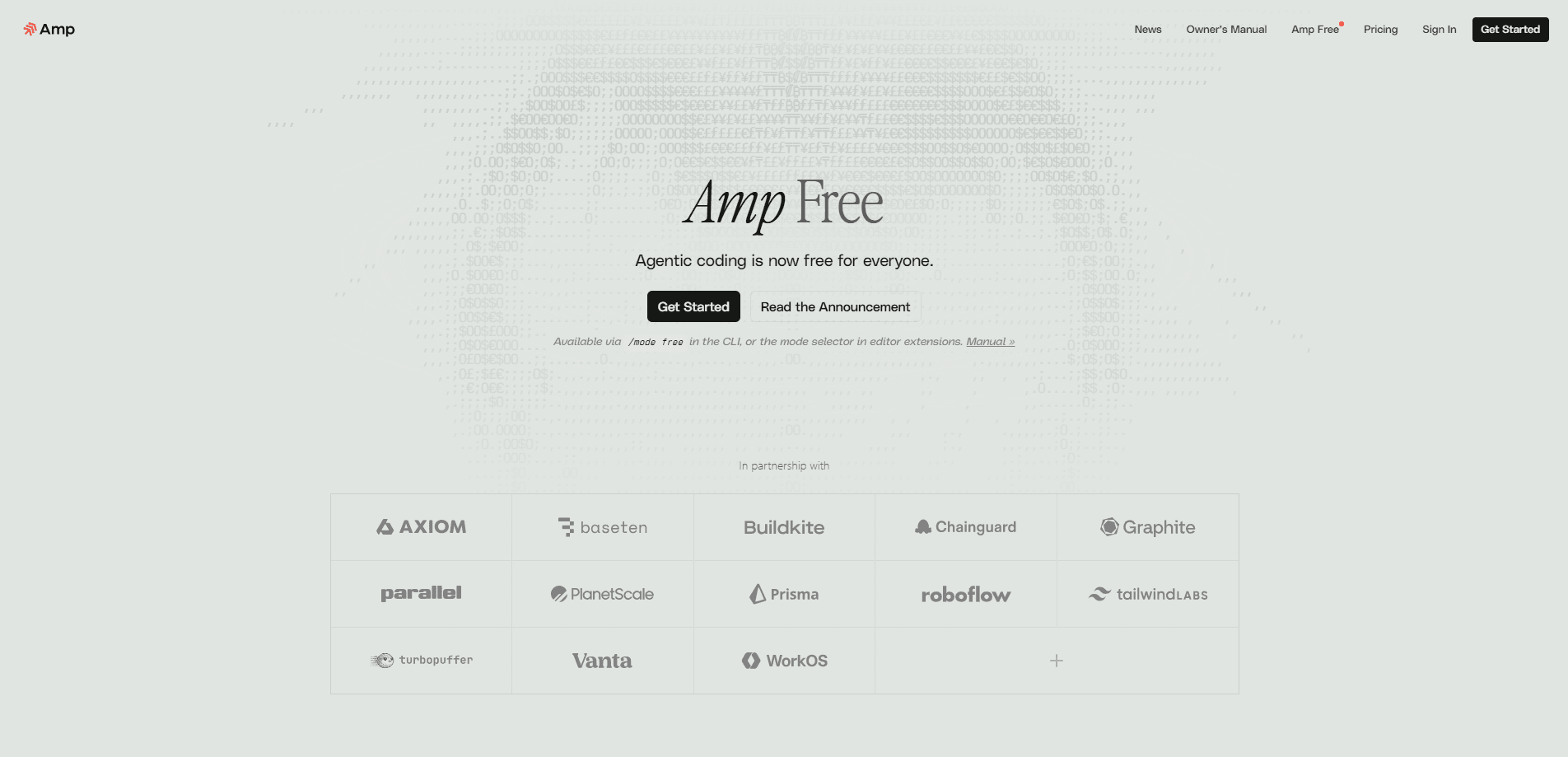
Amp Free is a free mode inside Amp, an agentic coding tool that runs autonomous coding agents against your own repositories. It mixes open source and frontier AI models behind a single prompt, spins up a cloud machine per task, and keeps working in the background while you do something else. The free tier was ad-supported at launch but has since dropped ads, so what you get today is a limited daily allowance of capable model time at no cost.
About Amp Free
What Is Amp Free
Amp Free is a pricing mode, not a separate app. You sign into Amp and switch the tool to free mode, and from there you get the same agent behavior as the paid smart mode, just on a budget of tokens the company sources from discounted capacity. Amp builds on the idea that coding agents are finally good enough that the cost is the only thing stopping most people from using one.
Amp itself is a coding agent and development environment from Sourcegraph. Each thread runs inside an orb, which is a disposable cloud machine the product creates with your code, tools, and plugins already loaded. You send a prompt. Then you close your laptop. You come back to a finished task. The same threads show up on the web, in the macOS and iOS apps, and in a terminal CLI, so the agent isn't tied to one device.
The catch is that free mode has moved around a lot. Amp added ads in October 2025, then removed them a few months later when cheaper frontier models changed the math. The company has since paused free mode for some users and trimmed the daily grant. Sound familiar? Terms shift fast here. If you rely on it, treat the allowance as something that can shrink without much notice.
Getting Started
- Sign up for an Amp account and verify your email.
- Install the CLI or the editor extension, then sign in on your machine.
- Turn on free mode by typing
/mode freein the CLI or selecting free in the prompt field of the editor. - Create a project from a Git repository, or start without one.
- Give the agent a task and let it run in its orb, then review the changes it produces.
Product Information
A quick look at Amp Free's pricing, supported platforms, and performance.
Best for
The users, tasks, and scenarios where this tool fits best.
Users
- Solo developers who want to try an AI coding agent without paying first
- Teams already paying for ChatGPT or Claude subscriptions
- People who work across devices
Tasks
- Multi-step refactors
- Bounded feature work
- Codebase questions
Scenarios
- Trying agentic coding before committing money
- Short bursts of work on the go
- Experimenting across models
Key features
Multi-Model Routing
Amp doesn't lock you to one provider. It runs a mix of GPT, Claude, and fast models, and free mode adds open source and limited-context frontier models on top. You can also connect your own ChatGPT or Claude subscription, or bring your own API keys, so the agent uses tokens you already pay for instead of billable Amp credits.
Orbs and Background Execution
Every thread gets its own orb, a cloud machine set up with your code, tools, and plugins. It works like a cloud coding agent that lives away from your laptop. You can send a prompt and walk away, and the agent keeps going without your laptop staying open. This is the part that separates Amp from an inline autocomplete tool: the work happens on its own machine, not in your editor.
Cross-Device Threads
Threads are shared across the web, macOS and iOS apps, and the CLI. Start a task from your iPhone on the train, follow up from your Mac at your desk, and finish in the terminal. The apps notify you when a thread is waiting for your next message, so you don't have to babysit it.
Free and Paid Tiers in One Tool
Why switch products later when you can grow in place? Free mode sits alongside paid plans, so you can scale up without leaving Amp. The Hobby tier is free with pay-as-you-go orbs, Individual runs $20 per month with 45,000 minutes of orb time, and Teams adds shared portals, permissions, and pooled billing at no extra charge. Enterprise adds SSO, audit logs, and spend controls.
Puck and Agent Coordination
Puck is Amp's component for launching and coordinating agents, letting one agent hand work to others instead of you orchestrating every step. Think of it as an AI pair programmer that keeps the loop moving without you in the middle. For longer jobs this matters more than raw model quality. A single thread that stalls isn't much use.
Pros and cons
Pros
- The free tier gets you real frontier-model agent runs, not a crippled demo.
- Multi-model routing and BYOK mean you can lean on subscriptions and keys you already have. Nothing extra to buy.
- Orbs let tasks run in the background. Long jobs won't tie up your machine.
- The same threads work on web, desktop, mobile, and terminal.
Cons
- Free mode has been paused, cut back, and stripped of ads in a short span, so its terms are unstable. If you build a workflow around it, expect the allowance to change.
- The tool moves fast by design and drops backward compatibility. Features you set up today can disappear later.
- Pricing and tiers are aimed at teams and individuals who will pay, so heavy free use isn't the intended long-term path.
Frequently asked questions
Yes, in the sense that you don't pay for it. It's a mode inside Amp that gives you a daily allowance of agent runs on discounted models. The catch is that this allowance has been reduced and paused for some users over time.
Related content
Explore related tools, skills, and articles for Amp Free.
Amp Free Alternatives
Forefront
Forefront · CodingForefront is a web platform for building with open-source AI. It lets you fine-tune leading open-source language models on your own data, evaluate how they perform, and run them through an API or export them to host yourself. Developers who want the convenience of a closed-source platform but insist on owning their models and data are the target audience here.

Startkit
StartKit.AI · CodingStartkit is a boilerplate for building AI SaaS and AI wrapper products. Think of it as an AI startup boilerplate with the boring parts already wired up: authentication, Stripe and Lemon Squeezy payments, usage limits, transactional email, and an AI API starter that talks to OpenAI, Anthropic, Groq, or Llama. You clone the repo, set your price, and start on the part of your product that people actually pay for. It's Next.js under React and Tailwind, so most of the boilerplate code already feels familiar.
Testim
Tricentis · CodingTestim is an AI-powered test automation platform for building and running end-to-end tests across web, mobile, and Salesforce applications. It leans on machine learning to keep tests stable when an interface changes, so teams spend less time fixing broken selectors. Not bad for an automated testing tool you can start using today. You create tests by recording actions in a browser, then optionally add JavaScript when you need more control. It's a solid pick for busy QA teams.